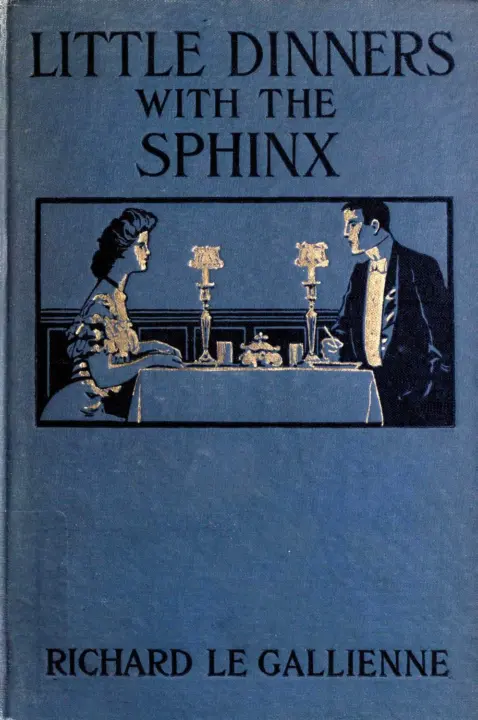
Little Dinners With the Sphinx, and Other Prose Fancies
Richard Le Gallienne
THE CLASSIC COLLECTION · 1894
"Prose Fancies" by Richard Le Gallienne is a collection of essays written in the late 19th century. The book explores themes of nature, society, and human relationships with a focus on the beauty and complexities of life. Through vivid imagery and reflections, Le Gallienne provides a thoughtful commentary on the nuances of everyday experiences and interactions. The opening of "Prose Fancies" presents a series of observations about the arrival of spring. The author paints a picturesque scene of the season, filled with imagery of blooming nature and the gentle stirrings of life. He describes a charming procession of a mother pig with her piglets and notes the tender connections between humans and animals, delving into the beauty of new beginnings. As the piece transitions, Le Gallienne begins to introduce other characters, such as a disheveled man gathering sticks and a town boy collecting palm, contrasting the vibrancy of nature with the struggles and realities of human life. This set of initial reflections sets the stage for a broader exploration of life's ironic and bittersweet moments throughout the essays that follow.
Introduction adapted from the source catalogue; source summaries may be automatically generated.
Free to read · English · 36,611 words · No account needed
MAKE TIME FOR A GOOD BOOK
On by default. Untick to stop anonymous reading totals. Each page counts after 10 seconds in view. How this works.
Anonymous counting is on unless you have switched it off.
It was a sad thing, too, that Dora and William were able to avoid the subject three hundred and sixty-four days of the year, but on that odd day it was sure to crop up. Perhaps they had been out late the night before, and their nerves were against them. The merest accident would bring it on. Dora would ask William to post a letter for her in town. Being out of sorts, and susceptible to the silliest irritation, he would not be able to resist criticising the addressing. If he didn't mention it, Dora would notice his 'expression.' That would be 'quite enough,' you may be sure. Half the tragedies of life depend on 'expression.'
'Well!' she would say.
'Well what?' he would answer, already beginning to tremble.
'You have one of your critical moods on again.'
'Not at all. What's the matter?'
'You have, I say.... Well, why do you look at the envelope in that way? I know what it is, well enough.'
'If you know, dear, why do you ask?'
'Don't try to be sarcastic, dear. It is so vulgar.'
'I hadn't the least intention of being so.'
'Yes, you had.... Give me that letter.'
'All right.'
'Yes, you admire every woman's writing but your wife's.'
'Don't be silly, dear. See, I don't feel very well this morning. I don't
want to be angry.'
'Angry! Be angry; what does it matter to me? Be as angry as you like. I wish I had never seen you.'
'Somewhat of a non sequitur, is it not, my love?'
'Don't "my love" me. With your nasty cool sarcasm!'
'Isn't it better to try and keep cool rather than to fly into a temper about nothing? See, I know you are a little nervous this morning. Let us be friends before I go.'
'I have no wish to be friends.'
'Dora!'
William would then lace his boots, and don his coat in silence, before making a final effort at reconciliation.
'Well, dear, good-bye. Perhaps you will love me again by the time I get
home.'
'Perhaps I shan't be here when you come home.'
'For pity's sake, don't begin that silly nonsense, Dora.'
'It isn't silly nonsense. I say again--I mayn't be here when you come
home, and I mean it.'
'Oh, all right then. Suppose I were to say that I won't come home?'
'I should be quite indifferent.'
'O Dora!'
Your reading position is saved on this browser. Take it to another device with a library code. Reading pages adapt to text, rather than matching a printed edition.
Richard Le Gallienne
Richard Le Gallienne
Richard Le Gallienne
Richard Le Gallienne
BEHIND THE BOOK
This eBook is for the use of anyone anywhere in the United States and most other parts of the world at no cost and with almost no restrictions whatsoever. You may copy it, give it away or re-use it under the terms of the Project Gutenberg License included with this eBook or online at www.gutenberg.org. If you are not located in the United States, you will have to check the laws of the country where you are located before using this eBook. Read the source licence.
The original source file, including credits and licence, is retained by this library. Request an original-format copy at no charge. Please include the book title and Project Gutenberg identifier #15025.
KEEP YOUR CURIOSITY GOING

David Patterson (Spirit) Hatch

David Patterson (Spirit) Hatch

David Patterson (Spirit) Hatch

Ralph Waldo Emerson

Maurice Baring

Oscar Wilde & James McNeill Whistler