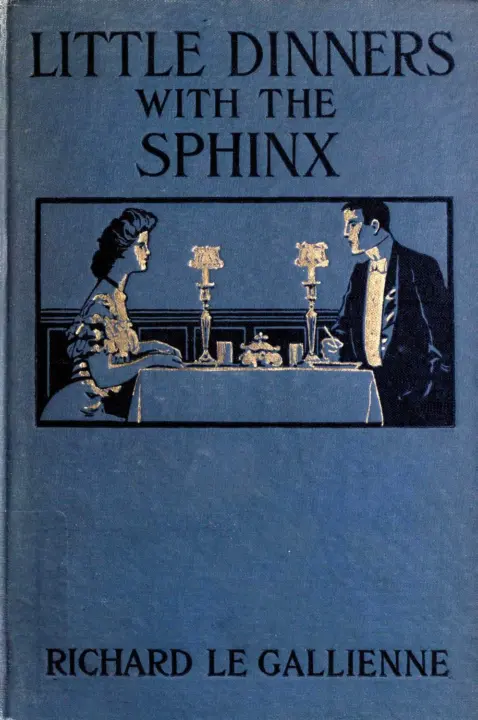
Little Dinners With the Sphinx, and Other Prose Fancies
Richard Le Gallienne
THE CLASSIC COLLECTION · 1894
"Prose Fancies" by Richard Le Gallienne is a collection of essays written in the late 19th century. The book explores themes of nature, society, and human relationships with a focus on the beauty and complexities of life. Through vivid imagery and reflections, Le Gallienne provides a thoughtful commentary on the nuances of everyday experiences and interactions. The opening of "Prose Fancies" presents a series of observations about the arrival of spring. The author paints a picturesque scene of the season, filled with imagery of blooming nature and the gentle stirrings of life. He describes a charming procession of a mother pig with her piglets and notes the tender connections between humans and animals, delving into the beauty of new beginnings. As the piece transitions, Le Gallienne begins to introduce other characters, such as a disheveled man gathering sticks and a town boy collecting palm, contrasting the vibrancy of nature with the struggles and realities of human life. This set of initial reflections sets the stage for a broader exploration of life's ironic and bittersweet moments throughout the essays that follow.
Introduction adapted from the source catalogue; source summaries may be automatically generated.
Free to read · English · 36,611 words · No account needed
MAKE TIME FOR A GOOD BOOK
On by default. Untick to stop anonymous reading totals. Each page counts after 10 seconds in view. How this works.
Anonymous counting is on unless you have switched it off.
It was five minutes to eleven. The clock ticked on while the two still stood in their absurdly tragic attitudes--he still hesitating, she with her pistol in line with the brain that laid the golden verse. The clock whirred before striking the hour. Annette made a determined movement. Hyacinth looked up; he saw she meant it, all the more for the mocking indifference of her expression.
'Once more--death, marriage, or the money?'
The clock struck.
'The money,' gasped the poet.
But Annette still kept her weapon in line.
'Your cheque-book!' she said. Rondel obeyed.
'Pay Miss Annette Jones, or order, the sum of two hundred and thirty pounds. No, don't cross it!'
Rondel obeyed.
'Now, toss it over to me. You observe I still hold the pistol.'
Rondel once more obeyed. Then, still keeping him under cover of the ugly-looking tube, she backed towards the door.
'Good-bye,' she said. 'Be sure I shall look out for your next volume.'
Rondel, bewildered as one who had lived through a fairy-tale, sank into his chair. Did such ridiculous things happen? He turned to his cheque-book. Yes, there was the counterfoil, fresh as a new wound, from which indeed his bank account was profusely bleeding.
Then he turned to his laurels: but, behold, they were all withered.
So, after a while, he donned hat and coat, and went forth to seek a
flatterer as a pick-me-up.
The reader will remember how Lamb imagines him as a rubicund priest of Hymen, and pictures him 'attended with thousands and ten thousands of little loves, and the air is
"Brush'd with the hiss of rustling wings."
Singing Cupids are thy choristers and thy precentors; and instead of the crozier, the mystical arrow is borne before thee.' Alas! who indeed would have expected the bitter historical truth, and have dreamed that poor Valentine, instead of being that rosy vision, was one of the Church's most unhappy martyrs? Tradition has but two pieces of information about him: that during the reign of Claudius II., probably in the year 270, he was 'first beaten with heavy clubs, and then beheaded'; and likewise that he was a man of exceptional chastity of character--a fact that may be considered no less paradoxical in regard to his genial reputation. He was certainly the last man to have been the patron saint of young blood, and if he has any cognisance of the frivolities done in his name, the knowledge must be more painful to him than all the clubs of Claudius. Unhappy saint! To have his good name murdered also! To be, through all time, the high-priest of that very 'paganism' which he died to repudiate: the one most potent survival throughout Christian times of the joyous old order he would fain supplant! Could anything be more characteristic of the whimsical humour of Time, which loves nothing better than to make a laughing-stock of human symbolism? The savage putting a stray dress-coat to solemn sacerdotal usage, or taking some blackguard of a Mulvaney for a very god, is not more absurd than mankind thus ignorantly bringing to this poor martyr throughout the years the very last offering he can have desired. Surely it must have filled his shade with a strange bewilderment to have watched us year by year bringing him garlands and the sweet incense of young love, to have seen this gay company approach his shrine with laughter and roses, a very bacchanal, where he had looked for sympathetic sackcloth and ashes--surely it must have all seemed a silly sacrilegious jest. However, he is long since slandered beyond all hope of restitution. So long as the spring moves in the blood, lovers will doubtless continue to take his name in vain, and feign his saintly sanction for their charming indiscretions. Indeed, he is fabled by the poets to be responsible for the billing and cooing of the whole creation. Everybody knows that the birds, too, pair on St. Valentine's Day. We have many a poet's word for it. Donne's charming lines, for instance--
Your reading position is saved on this browser. Take it to another device with a library code. Reading pages adapt to text, rather than matching a printed edition.
Richard Le Gallienne
Richard Le Gallienne
Richard Le Gallienne
Richard Le Gallienne
BEHIND THE BOOK
This eBook is for the use of anyone anywhere in the United States and most other parts of the world at no cost and with almost no restrictions whatsoever. You may copy it, give it away or re-use it under the terms of the Project Gutenberg License included with this eBook or online at www.gutenberg.org. If you are not located in the United States, you will have to check the laws of the country where you are located before using this eBook. Read the source licence.
The original source file, including credits and licence, is retained by this library. Request an original-format copy at no charge. Please include the book title and Project Gutenberg identifier #15025.
KEEP YOUR CURIOSITY GOING

David Patterson (Spirit) Hatch

David Patterson (Spirit) Hatch

David Patterson (Spirit) Hatch

Ralph Waldo Emerson

Maurice Baring

Oscar Wilde & James McNeill Whistler