READ · DISCOVER · ENJOYClassic literature · Always free
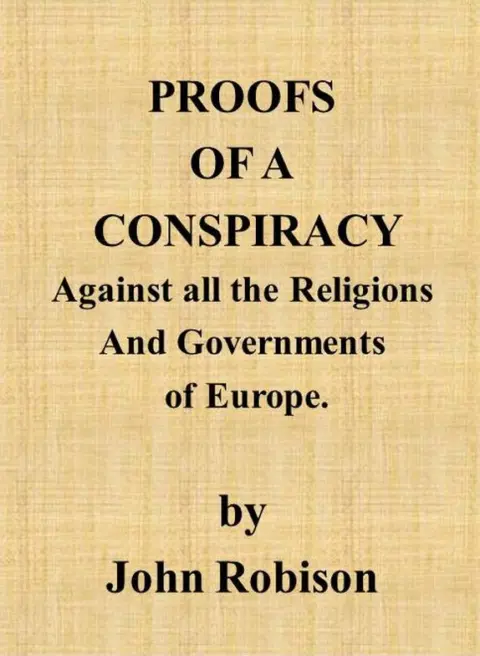
Proofs of a Conspiracy against all the Religions and Governments of Europe carried on in the secret meetings of Free Masons, Illuminati, and reading societies. — digital edition cover

THE CLASSIC COLLECTION · 1797

Proofs of a Conspiracy against all the Religions and Governments of Europe carried on in the secret meetings of Free Masons, Illuminati, and reading societies.

"Proofs of a Conspiracy against all the Religions and Governments of Europe" by John Robison is a historical account likely written in the late 18th century. The book investigates the influence and secrecy of organizations like the Free Masons and Illuminati, suggesting that they played a significant role in undermining traditional religion and government structures throughout Europe. Through an analytical lens, it examines the implications of such secrets societies in the context of the sociopolitical upheaval of the time, particularly in relation to the French Revolution. The opening of the book sets the stage for Robison’s exploration of secret societies, originating from his personal experiences and observations of Freemasonry. He reflects on his time as a Mason and expresses concern about the rising influence of radical ideas within the Masonic Lodges, particularly in France and Germany, where they became hotbeds for controversial doctrines. His introduction reveals a sense of urgency to unveil the concealed agendas behind these organizations, drawing historical parallels and highlighting the threats posed to established governments and religions—a theme that foreshadows the deeper inquiry into the conspiratorial networks that he intends to disclose throughout the text.

Introduction adapted from the source catalogue; source summaries may be automatically generated.

Start reading ↓

Free to read · English · 119,187 words · No account needed

MAKE TIME FOR A GOOD BOOK

Proofs of a Conspiracy against all the Religions and Governments of Europe carried on in the secret meetings of Free Masons, Illuminati, and reading societies.

On by default. Untick to stop anonymous reading totals. Each page counts after 10 seconds in view. How this works.

Anonymous counting is on unless you have switched it off.

Proofs of a Conspiracy against all the Religions and Governments of Europe carried on in the secret meetings of Free Masons, Illuminati, and reading societies.

The objects, the undoubted objects of this Association, are surely dangerous and detestable; namely, to overturn the present constitutions of the European States, in order to introduce a chimera which the history of mankind shews to be contrary to the nature of man.

Naturam expellas furcâ, tamen usque recurret.

Suppose it possible, and done in peace, the new system could not stand unless every principle of activity in the human mind be enthralled, all incitement to exertion and industry removed, and man brought into a condition incapable of improvement; and this at the expence of every thing that is valued by the best of men--by misery and devastation--by loosening all the bands of society. To talk of morality and virtue in conjunction with such schemes is an insult to common sense; dissoluteness of manners alone can bring men to think of it.

Is it not astonishing, therefore, to hear people in this country express any regard for this institution? Is it not most mortifying to think that there are Lodges of Illuminated among us? I think that nothing bids fairer for weaning our inconsiderate countrymen from having any connection with them, than the faithful account here given. I hope that there are few, very few of our countrymen, and none whom we call friend, who can think that an Order which held such doctrines, and which practised such things, can be any thing else than a ruinous Association, a gang of profligates. All their professions of the love of mankind are vain; their Illumination must be a bewildering blaze, and totally ineffectual for its purpose, for it has had no such influence on the leaders of the band; yet it seems quite adequate to the effects it has produced; for such are the characters of those who forget God.

If we in the next place attend to their mode of education, and examine it by those rules of common sense that we apply in other cases of conduct, we shall find it equally unpromising. The system of Illuminatism is one of the explanations of Free Masonry; and it has gained many partisans. These explanations rest their credit and their preference on their own merits. There is something in themselves, or in one of them as distinguished from another, which procures it the preference for its own sake. Therefore, to give this Order any dependence on Free Masonry is to degrade the Order. To introduce a Masonic Ritual into a manly institution, is to degrade it to a frivolous amusement for great children. Men really exerting themselves to reform the world, and qualified for the task, must have been disgusted with such occupations. They betray a frivolous conception of the task in which they are really engaged. To imagine that men engaged in the struggle and rivalship of life, under the influence of selfish, or mean, or impetuous passions, are to be wheedled into candid sentiments, or a generous conduct, as a froward child may sometimes be made gentle and tractable by a rattle or humming-top, betrays a great ignorance of human nature, and an arrogant self-conceit in those who can imagine that all but themselves are babies. The further we proceed, the more do we see of this want of wisdom. The whole procedure of their instruction supposes such a complete surrender of freedom of thought, of common sense, and of common caution, that it seems impossible that it should not have alarmed every sensible mind. This indeed happened before the Order was seven years old. It was wise indeed to keep their Areopagitæ out of sight; but who can be so silly as to believe that their unknown Superiors were all and always faultless men? But had they been the men they were represented to be,--If I have any knowledge of my own heart, or any capacity of drawing just inferences from the conduct of others, I am persuaded that the knowing his Superiors would have animated the pupil to exertion, that he might exhibit a pleasing spectacle to such intelligent and worthy judges. Did not the Stoics profess themselves to be encouraged in the scheme of life, by the thought that the immortal Gods were looking on and passing their judgments on their manner of acting the part assigned them? But what abject spirit will be contented with working, zealously working, for years, after a plan of which he is never to learn the full meaning? In short, the only knowledge that he can perceive is knowledge in its worst form, Cunning. This must appear in the contrivances by which he will soon find that he is kept in complete subjection. If he is a true and zealous Brother, he has put himself in the power of his Superiors by his rescripts, which they required of him on pretence of their learning his own character, and of his learning how to know the characters of other men. In these rescripts they have got his thoughts on many delicate points, and on the conduct of others. His Directors may ruin him by betraying him; and this without being seen in it. I should think that wise men would know that none but weak or bad men would subject themselves to such a task. They exclude the good, the manly, the only fit persons for assisting them in their endeavours to inform and to rule the world. Indeed I may say that this exclusion is almost made already by connecting the Order with Free Masonry. Lodges are not the resorts of such men. They may sometimes be found there for an hour's relaxation. But these places are the haunts of the young, the thoughtless, the idle, the weak, the vain, or of designing Literati; and accordingly this is the condition of three-fourths of the Illuminati whose names are known to the public. I own that the reasons given to the pupil for prescribing these tasks are artful, and well adapted to produce their effect. During the flurry of reception, and the glow of expectation, the danger may not be suspected; but I hardly imagine that it will remain unperceived when the pupil sits down to write his first lesson. Mason Lodges, however, were the most likely places for finding and enlisting members. Young men, warmed by declamations teeming with the flimsy moral cant of Cosmo-politism, are in the proper frame of mind for this Illumination. It now appears also, that the dissensions in Free Masonry must have had great influence in promoting this scheme of Weishaupt's, which was, in many particulars, so unpromising, because it pre-supposes such a degradation of the mind. But when the schismatics in Masonry disputed with warmth, trifles came to acquire unspeakable importance. The hankering after wonder was not in the least abated by all the tricks which had been detected, and the impossibility of the wished-for discovery had never been demonstrated to persons prepossessed in its favour. They still chose to believe that the symbols contained some important secret; and happy will be the man who finds it out. The more frivolous the symbols, the more does the heart cling to the mystery; and, to a mind in this anxious state, Weishaupt's proffer was enticing. He laid before them a scheme which was somewhat feasible, was magnificent, surpassing our conceptions, but at the same time such as permitted us to expatiate on the subject, and even to amplify it at pleasure in our imaginations without absurdity. It does not appear to me wonderful, therefore, that so many were fascinated till they became at last regardless of the absurdity and inconsistency of the means by which this splendid object was to be attained. Hear what Spartacus himself says of hidden mysteries. "Of all the means I know to lead men, the most effectual is a concealed mystery. The hankering of the mind is irresistible; and if once a man has taken it into his head that there is a mystery in a thing, it is impossible to get it out, either by argument or experience. And then, we can so change notions by merely changing a word. What more contemptible than fanaticism; but call it enthusiasm; then add the little word noble, and you may lead him over the world. Nor are we, in these bright days, a bit better than our fathers, who found the pardon of their sins mysteriously contained in a much greater sin, viz. leaving their family, and going barefooted to Rome."

Your reading position is saved on this browser. Take it to another device with a library code. Reading pages adapt to text, rather than matching a printed edition.

BEHIND THE WORDS

About John Robison

John Robison (1739–1805). Explore Proofs of a Conspiracy against all the Religions and Governments of Europe carried on in the secret meetings of Free Masons, Illuminati, and reading societies. in this collection. These books span history.

Explore this author’s books →

THE READERS’ VERDICT

How did this story stay with you?

Not rated yet
Your rating for Proofs of a Conspiracy against all the Religions and Governments of Europe carried on in the secret meetings of Free Masons, Illuminati, and reading societies.

Be the first to share your verdict.

One rating per browser, which you can change or remove. A necessary browser identifier remembers your vote. How ratings work

A GOOD STORY DESERVES COMPANY

Pass this book along.

A great read is even better when it’s shared.

SEND A LITTLE INSPIRATION

Share this book

BEHIND THE BOOK

Edition & source details.

Title
Proofs of a Conspiracy against all the Religions and Governments of Europe carried on in the secret meetings of Free Masons, Illuminati, and reading societies.
Author
John Robison
First publication (Open Library catalogue match)
1797
Digital edition publisher
Project Gutenberg
Gutenberg release date
2014-12-08
Language
English
Source edition imprint
Not stated in source catalogue
Source identifier
Project Gutenberg #47605
Contributors
No additional named contributors in source metadata

Public-domain source & licence

This eBook is for the use of anyone anywhere in the United States and most other parts of the world at no cost and with almost no restrictions whatsoever. You may copy it, give it away or re-use it under the terms of the Project Gutenberg License included with this eBook or online at www.gutenberg.org. If you are not located in the United States, you will have to check the laws of the country where you are located before using this eBook. Read the source licence.

Full source licence and obtaining an original copy

The original source file, including credits and licence, is retained by this library. Request an original-format copy at no charge. Please include the book title and Project Gutenberg identifier #47605.

the full Project Gutenberg License must appear
prominently whenever any copy of a Project Gutenberg work (any work
on which the phrase “Project Gutenberg” appears, or with which the
phrase “Project Gutenberg” is associated) is accessed, displayed,
performed, viewed, copied or distributed:

This eBook is for the use of anyone anywhere in the United States and most
other parts of the world at no cost and with almost no restrictions
whatsoever. You may copy it, give it away or re-use it under the terms
of the Project Gutenberg™ License included with this eBook or online
at www.gutenberg.org. If you
are not located in the United States, you will have to check the laws
of the country where you are located before using this eBook.

1.E.2. If an individual Project Gutenberg electronic work is
derived from texts not protected by U.S. copyright law (does not
contain a notice indicating that it is posted with permission of the
copyright holder), the work can be copied and distributed to anyone in
the United States without paying any fees or charges. If you are
redistributing or providing access to a work with the phrase “Project
Gutenberg” associated with or appearing on the work, you must comply
either with the requirements of paragraphs 1.E.1 through 1.E.7 or
obtain permission for the use of the work and the Project Gutenberg
trademark as set forth in paragraphs 1.E.8 or 1.E.9.

1.E.3. If an individual Project Gutenberg electronic work is posted
with the permission of the copyright holder, your use and distribution
must comply with both paragraphs 1.E.1 through 1.E.7 and any
additional terms imposed by the copyright holder. Additional terms
will be linked to the Project Gutenberg License for all works
posted with the permission of the copyright holder found at the
beginning of this work.

1.E.4. Do not unlink or detach or remove the full Project Gutenberg
License terms from this work, or any files containing a part of this
work or any other work associated with Project Gutenberg.

1.E.5. Do not copy, display, perform, distribute or redistribute this
electronic work, or any part of this electronic work, without
prominently displaying the sentence set forth in paragraph 1.E.1 with
active links or immediate access to the full terms of the Project
Gutenberg License.

1.E.6. You may convert to and distribute this work in any binary,
compressed, marked up, nonproprietary or proprietary form, including
any word processing or hypertext form. However, if you provide access
to or distribute copies of a Project Gutenberg work in a format
other than “Plain Vanilla ASCII” or other format used in the official
version posted on the official Project Gutenberg website
(www.gutenberg.org), you must, at no additional cost, fee or expense
to the user, provide a copy, a means of exporting a copy, or a means
of obtaining a copy upon request, of the work in its original “Plain
Vanilla ASCII” or other form. Any alternate format must include the
full Project Gutenberg License as specified in paragraph 1.E.1.

1.E.7. Do not charge a fee for access to, viewing, displaying,
performing, copying or distributing any Project Gutenberg works
unless you comply with paragraph 1.E.8 or 1.E.9.

1.E.8. You may charge a reasonable fee for copies of or providing
access to or distributing Project Gutenberg electronic works
provided that:

• You pay a royalty fee of 20% of the gross profits you derive from
the use of Project Gutenberg works calculated using the method
you already use to calculate your applicable taxes. The fee is owed
to the owner of the Project Gutenberg trademark, but he has
agreed to donate royalties under this paragraph to the Project
Gutenberg Literary Archive Foundation. Royalty payments must be paid
within 60 days following each date on which you prepare (or are
legally required to prepare) your periodic tax returns. Royalty
payments should be clearly marked as such and sent to the Project
Gutenberg Literary Archive Foundation at the address specified in
Section 4, “Information about donations to the Project Gutenberg
Literary Archive Foundation.”

• You provide a full refund of any money paid by a user who notifies
you in writing (or by e-mail) within 30 days of receipt that s/he
does not agree to the terms of the full Project Gutenberg™
License. You must require such a user to return or destroy all
copies of the works possessed in a physical medium and discontinue
all use of and all access to other copies of Project Gutenberg™
works.

• You provide, in accordance with paragraph 1.F.3, a full refund of
any money paid for a work or a replacement copy, if a defect in the
electronic work is discovered and reported to you within 90 days of
receipt of the work.

• You comply with all other terms of this agreement for free
distribution of Project Gutenberg™ works.


1.E.9. If you wish to charge a fee or distribute a Project
Gutenberg™ electronic work or group of works on different terms than
are set forth in this agreement, you must obtain permission in writing
from the Project Gutenberg Literary Archive Foundation, the manager of
the Project Gutenberg™ trademark. Contact the Foundation as set
forth in Section 3 below.

1.F.

1.F.1. Project Gutenberg volunteers and employees expend considerable
effort to identify, do copyright research on, transcribe and proofread
works not protected by U.S. copyright law in creating the Project
Gutenberg™ collection. Despite these efforts, Project Gutenberg™
electronic works, and the medium on which they may be stored, may
contain “Defects,” such as, but not limited to, incomplete, inaccurate
or corrupt data, transcription errors, a copyright or other
intellectual property infringement, a defective or damaged disk or
other medium, a computer virus, or computer codes that damage or
cannot be read by your equipment.

1.F.2. LIMITED WARRANTY, DISCLAIMER OF DAMAGES - Except for the “Right
of Replacement or Refund” described in paragraph 1.F.3, the Project
Gutenberg Literary Archive Foundation, the owner of the Project
Gutenberg™ trademark, and any other party distributing a Project
Gutenberg™ electronic work under this agreement, disclaim all
liability to you for damages, costs and expenses, including legal
fees. YOU AGREE THAT YOU HAVE NO REMEDIES FOR NEGLIGENCE, STRICT
LIABILITY, BREACH OF WARRANTY OR BREACH OF CONTRACT EXCEPT THOSE
PROVIDED IN PARAGRAPH 1.F.3. YOU AGREE THAT THE FOUNDATION, THE
TRADEMARK OWNER, AND ANY DISTRIBUTOR UNDER THIS AGREEMENT WILL NOT BE
LIABLE TO YOU FOR ACTUAL, DIRECT, INDIRECT, CONSEQUENTIAL, PUNITIVE OR
INCIDENTAL DAMAGES EVEN IF YOU GIVE NOTICE OF THE POSSIBILITY OF SUCH
DAMAGE.

1.F.3. LIMITED RIGHT OF REPLACEMENT OR REFUND - If you discover a
defect in this electronic work within 90 days of receiving it, you can
receive a refund of the money (if any) you paid for it by sending a
written explanation to the person you received the work from. If you
received the work on a physical medium, you must return the medium
with your written explanation. The person or entity that provided you
with the defective work may elect to provide a replacement copy in
lieu of a refund. If you received the work electronically, the person
or entity providing it to you may choose to give you a second
opportunity to receive the work electronically in lieu of a refund. If
the second copy is also defective, you may demand a refund in writing
without further opportunities to fix the problem.

1.F.4. Except for the limited right of replacement or refund set forth
in paragraph 1.F.3, this work is provided to you ‘AS-IS’, WITH NO
OTHER WARRANTIES OF ANY KIND, EXPRESS OR IMPLIED, INCLUDING BUT NOT
LIMITED TO WARRANTIES OF MERCHANTABILITY OR FITNESS FOR ANY PURPOSE.

1.F.5. Some states do not allow disclaimers of certain implied
warranties or the exclusion or limitation of certain types of
damages. If any disclaimer or limitation set forth in this agreement
violates the law of the state applicable to this agreement, the
agreement shall be interpreted to make the maximum disclaimer or
limitation permitted by the applicable state law. The invalidity or
unenforceability of any provision of this agreement shall not void the
remaining provisions.

1.F.6. INDEMNITY - You agree to indemnify and hold the Foundation, the
trademark owner, any agent or employee of the Foundation, anyone
providing copies of Project Gutenberg™ electronic works in
accordance with this agreement, and any volunteers associated with the
production, promotion and distribution of Project Gutenberg™
electronic works, harmless from all liability, costs and expenses,
including legal fees, that arise directly or indirectly from any of
the following which you do or cause to occur: (a) distribution of this
or any Project Gutenberg work, (b) alteration, modification, or
additions or deletions to any Project Gutenberg work, and (c) any
Defect you cause.

Section 2. Information about the Mission of Project Gutenberg

Project Gutenberg is synonymous with the free distribution of
electronic works in formats readable by the widest variety of
computers including obsolete, old, middle-aged and new computers. It
exists because of the efforts of hundreds of volunteers and donations
from people in all walks of life.

Volunteers and financial support to provide volunteers with the
assistance they need are critical to reaching Project Gutenberg’s
goals and ensuring that the Project Gutenberg collection will
remain freely available for generations to come. In 2001, the Project
Gutenberg Literary Archive Foundation was created to provide a secure
and permanent future for Project Gutenberg and future
generations. To learn more about the Project Gutenberg Literary
Archive Foundation and how your efforts and donations can help, see
Sections 3 and 4 and the Foundation information page at www.gutenberg.org.

Section 3. Information about the Project Gutenberg Literary Archive Foundation

The Project Gutenberg Literary Archive Foundation is a non-profit
501(c)(3) educational corporation organized under the laws of the
state of Mississippi and granted tax exempt status by the Internal
Revenue Service. The Foundation’s EIN or federal tax identification
number is 64-6221541. Contributions to the Project Gutenberg Literary
Archive Foundation are tax deductible to the full extent permitted by
U.S. federal laws and your state’s laws.

The Foundation’s business office is located at 41 Watchung Plaza #516,
Montclair NJ 07042, USA, +1 (862) 621-9288. Email contact links and up
to date contact information can be found at the Foundation’s website
and official page at www.gutenberg.org/contact

Section 4. Information about Donations to the Project Gutenberg
Literary Archive Foundation

Project Gutenberg™ depends upon and cannot survive without widespread
public support and donations to carry out its mission of
increasing the number of public domain and licensed works that can be
freely distributed in machine-readable form accessible by the widest
array of equipment including outdated equipment. Many small donations
($1 to $5,000) are particularly important to maintaining tax exempt
status with the IRS.

The Foundation is committed to complying with the laws regulating
charities and charitable donations in all 50 states of the United
States. Compliance requirements are not uniform and it takes a
considerable effort, much paperwork and many fees to meet and keep up
with these requirements. We do not solicit donations in locations
where we have not received written confirmation of compliance. To SEND
DONATIONS or determine the status of compliance for any particular state
visit www.gutenberg.org/donate.

While we cannot and do not solicit contributions from states where we
have not met the solicitation requirements, we know of no prohibition
against accepting unsolicited donations from donors in such states who
approach us with offers to donate.

International donations are gratefully accepted, but we cannot make
any statements concerning tax treatment of donations received from
outside the United States. U.S. laws alone swamp our small staff.

Please check the Project Gutenberg web pages for current donation
methods and addresses. Donations are accepted in a number of other
ways including checks, online payments and credit card donations. To
donate, please visit: www.gutenberg.org/donate.

Section 5. General Information About Project Gutenberg electronic works

Professor Michael S. Hart was the originator of the Project
Gutenberg concept of a library of electronic works that could be
freely shared with anyone. For forty years, he produced and
distributed Project Gutenberg eBooks with only a loose network of
volunteer support.

Project Gutenberg eBooks are often created from several printed
editions, all of which are confirmed as not protected by copyright in
the U.S. unless a copyright notice is included. Thus, we do not
necessarily keep eBooks in compliance with any particular paper
edition.

Most people start at our website which has the main PG search
facility: www.gutenberg.org.

This website includes information about Project Gutenberg,
including how to make donations to the Project Gutenberg Literary
Archive Foundation, how to help produce our new eBooks, and how to
subscribe to our email newsletter to hear about new eBooks.


KEEP YOUR CURIOSITY GOING

Your next chapter awaits.

Your privacy choices

Reading is always free. You can change these settings at any time.

Book banners link to our books on simonward.net. They do not use advertising cookies or tracking.

Privacy & cookie policy · Reading data and privacy controls