THE CLASSIC COLLECTION✦An outlaw’s diary: the CommuneCLASSIC FREE BOOKS
An outlaw’s diary: the Commune
Cécile Tormay
THE CLASSIC COLLECTION · 1797
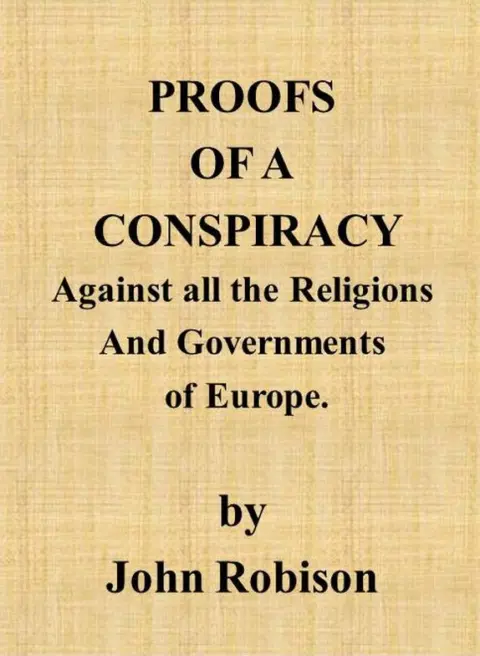
"Proofs of a Conspiracy against all the Religions and Governments of Europe" by John Robison is a historical account likely written in the late 18th century. The book investigates the influence and secrecy of organizations like the Free Masons and Illuminati, suggesting that they played a significant role in undermining traditional religion and government structures throughout Europe. Through an analytical lens, it examines the implications of such secrets societies in the context of the sociopolitical upheaval of the time, particularly in relation to the French Revolution. The opening of the book sets the stage for Robison’s exploration of secret societies, originating from his personal experiences and observations of Freemasonry. He reflects on his time as a Mason and expresses concern about the rising influence of radical ideas within the Masonic Lodges, particularly in France and Germany, where they became hotbeds for controversial doctrines. His introduction reveals a sense of urgency to unveil the concealed agendas behind these organizations, drawing historical parallels and highlighting the threats posed to established governments and religions—a theme that foreshadows the deeper inquiry into the conspiratorial networks that he intends to disclose throughout the text.
Introduction adapted from the source catalogue; source summaries may be automatically generated.
Free to read · English · 119,187 words · No account needed
MAKE TIME FOR A GOOD BOOK
On by default. Untick to stop anonymous reading totals. Each page counts after 10 seconds in view. How this works.
Anonymous counting is on unless you have switched it off.
Basedow corrected, and corrected again, but not one Catholic came to the Philanthropine. He seems to have thought that the best plan would be, to banish all positive religion whatever, and that he would then be sure of Catholic scholars. Cardinal Dubois was so far right with respect to the first Catholic pupil of the church. He had recommended a man of his own stamp to Louis XIV. to fill some important office. The monarch was astonished, and told the Cardinal, that "that would never do, for the man was a Jansenist; Eh! que non, Sire," said the Cardinal, "il n'est qu' Athée;" all was safe, and the man got the priory. But though all was in vain, Basedow's Philanthropine at Dessau got a high character. He published many volumes on education that have much merit.
It were well had this been all. But most unfortunately, though most naturally, writers of loose moral principles and of wicked hearts were encouraged by the impunity which the sceptical writers experienced, and ventured to publish things of the vilest tendency, inflaming the passions and justifying licentious manners. These maxims are congenial with irreligion and Atheism, and the books found a quick market. It was chiefly in the Prussian States that this went on. The late King was, to say the best of him, a naturalist, and, holding this life for his all, gave full liberty to his subjects to write what they pleased, provided they did not touch on state matters. He declared, however, to a minister of his court, long before his death, that "he was extremely sorry that his indifference had produced such effects; that he was sensible it had greatly contributed to hurt the peace and mutual good treatment of his subjects;" and he said, "that he would willingly give up the glory of his best-fought battle, to have the satisfaction of leaving his people in the same state of peace and satisfaction with their religious establishments, that he found them in at his accession to the throne." His successor Frederick William found that things had gone much too far, and determined to support the church-establishment in the most peremptory manner; but at the same time to allow perfect freedom of thinking and conversing to the professors of every Christian faith, provided it was enjoyed without disturbing the general peace, or any encroachment on the rights of those already supported by law. He published an edict to this effect, which is really a model worthy of imitation in every country. This was the epoch of a strange revolution. It was attacked from all hands, and criticisms, satires, slanders, threatenings, poured in from every quarter. The independency of the neighbouring states, and the monarch's not being a great favourite among several of his neighbours, permitted the publication of those pieces in the adjoining principalities, and it was impossible to prevent their circulation even in the Prussian States. His edict was called an unjustifiable tyranny over the consciences of men; the dogmas supported by it were termed absurd superstitions; the King's private character, and his opinions in religious matters, were treated with little reverence, nay, were ridiculed and scandalously abused. This field of discussion being thus thrown open, the writers did not confine themselves to religious matters. After flatly denying that the prince of any country had the smallest right to prescribe, or even direct the faith of his subjects, they extended their discussions to the rights of princes in general; and now they fairly opened their trenches, and made an attack in form on the constitutions of the German confederacy, and, after the usual approaches, they set up the standard of universal citizenship on the very ridge of the glacis, and summoned the fort to surrender. The most daring of these attacks was a collection of anonymous letters on the constitution of the Prussian States. It was printed (or said to be so) at Utrecht; but by comparing the faults of some types with some books printed in Berlin, it was supposed by all to be the production of one of Nicholai's presses. It was thought to be the composition of Mirabeau. It is certain that he wrote a French translation, with a preface and notes, more impudent than the work itself. The monarch is declared to be a tyrant; the people are addressed as a parcel of tame wretches crouching under oppression. The people of Silesia are represented as still in a worse condition, and are repeatedly called to rouse themselves, and to rise up and assert their rights. The King is told, that there is a combination of philosophers (conjuration) who are leagued together in defence of truth and reason, and which no power can withstand; that they are to be found in every country, and are connected by mutual and solemn engagement, and will put in practice every mean of attack. Enlightening, instruction, was the general cry among the writers. The triumph of reason over error, the overthrow of superstition and slavish fear, freedom from religious and political prejudices, and the establishment of liberty and equality, the natural and unalienable rights of man, were the topics of general declamation; and it was openly maintained, that secret societies, where the communication of sentiment should be free from every restraint, was the most effectual means for instructing and enlightening the world.
Your reading position is saved on this browser. Take it to another device with a library code. Reading pages adapt to text, rather than matching a printed edition.
BEHIND THE BOOK
This eBook is for the use of anyone anywhere in the United States and most other parts of the world at no cost and with almost no restrictions whatsoever. You may copy it, give it away or re-use it under the terms of the Project Gutenberg License included with this eBook or online at www.gutenberg.org. If you are not located in the United States, you will have to check the laws of the country where you are located before using this eBook. Read the source licence.
The original source file, including credits and licence, is retained by this library. Request an original-format copy at no charge. Please include the book title and Project Gutenberg identifier #47605.
KEEP YOUR CURIOSITY GOING
Cécile Tormay

Moritz Busch
John L. Ransom
Frances Wright
Cécile Tormay

Mabel Potter Daggett