THE CLASSIC COLLECTION✦An outlaw’s diary: the CommuneCLASSIC FREE BOOKS
An outlaw’s diary: the Commune
Cécile Tormay
THE CLASSIC COLLECTION · 1797
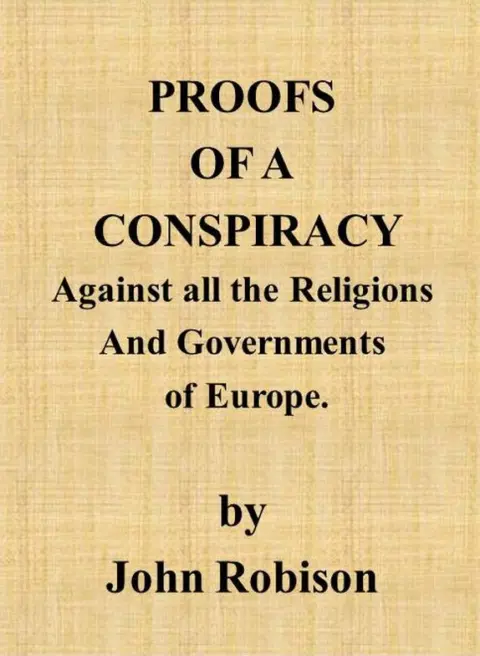
"Proofs of a Conspiracy against all the Religions and Governments of Europe" by John Robison is a historical account likely written in the late 18th century. The book investigates the influence and secrecy of organizations like the Free Masons and Illuminati, suggesting that they played a significant role in undermining traditional religion and government structures throughout Europe. Through an analytical lens, it examines the implications of such secrets societies in the context of the sociopolitical upheaval of the time, particularly in relation to the French Revolution. The opening of the book sets the stage for Robison’s exploration of secret societies, originating from his personal experiences and observations of Freemasonry. He reflects on his time as a Mason and expresses concern about the rising influence of radical ideas within the Masonic Lodges, particularly in France and Germany, where they became hotbeds for controversial doctrines. His introduction reveals a sense of urgency to unveil the concealed agendas behind these organizations, drawing historical parallels and highlighting the threats posed to established governments and religions—a theme that foreshadows the deeper inquiry into the conspiratorial networks that he intends to disclose throughout the text.
Introduction adapted from the source catalogue; source summaries may be automatically generated.
Free to read · English · 119,187 words · No account needed
MAKE TIME FOR A GOOD BOOK
On by default. Untick to stop anonymous reading totals. Each page counts after 10 seconds in view. How this works.
Anonymous counting is on unless you have switched it off.
About this very time there was a great revolution of the public mind in Germany, and scepticism, infidelity, and irreligion, not only were prevalent in the minds and manners of the wealthy and luxurious, and of the profligate of lower ranks, but began to appear in the productions of the press. Some circumstances, peculiar to Germany, occasioned these declensions from the former acquiescence in the faith of their forefathers to become more uniform and remarkable than they would otherwise have been. The confessions of Germany are the Roman Catholic, the Lutheran, (which they call Protestant,) and the Calvinist, (which they call Reformed). These are professed in many small contiguous principalities, and there is hardly one of them in which all the three have not free exercise. The desire of making proselytes is natural to all serious professors of a rational faith, and was frequently exercised. The Roman Catholics are supposed by us to be particularly zealous, and the Protestants (Lutherans and Calvinists) were careful to oppose them by every kind of argument, among which those of ridicule and reproach were not spared. The Catholics accused them of infidelity respecting the fundamental doctrines of Christianity which they professed to believe, and even with respect to the doctrines of natural religion. This accusation was long very slightly supported; but, of late, by better proofs. The spirit of free enquiry was the great boast of the Protestants, and the only support against the Catholics, securing them both in their religious and civil rights. It was therefore encouraged by their governments. It is not to be wondered at that it should be indulged to excess, or improperly, even by serious men, liable to error, in their disputes with the Catholics. In the progress of this contest, even their own Confessions did not escape criticism, and it was asserted that the Reformation which those Confessions express was not complete. Further Reformations were proposed. The Scriptures, the foundation of our faith, were examined by clergymen of very different capacities, dispositions, and views, till by explaining, correcting, allegorising, and otherwise twisting the Bible, men's minds had hardly any thing left to rest on as a doctrine of revealed religion. This encouraged others to go farther, and to say that revelation was a solecism, as plainly appeared by the irreconcilable differences among those Enlighteners (so they were called) of the public, and that man had nothing to trust to but the dictates of natural reason. Another set of writers, proceeding from this as a point already settled, proscribed all religion whatever, and openly taught the doctrines of materialism and atheism. Most of these innovations were the work of Protestant divines, from the causes that I have mentioned. Teller, Semler, Eberhardt, Lessing, Bahrdt, Riem, and Shultz, had the chief hand in all these innovations. But no man contributed more than Nicholai, an eminent and learned bookseller in Berlin. He has been for many years the publisher of a periodical work, called the General German Library, (Algemein deutsche Bibliothek,) consisting of original dissertations, and reviews of the writings of others. The great merit of this work, on account of many learned dissertations which appear in it, has procured it much influence on that class of readers whose leisure or capacity did not allow them a more profound kind of reading. This is the bulk of readers in every country. Nicholai gives a decided preference to the writings of the Enlighteners, and in his reviews treats them with particular notice, makes the public fully acquainted with their works, and makes the most favourable comments; whereas the performances of their opponents, or more properly speaking, the defenders of the National Creeds, are neglected, omitted, or barely mentioned, or they are criticised with every severity of ridicule and reproach. He fell upon a very sure method of rendering the orthodox writers disagreeable to the public, by representing them as the abetters of superstition, and as secret Jesuits. He asserted, that the abolition of the Order of Loyola is only apparent. The Brethren still retained their connection, and most part of their property, under the secret patronage of Catholic Princes. They are, therefore, in every corner, in every habit and character, working with unwearied zeal for the restoration of their empire. He raised a general alarm, and made a journey through Germany, hunting for Jesuits, and for this purpose, became Free Mason and Rosycrucian, being introduced by his friends Gedicke and Biester, clergymen, publishers of the Berlin Monatschrift, and most zealous promoters of the new doctrines. This favour he has repaid at his return, by betraying the mysteries of the Lodges, and by much bitter satire. His journey was published in several volumes, and is full of frightful Jesuitisms. This man, as I have said, found the greatest success in his method of slandering the defenders of Bible-Christianity, by representing them as concealed Jesuits. But, not contented with open discussion, he long ago published a sort of romance, called Sebaldus Nothanker, in which these divines are introduced under feigned names, and made as ridiculous and detestable as possible. All this was a good trading job; for sceptical and free-thinking writings have every where a good market; and Nicholai was not only reviewer, but publisher, having presses in different cities of the Empire. The immense literary manufacture of Germany, far exceeding that of any nation of Europe, is carried on in a very particular way. The books go in sheets to the great fairs of Leipsic and Frankfort, twice a-year. The booksellers meet there, and see at one glance the state of literature; and having speculated and made their bargains, the books are instantly dispersed through every part of the Empire, and appear at once in all quarters. Although every Principality has an officer for licensing, it is impossible to prevent the currency of a performance, although it may be prohibited; for it is to be had by the carrier at three or four miles distance in another state. By this mode of traffic, a plot may be formed, and actually has been formed, for giving any particular turn to the literature of the country. There is an excellent work printed at Bern by the author Heinzmann, a bookseller, called, Appeal to my Country, concerning a Combination of Writers, and Booksellers, to rule the Literature of Germany, and form the Public Mind into a Contempt for the Religion and Civil Establishments of the Empire. It contains a historical account of the publications in every branch of literature for about thirty years. The author shows, in the most convincing manner, that the prodigious change from the former satisfaction of the Germans on those subjects to their present discontent and attacks from every quarter, is neither a fair picture of the prevailing sentiments, nor has been the simple operation of things, but the result of a combination of trading Infidels.
Your reading position is saved on this browser. Take it to another device with a library code. Reading pages adapt to text, rather than matching a printed edition.
BEHIND THE BOOK
This eBook is for the use of anyone anywhere in the United States and most other parts of the world at no cost and with almost no restrictions whatsoever. You may copy it, give it away or re-use it under the terms of the Project Gutenberg License included with this eBook or online at www.gutenberg.org. If you are not located in the United States, you will have to check the laws of the country where you are located before using this eBook. Read the source licence.
The original source file, including credits and licence, is retained by this library. Request an original-format copy at no charge. Please include the book title and Project Gutenberg identifier #47605.
KEEP YOUR CURIOSITY GOING
Cécile Tormay

Moritz Busch
John L. Ransom
Frances Wright
Cécile Tormay

Mabel Potter Daggett