THE CLASSIC COLLECTION✦An outlaw’s diary: the CommuneCLASSIC FREE BOOKS
An outlaw’s diary: the Commune
Cécile Tormay
THE CLASSIC COLLECTION · 1797
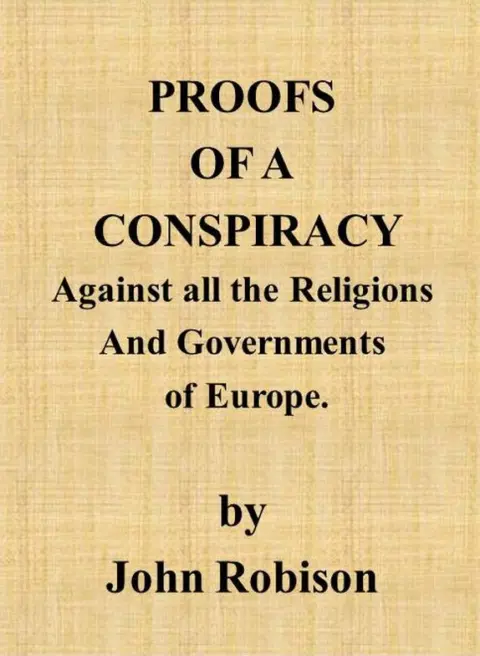
"Proofs of a Conspiracy against all the Religions and Governments of Europe" by John Robison is a historical account likely written in the late 18th century. The book investigates the influence and secrecy of organizations like the Free Masons and Illuminati, suggesting that they played a significant role in undermining traditional religion and government structures throughout Europe. Through an analytical lens, it examines the implications of such secrets societies in the context of the sociopolitical upheaval of the time, particularly in relation to the French Revolution. The opening of the book sets the stage for Robison’s exploration of secret societies, originating from his personal experiences and observations of Freemasonry. He reflects on his time as a Mason and expresses concern about the rising influence of radical ideas within the Masonic Lodges, particularly in France and Germany, where they became hotbeds for controversial doctrines. His introduction reveals a sense of urgency to unveil the concealed agendas behind these organizations, drawing historical parallels and highlighting the threats posed to established governments and religions—a theme that foreshadows the deeper inquiry into the conspiratorial networks that he intends to disclose throughout the text.
Introduction adapted from the source catalogue; source summaries may be automatically generated.
Free to read · English · 119,187 words · No account needed
MAKE TIME FOR A GOOD BOOK
On by default. Untick to stop anonymous reading totals. Each page counts after 10 seconds in view. How this works.
Anonymous counting is on unless you have switched it off.
The mean motive of the Protestant Sceptic is as inconsistent with our notions of honesty as with our notions of honour; and our suspicions are justly raised of the character of Dr. Bahrdt and his associates, even although we do not suppose that their aim is the total abolishing of religion. With propriety therefore may we make some enquiry about their lives and conduct. Fortunately this is easy in the present instance. A man that has turned every eye upon himself can hardly escape observation. But it is not so easy to get fair information. The peculiar situation of Dr. Bahrdt, and the cause between him and the public, are of all others the most productive of mistake, misrepresentation, obloquy, and injustice. But even here we are fortunate. Many remarkable parts of his life are established by the most respectable testimony, or by judicial evidences; and, to make all sure, he has written his own life. I shall insert nothing here that is not made out by the two last modes of proof, resting nothing on the first, however respectable the evidence may be. But I must observe, that his life was also written by his dear friend Pott, the partner of Walther the bookseller. The story of this publication is curious, and it is instructive.
Bahrdt was in prison, and in great poverty. He intended to write his own life, to be printed by Walther, under a fictitious name, and in this work he intended to indulge his spleen and his dislike of all those who had offended him, and in particular all priests, and rulers, and judges, who had given him so much trouble. He knew that the strange, and many of them scandalous anecdotes, with which he had so liberally interlarded many of his former publications, would set curiosity on tiptoe, and would procure a rapid sale as soon as the public should guess that it was his own performance, by the singular but significant name which the pretended author would assume. He had almost agreed with Walther for a thousand dahlers, (about L. 200), when he was imprisoned for being the author of the farce so often named, and of the commentary on the Religion Edict, written by Pott, and for the proceedings of the German Union. He was refused the use of pen and ink. He then applied to Pott, and found means to correspond with him, and to give him part of his life already written, and materials for the rest, consisting of stories, and anecdotes, and correspondence. Pott sent him several sheets, with which he was so pleased, that they concluded a bargain. Bahrdt says, that Pott was to have 400 copies, and that the rest was to go to the maintenance of Bahrdt and his family, consisting of his wife, daughter, a Christina and her children who lived with them, &c. Pott gives a different account, and the truth was different from both, but of little consequence to us. Bahrdt's papers had been seized, and searched for evidence of his transactions, but the strictest attention was paid to the precise points of the charge, and no paper was abstracted which did not relate to these. All others were kept in a sealed room. Pott procured the removal of the seals and got possession of them. Bahrdt says, that his wife and daughter came to him in prison, almost starving, and told him that now that the room was opened, Pott had made an offer to write for their support, if he had the use of these papers--that this was the conclusion of the bargain, and that Pott took away all the papers. N. B. Pott was the associate of Walther, who had great confidence in him (Anecdotenbuch fur meinen lieben Amtsbruder, p. 400) and had conducted the business of Stark's book, as has been already mentioned. No man was better known to Bahrdt, for they had long acted together as chief hands in the Union. He would therefore write the life of its founder con amore, and it might be expected to be a rare and tickling performance. And indeed it was. The first part of it only was published at this time; and the narration reaches from the birth of the hero till his leaving Leipzig in 1768. The attention is kept fully awake, but the emotions which successively occupy the mind of the reader are nothing but strong degrees of aversion, disgust, and horror. The figure set up to view is a monster, a man of talents indeed, and capable of great things; but lost to truth, to virtue, and even to the affectation of common decency--In short, a shameless profligate.--Poor Bahrdt was astonished,--stared--but, having his wits about him, saw that this life would sell, and would also sell another.--Without loss of time, he said that he would hold Pott to his bargain--but he reckoned without his host. "No, no," said Pott, "your are not the man I took you for--your correspondence was put into my hands--I saw that you had deceived me, and it was my duty, as a man who loves truth above all things, to hinder you from deceiving the world. I have not written the book you desired me. I did not work for you, but for myself--therefore you get not a groschen." "Why, Sir," said Bahrdt, "we both know that this won't do. You and I have already tried it. You received Stark's manuscript, to be printed by Walther--Walther and you sent it hither to Michaelis, that I might see it during the printing. I wrote an illustration and a key, which made the fellow very ridiculous, and they were printed together, with one title page.--You know that we were cast in court.--Walther was obliged to print the work as Stark first ordered, and we lost all our labour.--So shall you now, for I will commence an action this instant, and let me see with what face you will defend yourself, within a few weeks of your last appearance in court." Pott said, "You may try this. My work is already sold, and dispersed over all Germany--and I have no objection to begin yours to-morrow--believe me, it will sell." Bahrdt pondered--and resolved to write one himself.
Your reading position is saved on this browser. Take it to another device with a library code. Reading pages adapt to text, rather than matching a printed edition.
BEHIND THE BOOK
This eBook is for the use of anyone anywhere in the United States and most other parts of the world at no cost and with almost no restrictions whatsoever. You may copy it, give it away or re-use it under the terms of the Project Gutenberg License included with this eBook or online at www.gutenberg.org. If you are not located in the United States, you will have to check the laws of the country where you are located before using this eBook. Read the source licence.
The original source file, including credits and licence, is retained by this library. Request an original-format copy at no charge. Please include the book title and Project Gutenberg identifier #47605.
KEEP YOUR CURIOSITY GOING
Cécile Tormay

Moritz Busch
John L. Ransom
Frances Wright
Cécile Tormay

Mabel Potter Daggett