
Last letters from the living dead man
David Patterson (Spirit) Hatch
THE CLASSIC COLLECTION · 1812
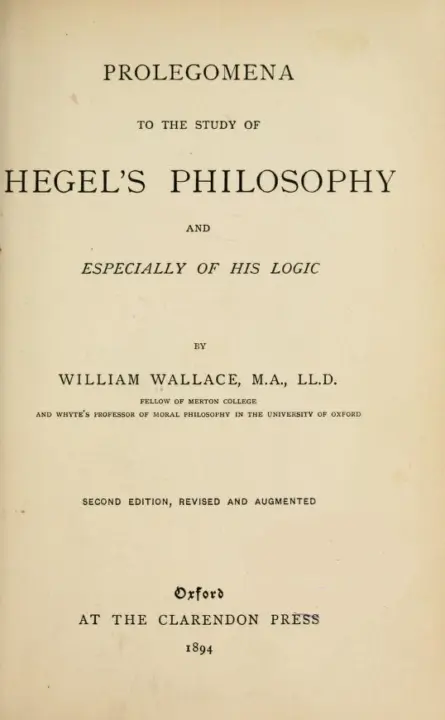
"Prolegomena to the Study of Hegel's Philosophy, and Especially of His Logic" by William Wallace is a philosophical treatise written in the late 19th century. This work serves as an introduction to the complex thought of Hegel, focusing particularly on his concepts of logic and how they relate to broader philosophical inquiries. Wallace aims to clarify and make accessible the often dense and abstract ideas attributed to Hegel, which have elicited varied interpretations and controversies among scholars. The opening of the text presents Wallace's preface, where he details the evolution of his own understanding of Hegel over two decades and outlines the challenges associated with Hegel's philosophy. He argues about the nature of Hegel's writings, contrasting the clarity sought in traditional sciences with the more intricate demands of Hegelian thought. The author acknowledges the difficulties readers face when engaging with Hegel, emphasizing the importance of patience and a willingness to abandon preconceived notions. Wallace highlights the relationship between Hegel's logic and the philosophical landscape of his time, suggesting that understanding Hegel is essential for grasping the evolution of modern philosophy and the responses to Kantian thought.
Introduction adapted from the source catalogue; source summaries may be automatically generated.
Free to read · English · 144,248 words · No account needed
MAKE TIME FOR A GOOD BOOK
On by default. Untick to stop anonymous reading totals. Each page counts after 10 seconds in view. How this works.
Anonymous counting is on unless you have switched it off.
It is originally in our practical operations that the distinctions of necessary and possible emerge,--with a view to the accomplishment of our desires and purposes. That is necessary which is required and needed if some bare plan is projected and is to be actualised: it is the condition or conditions without which the end cannot be attained. It is an epithet of the means. Possible, on the contrary, is an epithet of the end or plan, and denotes that there are means for its attainment, without however always specifying that this is known of the present or given instance. It is clear that everything as regards the application of these terms will depend on the definiteness with which the plan is conceived, both in itself so to speak and in its relations with the rest of the circumstances. On the other hand, when a result emerges without being included in the purpose, and without any means having been employed for attaining it, it is said to be a chance, accident, or contingency.
These terms are applied by analogy to the uses of theoretical explanation. Just as in will you have a general aim to begin with, which becomes more and more determinate as it moves forward in the volitional process to execution; so in the attempt to understand the world you suppose it first of all the mere shadow or phantom of itself, a promise and potentiality of things to come: a next-to-nothing, which however you credit with a magic wealth of potential being. So much indeed may this possibility be emphasised that nothing more is needed: it is possible, and, without a thought of difficulties and counteractives, you could swear that it is actual[3]. Being removed above this solid land of actuality, cut off from the ties and bonds of conditions, it fancies itself moving in its vacuum; and being free from all bonds of actuality fancies itself actually free, or self-disposing, whereas it can only claim this liberum arbitrium indifferentiae, so long as it remains bare and powerless possibility--a mere may-be, which, apart from all conditions, would exist only by a mere contingency, or freak of chance. This mere potentiality--being only an ante-dated, presupposed, and hypothetical actuality--being only a substance or substratum--must be raised out of its supposititious existence into reality by means of appropriate conditions. These conditions are necessary to its resuming its place or reaching a place in actuality. Thus each object becomes actual or real from a presupposed possibility by means of an external necessity. As in the former case the possibility was identified with power, and conditions were left out of sight as comparatively unimportant: so here the possibility--taken to lie at the root of the thing--is made a mere susceptibility, which would be nothing actual unless stimulated and necessitated from outside. This necessity in the very heart of actuality (which is its characteristic to the reflectional mode of mind) thus arises from the separation and hypostatisation of its elements into independent powers which are so far in stress and opposition. This is the climax of metaphysics--if metaphysics be the investiture of the dynamic factors of the notion with the power and character of supposed agents or forces. It appears in three phases, with the three categories of substance, cause, and reciprocity. To the first, reality is regarded as dominated by its mere underlying potentiality: the reality of the mere superficial contingents is controlled by the necessity of its latent or substantial being. To explain event or incident, here, is merely to bind it to the generic nature or the intrinsic doom, which--unexplained and inexplicable--manifests itself in an extrinsically fluctuating appearance of facts: e. g. the single crime is explained as the product of social conditions. Under the conception of Causality, each thing is a mere might-be which owes all its actuality to a definite antecedent or cause,--an antecedent termed for the moment unconditional, but anon reduced to dependence on further conditions. The effect is as a fact: but would not have been so unless for an earlier fact--i. e. unless the effect in a supposed earlier stage of its growth had been helped on by certain conditions or circumstances to acquire actual and full being in the effect. And cause and conditions can change places, according to what we happen to regard as the central nucleus or inner possibility of the effect. Lastly, the conception of reciprocity recognises that causality is rather an arbitrary simplification of reality into strands of rectilinear event; it remembers that Substance emphasises the dependence of each non-independent element on the supposed totality which they grow from, and doing so, it lays down the reversibility and essential elasticity of the causal relation. The cause in causing re-acts upon itself, and the effect is itself a cause of the effect, active as well as passive. The dependence in short is all-environing: nowhere is there any loop-hole to escape from necessity. Motives act on purpose, and purpose acts on motives: the stone hurls back the hand that hurled it.
Your reading position is saved on this browser. Take it to another device with a library code. Reading pages adapt to text, rather than matching a printed edition.
BEHIND THE BOOK
This eBook is for the use of anyone anywhere in the United States and most other parts of the world at no cost and with almost no restrictions whatsoever. You may copy it, give it away or re-use it under the terms of the Project Gutenberg License included with this eBook or online at www.gutenberg.org. If you are not located in the United States, you will have to check the laws of the country where you are located before using this eBook. Read the source licence.
The original source file, including credits and licence, is retained by this library. Request an original-format copy at no charge. Please include the book title and Project Gutenberg identifier #54992.
KEEP YOUR CURIOSITY GOING
David Patterson (Spirit) Hatch
Coulson Kernahan

Ralph Waldo Emerson
Frances Wright

Edwin Abbott Abbott

Joseph Droz