
Last letters from the living dead man
David Patterson (Spirit) Hatch
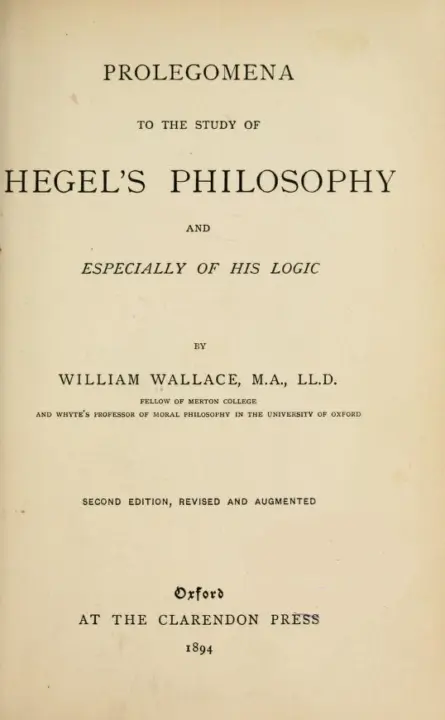
THE CLASSIC COLLECTION · 1812
"Prolegomena to the Study of Hegel's Philosophy, and Especially of His Logic" by William Wallace is a philosophical treatise written in the late 19th century. This work serves as an introduction to the complex thought of Hegel, focusing particularly on his concepts of logic and how they relate to broader philosophical inquiries. Wallace aims to clarify and make accessible the often dense and abstract ideas attributed to Hegel, which have elicited varied interpretations and controversies among scholars. The opening of the text presents Wallace's preface, where he details the evolution of his own understanding of Hegel over two decades and outlines the challenges associated with Hegel's philosophy. He argues about the nature of Hegel's writings, contrasting the clarity sought in traditional sciences with the more intricate demands of Hegelian thought. The author acknowledges the difficulties readers face when engaging with Hegel, emphasizing the importance of patience and a willingness to abandon preconceived notions. Wallace highlights the relationship between Hegel's logic and the philosophical landscape of his time, suggesting that understanding Hegel is essential for grasping the evolution of modern philosophy and the responses to Kantian thought.
Introduction adapted from the source catalogue; source summaries may be automatically generated.
Free to read · English · 144,248 words · No account needed
MAKE TIME FOR A GOOD BOOK
On by default. Untick to stop anonymous reading totals. Each page counts after 10 seconds in view. How this works.
Anonymous counting is on unless you have switched it off.
If the first branch of Logic was the sphere of simple Being in a point or series of points, the second is that of difference and discordant Being, broken up in itself. The progress in this second sphere--of Essentia or Relative being--consists in gradually overcoming the antithesis and discrepancy between the two sides in it--the Permanent and the Phenomenal. At first the stress rests upon the Permanent and true Being which lies behind the seeming--upon the essence or substratum in the background, on which the show of immediate Being has been proved by the process in the first sphere really to rest. Then, secondly, Existence comes to the front, and Appearances or Phenomena are regarded as the only realities with which science can deal. And yet even in this case we cannot but distinguish between matter and form, between the phenomena and their laws, between force and its exercises: and thus repeat the relativity, though both terms in it are now on the whole transferred into the range of the Phenomenal world. The third range of Essential Being is known as Actuality, where the two elements in relation rise to the level of independent existences, essences in phenomenal guise--bound together, and deriving their very characteristics from that close union. Relativity or correlation is now clearly apparent in actual form, and comprises the three heads of Substantial Relation, Causal Relation, and Reciprocal Relation. In this case while the two members of the relation are now indissolubly linked together, they are no more submitted to each other than they are independent. According to Reciprocity everything actual is at once cause and effect: it is the meeting-point of relations: a whole with independent elements in mutual interconnexion. Such a total is the Notion.
This brings us to the third branch of Logic,--the theory of the Notion, or Grasp of Thought.[2] The theory of Causality, with which the second branch closed, continued to let the thought fall asunder into two unequal halves--always however in relation or connexion with each other. But in the present part of the Logic the two halves are re-united, or in their difference their identity is also recognised. Instead of a cause of a thing (which is separate from it in order), we have a concept which is its principle of unity, its universal in which it is individualised. Instead of incessant and endless Relativity, we have Development. By development is meant self-specification, or self-actualisation: the thing is what it becomes, or while it changes it remains identical with itself. The Category or Development is the category or method of philosophic or speculative science: just as Being corresponded to natural thought, and Relativity or Reflection to metaphysical and realistic science. According to the law of Development diversity and unity both receive their due. Mere unity or Being reappears now as Universality or Generality. Mere diversity, or the relativity of essence, re-appears as Particularity, or the speciality of details. And the union of the two is seen in the Individualised notion or real object. In other words, the true thought which really grasps and gets all round its object, which is a real whole, is a Triplicity: it is first seen all as the ground or self-same, the possibility--secondly, all as the existence in details, and difference, the actuality or contingency--and thirdly, all as the self-same in difference, and the possible in actuality. Every object in its full reality is an innate movement; and to grasp it wholly we must apprehend it as such a self-evolving and self-involving unity of elements, in each of which however it is whole and entire. Thus the Notion embraces the three elements or factors of universal, particular and individual. These three elements first rise to independence and get their full significance or explication in the syllogism, with its three terms and judgments, exhibiting the various ways in which any two of these elements in thought are brought into unity by means of the third. This adequate form is a system or organic unity which contains in itself the premisses of its conclusion or the means to its realisation,--which is a process within itself, and when complete and self-supporting perforce gives itself reality.
Your reading position is saved on this browser. Take it to another device with a library code. Reading pages adapt to text, rather than matching a printed edition.
BEHIND THE BOOK
This eBook is for the use of anyone anywhere in the United States and most other parts of the world at no cost and with almost no restrictions whatsoever. You may copy it, give it away or re-use it under the terms of the Project Gutenberg License included with this eBook or online at www.gutenberg.org. If you are not located in the United States, you will have to check the laws of the country where you are located before using this eBook. Read the source licence.
The original source file, including credits and licence, is retained by this library. Request an original-format copy at no charge. Please include the book title and Project Gutenberg identifier #54992.
KEEP YOUR CURIOSITY GOING
David Patterson (Spirit) Hatch
Coulson Kernahan

Ralph Waldo Emerson
Frances Wright

Edwin Abbott Abbott

Joseph Droz