
Last letters from the living dead man
David Patterson (Spirit) Hatch
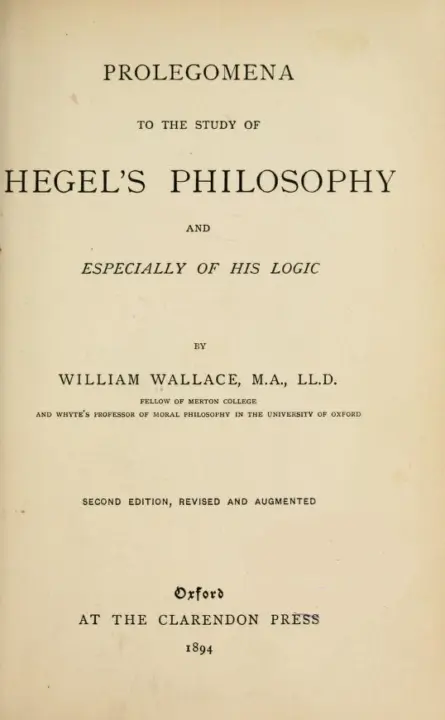
THE CLASSIC COLLECTION · 1812
"Prolegomena to the Study of Hegel's Philosophy, and Especially of His Logic" by William Wallace is a philosophical treatise written in the late 19th century. This work serves as an introduction to the complex thought of Hegel, focusing particularly on his concepts of logic and how they relate to broader philosophical inquiries. Wallace aims to clarify and make accessible the often dense and abstract ideas attributed to Hegel, which have elicited varied interpretations and controversies among scholars. The opening of the text presents Wallace's preface, where he details the evolution of his own understanding of Hegel over two decades and outlines the challenges associated with Hegel's philosophy. He argues about the nature of Hegel's writings, contrasting the clarity sought in traditional sciences with the more intricate demands of Hegelian thought. The author acknowledges the difficulties readers face when engaging with Hegel, emphasizing the importance of patience and a willingness to abandon preconceived notions. Wallace highlights the relationship between Hegel's logic and the philosophical landscape of his time, suggesting that understanding Hegel is essential for grasping the evolution of modern philosophy and the responses to Kantian thought.
Introduction adapted from the source catalogue; source summaries may be automatically generated.
Free to read · English · 144,248 words · No account needed
MAKE TIME FOR A GOOD BOOK
On by default. Untick to stop anonymous reading totals. Each page counts after 10 seconds in view. How this works.
Anonymous counting is on unless you have switched it off.
In a true plural, on the contrary, it is required that the sign of number be clearly eliminated from any peculiarities of its special object, and be distinctly separated from the collective. And similarly the true numeral has to be realised in its abstractness, as a category per se. And to do this requires some amount of abstraction. In Greek, for example, we meet the distinction between numbers in the abstract, pure numbers (such as four and six), and bodily or physical numbers (such as four men, six trees)[3]. The geometrical aspect under which numbers were regarded by the Greeks, e. g. as oblong or square numbers, bears in the same direction. But another phenomenon in language tells the tale more distinctly[4]. Abundantly in Sanscrit and Greek, more rarely in Zend and Teutonic, and here and there in the Semitic languages, we meet with what is known as the dual number, a special grammatical form intended to express a pair of objects. The witty remark of Du Ponceau[5] concerning the Greek dual, that it had apparently been invented only for lovers and married people, may illustrate its uses, but hardly suffices to explain its existence in language. But a comparison of barbarian dialects serves to show that the dual is, as it were, a prelude to the plural,--a first attempt to grasp the notion of plurality in a definite way, which served its turn in primitive society, but afterwards disappeared, when the plural had been developed, and the numerals had attained a form of their own. If this be so, the dual is what physiologists call a rudimentary organ, and tells the same story as these organs do of the processes of nature.
The language of the Melanesian island of Annatom, one of the New Hebrides, may be taken as an instance of a state of speech in which the dual is natural. That language possesses a fourfold distinction of number in its personal pronouns, a different form to mark the singular, dual, trial, and plural: and the pronoun of the first person plural distinguishes in addition whether the person addressed is or is not included in the 'we-two,' 'we-three,' or 'we-many' of the speaker[6]. The same language however possesses only the first three numerals, and in the translation of the Bible into this dialect it was necessary to introduce the English words, four, five, &c. The two facts must be taken together: the luxuriance of the personal pronouns and the scanty development of numerals in such languages are two phenomena of the same law. The numeral 'four' to these tribes is said to bear the meaning of 'many' or 'several,' Another fact points in the same direction. In many languages, such as those of China, Further India and Mexico, it is customary in numbering to use what W. von Humboldt has called class-words. Here it is felt that an artificial unity has to be created, a common denominator found, and all reduced to it, before any summation can be carried out. Scholars and officials, in Chinese, can only be classed under the rubric of 'jewel' or dignity: and animals or fish by 'tails,' as if thereby only could one get a handle to hold them and count them. (The idiom still lingers in western languages: as in English, heads of cabbage, or of cattle: or German, sechs Mann Soldaten.) So in Malay, instead of 'five boys' the phrase used is 'boy five-man': in other words, the numerals are supposed to inhere as yet in objects of a special kind or common occurrence[7]. And among the South Sea Islanders the consciousness of number is decidedly personal: that is to say, the distinction between one and two is first conceived as a distinction between 'I' and 'we two.' Even this amount of simplification surpasses what is found amongst some Australian tribes. There we find four duals: one for brothers and sisters: one for parents and children: one for husbands and wives: and one between brothers-in-law[8]. Each pair has a different form. We thus seem to see to what early language is applied: not to designate the objects of nature, but the members of the primitive family and their interests. The consciousness of numbers was first awakened by the need of distinguishing and combining the things that belonged to and specially interested men and women in the narrow circle of barbarian life[9]. It is not altogether imaginative in principle, though it may be occasionally surmise in details, to connect the rise of grammatical forms with the temperament and character of the people, and therefore with its social organisation. If the Bantoo or Caffir languages of Southern Africa instead of a single third personal pronoun and third personal termination to the verb use the separate forms corresponding to the ten class-prefixes of the nouns, it must be in accordance with the general spirit and system of these tribes. The various plural forms, if they persist, will reflect contemporary modes of life.
Your reading position is saved on this browser. Take it to another device with a library code. Reading pages adapt to text, rather than matching a printed edition.
BEHIND THE BOOK
This eBook is for the use of anyone anywhere in the United States and most other parts of the world at no cost and with almost no restrictions whatsoever. You may copy it, give it away or re-use it under the terms of the Project Gutenberg License included with this eBook or online at www.gutenberg.org. If you are not located in the United States, you will have to check the laws of the country where you are located before using this eBook. Read the source licence.
The original source file, including credits and licence, is retained by this library. Request an original-format copy at no charge. Please include the book title and Project Gutenberg identifier #54992.
KEEP YOUR CURIOSITY GOING
David Patterson (Spirit) Hatch
Coulson Kernahan

Ralph Waldo Emerson
Frances Wright

Edwin Abbott Abbott

Joseph Droz