
Last letters from the living dead man
David Patterson (Spirit) Hatch
THE CLASSIC COLLECTION · 1812
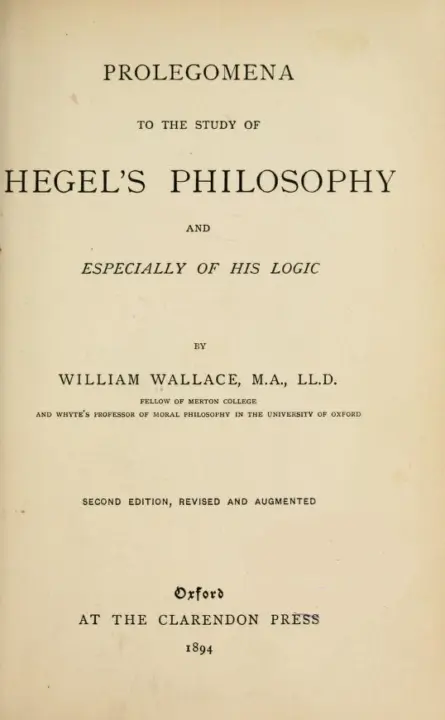
"Prolegomena to the Study of Hegel's Philosophy, and Especially of His Logic" by William Wallace is a philosophical treatise written in the late 19th century. This work serves as an introduction to the complex thought of Hegel, focusing particularly on his concepts of logic and how they relate to broader philosophical inquiries. Wallace aims to clarify and make accessible the often dense and abstract ideas attributed to Hegel, which have elicited varied interpretations and controversies among scholars. The opening of the text presents Wallace's preface, where he details the evolution of his own understanding of Hegel over two decades and outlines the challenges associated with Hegel's philosophy. He argues about the nature of Hegel's writings, contrasting the clarity sought in traditional sciences with the more intricate demands of Hegelian thought. The author acknowledges the difficulties readers face when engaging with Hegel, emphasizing the importance of patience and a willingness to abandon preconceived notions. Wallace highlights the relationship between Hegel's logic and the philosophical landscape of his time, suggesting that understanding Hegel is essential for grasping the evolution of modern philosophy and the responses to Kantian thought.
Introduction adapted from the source catalogue; source summaries may be automatically generated.
Free to read · English · 144,248 words · No account needed
MAKE TIME FOR A GOOD BOOK
On by default. Untick to stop anonymous reading totals. Each page counts after 10 seconds in view. How this works.
Anonymous counting is on unless you have switched it off.
To such a common frame of mind ideas, truths, forces are vacant, ghostly forms, devoid of true life and reality: to get such they need blood and flesh to clothe them, to give them substance and power. Now Hegel, no less than those who offer this criticism, regards ideas (in the ordinary sense of that term), truths and forces, also as abstractions which need something to make them powers in the real world of nature and the ideal world of mind. Hegel, like Schelling, has a sublime contempt for mere universals. But as to the something else, there is a divergence of view. Two well-known answers are given by the popular philosophy known as materialism or spiritualism: two systems which are probably not so wide apart as the contrast of their names might imply. According to the former, thinking, ideas, truths, goodness and beauty are special functions (the grosser materialists say secretions) of a special kind of matter--of something which is accessible to ordinary mechanical and chemical tests, but which exhibits also, in certain cases, the exceptional phenomena of consciousness. Here the essential reality is a something, permanent and essentially indestructible,--something which no man has seen, nor indeed can see,--but which is called Matter. The spiritualistic philosopher (as distinguished from the idealist) regards as the essential realities in the universe what he calls spirits. What these are, also, nobody has as yet (any more than in Kant's time[5]) given any very authoritative account, but so far as the quasi-scientific expositions in regard to them throw any general light on the subject, we may say that they suggest only a differently-constituted matter, a matter e. g. of less or more dimensions than that we are most familiar with.
Now the advocate of spiritual reality, who protests most strongly against the injury done to personality by reducing it to something fluid and not fixed, something in process and not in persistent substance, seems mostly to lean to a quasi-spiritualistic hypothesis, or to the--so-called--higher materialism. He is an advocate of what we may describe as the soul-thing, of a permanent, (he would even hold, an absolutely permanent) substance or substratum of psychical reality which, no doubt, exhibits certain properties, but is always more than any one, or any mere series of its phenomena. It has been said, indeed, by one who spoke with authority that he that will save his soul shall lose it, and he that will lose it shall find it. But this has always been a hard saying, which has been as far as possible explained away by exegesis. Yet its moral import is not so very far removed from its philosophical equivalent. The true life is not that of self-seeking pleasure, but the life spent in the service of truth and love, the life dedicated to impersonal interests, and ideal good. So also the reality of the human soul as we first know it lies not in itself, but in its transfiguration, its purification, and liberation to higher forms of being. The Soul, in its first avatar in each of us, is after all of the earth, earthy, unless it continue on that path of growth and development on which it has entered. It is as Aristotle said, and said well, the first actualisation[6]--the proximate ideality of an organic body. In soul organic body carries out its promise: in soul we, the observers, or untrained psychologists, note our first awareness of mental life in its organic environment. But there are other grades, other heights of achievement, yet set before the principle of life, which is more than mere life and mere soul: or soul contains a germ which must bear higher fruit. To be itself, or to become all that it in promise and potency contains, it must dispossess itself of what clings to it and possess itself of what is its own; and so transmute its first phase into one more adequate. The soul is, as Hegel has said, the awakening of mind from the sleep of nature[7]: it is nature gathering itself out of its absorption in its dispersion, the breath of life and feeling striving through the scattered members of the material world, and finding itself at first half-asleep, a pervading, unifying current that flows through and makes continuous the various portions of the universe. It is the earliest real, felt unity in which the logical or synthetic pulse--as yet purely potential in Nature, and only surmised by science--re-appears in the actual concrete world. And as the earliest, it is, like first loves, what one clings to hardest as our prime and fundamental differentia. Here at least we are something--a centre of being, and not a mere centreless expanse of extension: something emerging from the world of silence and of night--something in which each feels
Your reading position is saved on this browser. Take it to another device with a library code. Reading pages adapt to text, rather than matching a printed edition.
BEHIND THE BOOK
This eBook is for the use of anyone anywhere in the United States and most other parts of the world at no cost and with almost no restrictions whatsoever. You may copy it, give it away or re-use it under the terms of the Project Gutenberg License included with this eBook or online at www.gutenberg.org. If you are not located in the United States, you will have to check the laws of the country where you are located before using this eBook. Read the source licence.
The original source file, including credits and licence, is retained by this library. Request an original-format copy at no charge. Please include the book title and Project Gutenberg identifier #54992.
KEEP YOUR CURIOSITY GOING
David Patterson (Spirit) Hatch
Coulson Kernahan

Ralph Waldo Emerson
Frances Wright

Edwin Abbott Abbott

Joseph Droz