
Last letters from the living dead man
David Patterson (Spirit) Hatch
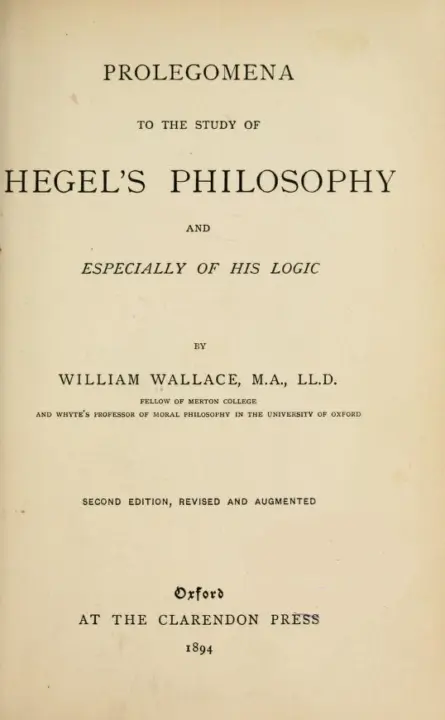
THE CLASSIC COLLECTION · 1812
"Prolegomena to the Study of Hegel's Philosophy, and Especially of His Logic" by William Wallace is a philosophical treatise written in the late 19th century. This work serves as an introduction to the complex thought of Hegel, focusing particularly on his concepts of logic and how they relate to broader philosophical inquiries. Wallace aims to clarify and make accessible the often dense and abstract ideas attributed to Hegel, which have elicited varied interpretations and controversies among scholars. The opening of the text presents Wallace's preface, where he details the evolution of his own understanding of Hegel over two decades and outlines the challenges associated with Hegel's philosophy. He argues about the nature of Hegel's writings, contrasting the clarity sought in traditional sciences with the more intricate demands of Hegelian thought. The author acknowledges the difficulties readers face when engaging with Hegel, emphasizing the importance of patience and a willingness to abandon preconceived notions. Wallace highlights the relationship between Hegel's logic and the philosophical landscape of his time, suggesting that understanding Hegel is essential for grasping the evolution of modern philosophy and the responses to Kantian thought.
Introduction adapted from the source catalogue; source summaries may be automatically generated.
Free to read · English · 144,248 words · No account needed
MAKE TIME FOR A GOOD BOOK
On by default. Untick to stop anonymous reading totals. Each page counts after 10 seconds in view. How this works.
Anonymous counting is on unless you have switched it off.
And this is a subject on which there is inevitably a good deal of misunderstanding. And the misunderstanding will probably last so long as one set of writers flaunts over it that blessed word Personality as a holy, a sacrosanct thing, like the visionary cross with its inscription In hoc signo vinces: and as another set treats it as a mere fetish, under which is hidden nothing better than stock or stone, or a heap of old bones. Perhaps some concessions might well be made on both sides. And the first of them would be to try to come to some clearer understanding what the term in question means. And, on that point, if we follow the example of Aristotle and examine popular usage, to see if it can help us to any consistent use of the term, we shall find that by personal as opposed to real we mean something peculiarly attached to the individual, of which he cannot divest himself as of other outward things, though it also is an outward thing[1] The person in this narrowest sense means the body; and if the epithet is further extended it still expresses what is directly manipulated through the members of the living agent, and is more or less closely attached to it. Yet if it means the body, we must be careful to add that it is the body, regarded not as such but as the representative, the outward manifestation, the inseparable sign or symbol of a spirit, an intelligence and a will. The person is the visible or tangible phenomenon of something inward,--the phase or function by which an individual agent takes his place in the common world of human intercourse and interaction--his peculiar and definite part in the general or universal world and field.
Personality thus mingles or unifies in it an universal and an individual aspect or element: it hints that the universal work always has in reality an individually-determinate tone,--that nothing in the world, even if it be called the same, is really and actively the same. Si duo idem faciunt, non est idem quod faciunt. Thus, what separates personality from individuality is simply that in the narrower or abstracter use of the latter term there is an absence of the due subordination of all individuality to universality, and of all universality to individuality. Personality, in short, is an individuality which is not a mere freak, not merely different from other things, but also in itself charged with a universal meaning or function. Yet even this is not enough to describe it. It is the individuality of an intelligence: the flesh and blood, and, in a secondary degree, the outward things, stamped with intelligence. Every member of a kind, every natural existence, has this double character; this convergence or union of universal and individual. In being this individual object, it is at the same time a universal, and vice versa. But in the attribution of personality there is involved something beyond what is common to all creatures. And that something, we may first of all say, is this. Whereas in the case of other things the individuality is distinctly subordinate, and each is reckoned primarily by its kind, in the case of persons we can almost declare that the universality is subordinate to the individuality. This union of individuality and universality in a single manifestation, with the implication that the individuality is the essential and permanent element to which the universality is almost in the nature of an accident, is what forms the cardinal point in Personality. And one can understand, when the distinction is thus put, the obvious and palpable antagonism in which the view stands to the central principles of Spinoza[2] We speak of a man as a Personality when we wish to note the fact that he is no mere manufactured article, the representative of a common type, with nothing to choose between him and a thousand others, but that he is, as it were, one of a thousand, one 'Whom nature printed and then broke the type,' that he has in the highest sense 'distinction,' the nobility of nature's own patent. Other things exist, so to speak, for the sake of their kind, and for the sake of other things; a person, in the strictest sense, is never a mere means to something beyond, but always at the same time an end in itself or himself. Other things are mere examples in illustration of a law that rides superior to them and overrules them: the person is a law unto himself. He has the royal and divine right of creating law--of starting by his exception a new law which shall henceforth be a canon and a standard. For in such a personality when he claims his full rights there is the visible immanence of the divine and universal--or there is the visible unity of the eternal and the temporal. He rules as the natural king, the great ruler whose judgment and authority are better than the complex code of common laws: he guides as the artistic genius who sees truth steadily in a single intuition and in that single picture sees it whole[3].
Your reading position is saved on this browser. Take it to another device with a library code. Reading pages adapt to text, rather than matching a printed edition.
BEHIND THE BOOK
This eBook is for the use of anyone anywhere in the United States and most other parts of the world at no cost and with almost no restrictions whatsoever. You may copy it, give it away or re-use it under the terms of the Project Gutenberg License included with this eBook or online at www.gutenberg.org. If you are not located in the United States, you will have to check the laws of the country where you are located before using this eBook. Read the source licence.
The original source file, including credits and licence, is retained by this library. Request an original-format copy at no charge. Please include the book title and Project Gutenberg identifier #54992.
KEEP YOUR CURIOSITY GOING
David Patterson (Spirit) Hatch
Coulson Kernahan

Ralph Waldo Emerson
Frances Wright

Edwin Abbott Abbott

Joseph Droz