
Last letters from the living dead man
David Patterson (Spirit) Hatch
THE CLASSIC COLLECTION · 1812
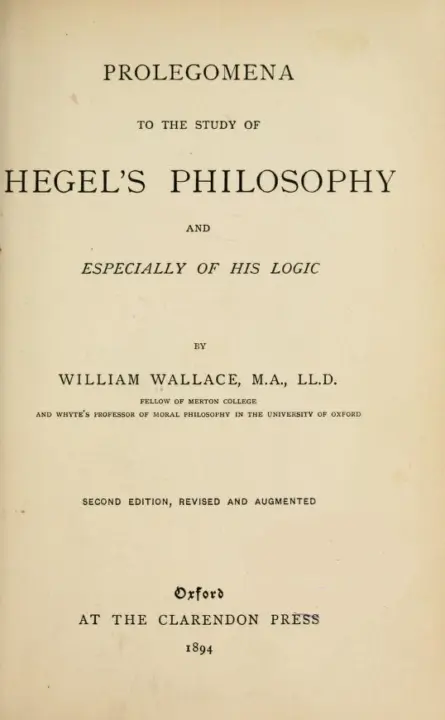
"Prolegomena to the Study of Hegel's Philosophy, and Especially of His Logic" by William Wallace is a philosophical treatise written in the late 19th century. This work serves as an introduction to the complex thought of Hegel, focusing particularly on his concepts of logic and how they relate to broader philosophical inquiries. Wallace aims to clarify and make accessible the often dense and abstract ideas attributed to Hegel, which have elicited varied interpretations and controversies among scholars. The opening of the text presents Wallace's preface, where he details the evolution of his own understanding of Hegel over two decades and outlines the challenges associated with Hegel's philosophy. He argues about the nature of Hegel's writings, contrasting the clarity sought in traditional sciences with the more intricate demands of Hegelian thought. The author acknowledges the difficulties readers face when engaging with Hegel, emphasizing the importance of patience and a willingness to abandon preconceived notions. Wallace highlights the relationship between Hegel's logic and the philosophical landscape of his time, suggesting that understanding Hegel is essential for grasping the evolution of modern philosophy and the responses to Kantian thought.
Introduction adapted from the source catalogue; source summaries may be automatically generated.
Free to read · English · 144,248 words · No account needed
MAKE TIME FOR A GOOD BOOK
On by default. Untick to stop anonymous reading totals. Each page counts after 10 seconds in view. How this works.
Anonymous counting is on unless you have switched it off.
People talk glibly of the Historical Method, and what it has done for us. To hear what is sometimes said it might be supposed that this was the method that had been always habitual in history, but which in these latter days had been applied to other topics, and had proved its value on the new ground by achieving results that had hitherto been mere desiderata. This however is pretty nearly to reverse the true state of the case. It was long till history came to have any method worthy of the name. In most of those who figure as great historians the object had been to tell a good tale, to keep the thread of events distinct, to subordinate incidents to the main issue, to portray personal and public character and its influence on events. History was practised--we may even say--more as an art than as a science. If it dealt with causes, it dealt with individual, concrete, living causes, not with cold, dead abstractions of forces, laws, or tendencies. If it did not altogether ignore the suggestions of a quest for principles to be found in Thucydides and Polybius, it was much more enamoured of the art of Livy and Tacitus, or even of the naïveté of Herodotus. Of such history who has not felt the power; who has not admired the genius that reconstructs the men and circumstances of the past, and makes them live over again their deeds, and again in the end yield the palm to inevitable fate! But it was not from such history that the historical method arose.
The historical method was the product of the new conception of nature and mind in their mutual relations which has been already noted. To estimate the labours of thinkers towards this view of history would be an interesting but complex inquiry. Leibniz in particular by his principles of development, of continuity, of general analogy, should have made two things for ever clear. And these two results that might have been supposed secure were, first, that the present existence (which at first seems to be alone real) is only a narrow transition line between a past and a future,--a line of points intersecting a complex movement or development; and secondly, that all development is of something which is essentially infinite, which requires nothing external, no fillip from circumstances or from an external providence, to set it going, but is in itself a synthesis of active and passive force in a something at least analogous to an Ego. The first principle is embalmed in Leibniz's maxim: 'The present is laden with the past, and full of the future': and the second, in the maxim 'the Monads have no doors or windows.' In virtue of the first, the existent (of this instant) is only a stage or grade, rooted in what has been, and insignificant unless in reference to what is to come. In virtue of the second, all development is from within, and presupposes therefore that the developing individual includes within it a great deal which a cursory view would at first sight assume to be without it, and only accidentally in contact with it. It might indeed be well to add a third principle--what Leibniz has sometimes called the Law of Continuity--the law that, as he says, distinct and noticeable perceptions are the resultants of an infinite number of insensible or little perceptions. But continuity proper is not this: continuity proper or identity is a pure idea. The visible or sensible discontinuity reposes on, and is to be explained by, an invisible or ideal continuity. Each body, for instance, in nature, appearing to have a separate existence of its own, is only a stage isolated or insulated in a continuing process: and that process, binding, as it does, past to future, is the process of a Mind. Omne Corpus, wrote Leibniz in 1671, est mens momentanea seu carens recordatione. Every physical and material object is an intelligence, but an intelligence which neither looks before nor after, but is limited for itself to the mere instant: an intelligence which has no history. Yet to the intelligent observer it has a past,--it has a memory, it bears in it the traces of its antecedent. Yet to read that book of memory, to decipher the 'insensible perceptions' which are buried beneath the momentary present, beneath its unspiritual reality, and to knit present with past and future, is the work of an intelligence, in and to whom the material discloses its store of meaning, or in whom it is re-spiritualised. In other words, the presupposition of this historical method is the ideal continuity of being, transcending and absorbing the differences of time.
Your reading position is saved on this browser. Take it to another device with a library code. Reading pages adapt to text, rather than matching a printed edition.
BEHIND THE BOOK
This eBook is for the use of anyone anywhere in the United States and most other parts of the world at no cost and with almost no restrictions whatsoever. You may copy it, give it away or re-use it under the terms of the Project Gutenberg License included with this eBook or online at www.gutenberg.org. If you are not located in the United States, you will have to check the laws of the country where you are located before using this eBook. Read the source licence.
The original source file, including credits and licence, is retained by this library. Request an original-format copy at no charge. Please include the book title and Project Gutenberg identifier #54992.
KEEP YOUR CURIOSITY GOING
David Patterson (Spirit) Hatch
Coulson Kernahan

Ralph Waldo Emerson
Frances Wright

Edwin Abbott Abbott

Joseph Droz