
Last letters from the living dead man
David Patterson (Spirit) Hatch
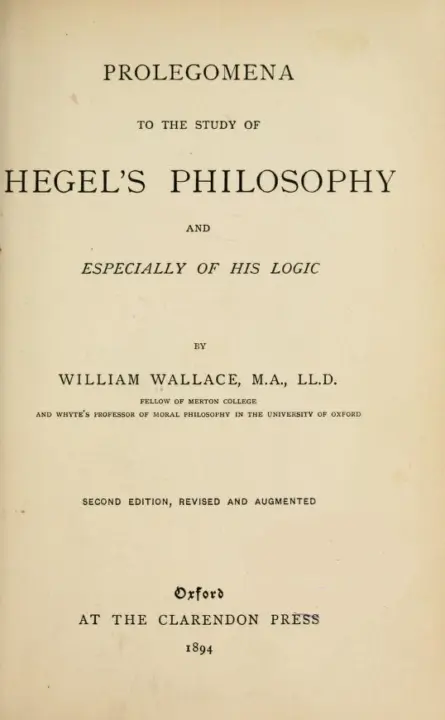
THE CLASSIC COLLECTION · 1812
"Prolegomena to the Study of Hegel's Philosophy, and Especially of His Logic" by William Wallace is a philosophical treatise written in the late 19th century. This work serves as an introduction to the complex thought of Hegel, focusing particularly on his concepts of logic and how they relate to broader philosophical inquiries. Wallace aims to clarify and make accessible the often dense and abstract ideas attributed to Hegel, which have elicited varied interpretations and controversies among scholars. The opening of the text presents Wallace's preface, where he details the evolution of his own understanding of Hegel over two decades and outlines the challenges associated with Hegel's philosophy. He argues about the nature of Hegel's writings, contrasting the clarity sought in traditional sciences with the more intricate demands of Hegelian thought. The author acknowledges the difficulties readers face when engaging with Hegel, emphasizing the importance of patience and a willingness to abandon preconceived notions. Wallace highlights the relationship between Hegel's logic and the philosophical landscape of his time, suggesting that understanding Hegel is essential for grasping the evolution of modern philosophy and the responses to Kantian thought.
Introduction adapted from the source catalogue; source summaries may be automatically generated.
Free to read · English · 144,248 words · No account needed
MAKE TIME FOR A GOOD BOOK
On by default. Untick to stop anonymous reading totals. Each page counts after 10 seconds in view. How this works.
Anonymous counting is on unless you have switched it off.
But, as perhaps may have been apparent, to call this way of thought idealism need not keep us from acknowledging that the same philosophy is also realism. If it insists, so to say, on the idealism of--what we sometimes call material--nature, it no less insists on the realism of--what is supposed immaterial--mind. The mental or spiritual world loses its unsubstantial intangibleness, its mere supposedness, its 'ideal' or merely-ideal character. To the older, and we may say vulgar, view the mind or soul was a mere 'thought,' something of which all that could be seen were certain acts or phenomena. It was a mere idea, which one could pretty well get on without--so long as he kept, as the phrase was, to the phenomena--phenomena without reality. How vague and aery again was the subject-matter of morals! A few virtues and vices, confessedly general descriptive titles, a talk about will and conscience,--all of them merely several predicates of an unknown, spoken of, postulated, but unproducible. Compared with this mere supposedness the spiritual world in Schelling and Hegel acquires the reality of a quasi-organism (really supra-organic), growing and constituting itself, and making room in it for a host of human relationships. The abstract faculties of mind get reality (not indeed sensible): the intangible notions of morals become almost palpable: the kingdom of mind becomes a real pendant to the kingdom of nature. And, on the other hand, the kingdom of nature gets its ideality recognised: its unity and continuity made effective in an Idea which embraces, co-ordinated and systematised, its disparate and unconnected portions.
This new Idealism, if it led men back from the historical world to nature, was yet hardly in all respects a pupil of Rousseau. Not 'Back from civilisation and artificiality to nature and the freedom of the woodland,' was its cry: but rather 'Remember that man always rests on and grows out of nature, always has his ideals made directly or indirectly visible in physical (sensible) structures; and that, when culture turns away from sense and nature to some supposed higher, it is really entering on a path which leads to abysses,' Its voice, in fact, was much like the longing expressed in Schiller's Gods of Greece; it wished man more godlike and the divine more human. But instead of backward,--its motto was forward: or back to nature, only to resume the true starting-point, and retreat from a path of civilisation whose end is perdition. Man also was nature[1]--if he is never mere nature, i. e. the nature unexalted to its truth--but he brought to expression, and might bring to ever clearer and fuller expression, a something which was in infra-human nature, but which nature elsewhere had failed adequately to present. Thus the relation of Man to Nature was apparently twofold. On one hand, the physical world was essentially a world of reason and intelligence--though of intelligence petrified[2]. So far Hegel agreed with Schelling. But, on the other hand (and here Hegel took up the great paradox of Fichte), man's place in the universe is to fulfil the promise and implication of Nature to the full reality of Spirit, to fulfil it by law and morality; but (here he completes Fichte by the help of Schelling) also in higher measure, by art, religion, and science. The world of intelligence and reason which man constructs as an ethical, artistic, and religious being, is the full truth of the natural world,--the higher meaning, and fuller, more consistent, and complete reality of the sensible: and it is so, because the lord of Nature is one with the lord of the human soul. The new way of philosophy therefore, if it could be ever charged with saying that the so-called real things of ordinary life were only ideas, or mental images, meant that, as taken by the unthinking or imperfectly thinking perception, they were something of which all that could be said was to describe their relations to something else, of which in turn the same remark might be made; so that--as far as they went--reality was never with us, but only an assurance (soon to be proved vain) that it was next door[3]. On the contrary--in its use of the term Idea--what this idealism asserted rather was that the objects of Nature in their prima facie apprehension were not yet an Idea: if, i.e., an Idea is a mental or spiritual reality which explains and completes itself, instead of sending us on endless fool's errands elsewhere--, is a concept which is exactly adequate to reality, and has gathered in it the power of reality.
Your reading position is saved on this browser. Take it to another device with a library code. Reading pages adapt to text, rather than matching a printed edition.
BEHIND THE BOOK
This eBook is for the use of anyone anywhere in the United States and most other parts of the world at no cost and with almost no restrictions whatsoever. You may copy it, give it away or re-use it under the terms of the Project Gutenberg License included with this eBook or online at www.gutenberg.org. If you are not located in the United States, you will have to check the laws of the country where you are located before using this eBook. Read the source licence.
The original source file, including credits and licence, is retained by this library. Request an original-format copy at no charge. Please include the book title and Project Gutenberg identifier #54992.
KEEP YOUR CURIOSITY GOING
David Patterson (Spirit) Hatch
Coulson Kernahan

Ralph Waldo Emerson
Frances Wright

Edwin Abbott Abbott

Joseph Droz