
Last letters from the living dead man
David Patterson (Spirit) Hatch
THE CLASSIC COLLECTION · 1812
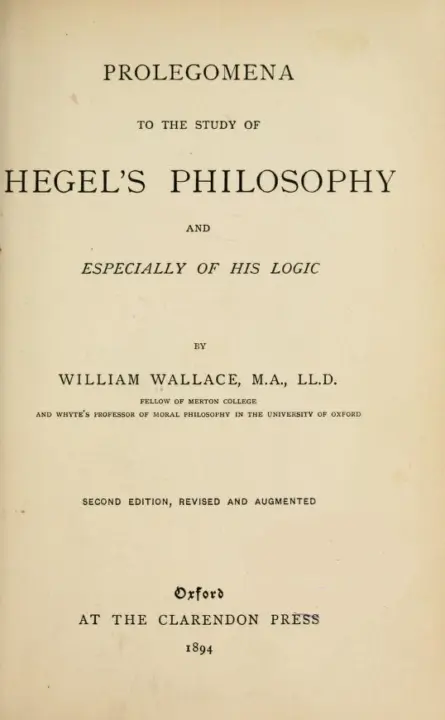
"Prolegomena to the Study of Hegel's Philosophy, and Especially of His Logic" by William Wallace is a philosophical treatise written in the late 19th century. This work serves as an introduction to the complex thought of Hegel, focusing particularly on his concepts of logic and how they relate to broader philosophical inquiries. Wallace aims to clarify and make accessible the often dense and abstract ideas attributed to Hegel, which have elicited varied interpretations and controversies among scholars. The opening of the text presents Wallace's preface, where he details the evolution of his own understanding of Hegel over two decades and outlines the challenges associated with Hegel's philosophy. He argues about the nature of Hegel's writings, contrasting the clarity sought in traditional sciences with the more intricate demands of Hegelian thought. The author acknowledges the difficulties readers face when engaging with Hegel, emphasizing the importance of patience and a willingness to abandon preconceived notions. Wallace highlights the relationship between Hegel's logic and the philosophical landscape of his time, suggesting that understanding Hegel is essential for grasping the evolution of modern philosophy and the responses to Kantian thought.
Introduction adapted from the source catalogue; source summaries may be automatically generated.
Free to read · English · 144,248 words · No account needed
MAKE TIME FOR A GOOD BOOK
On by default. Untick to stop anonymous reading totals. Each page counts after 10 seconds in view. How this works.
Anonymous counting is on unless you have switched it off.
But though poetry and the allied arts of words were very helpful to philosophy--witness the services which, though in widely different ways, Goethe and Schiller rendered to the higher thinking of Germany--even more stimulative and fruitful was the research into nature and history. Nature and history: but they lie closer together than the conjunction suggests. It is true that in recent times we have been forcibly taught to separate civil from natural history, if we have not even been further taught that the latter is an improper application of the term. But when Aristotle said that 'Poetry is more philosophical than History' he was probably not restricting his remark to the story of nations and states; even as when Bacon set history as the field of memory beside the fields of imagination and reasoning, he was not solely referring to the records of the human past. The distinction between natural and civil history is no doubt for practical education a distinction of supreme importance. But it is so, because in this scholastic phase the conception of both, under these comprehensive names, was superficial and abstract. Natural history meant only the classificatory description of animals, plants, and minerals: civil history the tale composed to string together the succession of human actions on the public and national field of life.
We have seen in an earlier chapter the advances which Lessing, Kant, and above all Herder, made in this direction[6]. Emphasising in their several ways the great dictum of Spinoza that human passions, and the whole scheme of human life, are res naturales, quae communes naturae leges sequuntur, they gave to history a higher, more philosophical, more scientific scope than what the name used to connote. Neither in Spinoza himself, nor in these his followers, did this insistence on the unity of nature at all lead them to neglect the difference--almost equivalent, it may be said, in the end to an Imperium in imperio--by which rational man marks himself off to a special kindred with the divine[7]. We have seen too what Schelling did to show that history, if in one aspect it be the product of free human volitions, is, in another and as he thought a superior aspect, the realm subject to a divine or natural necessity. The whole tendency of this epoch of thought--the tendency which entitles it above all to the name of speculative--is its impulse to over-ride this distinction between Nature and History; to over-ride it, however, not in the sense of simply ignoring or denying it, but of carrying it up into a unity which would do justice to both, without exclusively favouring either, and hardly without clipping both of any extravagant claims. The distinction remains,--no longer an abrupt division, but now tempered and mellowed by the presence of a paramount unity. Nature now has a real history: no longer a mere factitious aggregate of classified facts, it is the phenomenon of a 'latent process,' due to a 'latent schematism,' and a 'form' or principle of organisation. Classification does not cease: but it ceases to be an end in itself, and becomes only subordinate or auxiliary to a higher scientific end. The main theme is to construe the complete cycle of life-change and the complete organisation of life-state from the evidence pieced out and put together from the various orders, classes, and species of living creatures. And on the other side the mere tale or narrative of history, with its gossip of personalities, and its accidents of war and intrigue, tends to become insignificant in the presence of the great popular life, in its deep and subtle connexion with agencies of nature hitherto unsurmised, in its dependence upon necessities and uniformities which envelope or rather permeate and constitute the human will. It is not indeed that the force of great personalities has come to be treated as a quantity we may neglect. The force of the great leader, of the genius, of the hero, is not less admirable to the wise philosophical historian to-day than it ever was to his story-telling predecessor. But he flatters himself that he understands better, and can better take account of, the conditions which make the genius and the hero possible. Achilles still counts for more than a thousand common soldiers, and Homer himself is not merely the composite image by which a long tradition has fused into a dim pictorial unity the countless bards who sang for ages on the isles of Greece and the coasts of Ionia. Yet we feel sure that Achilles did what he did, because of the race he sprang from, the inspiration he felt around him, the companionship in body and spirit of his peers. We feel that the hero derives his strength from earth and air, from the spiritual and material substance in which he draws his breath. True, we cannot explain him, as if he and his heroisms were a mere product of mathematical and mechanical forces. But where we once recognise that behind the single visible deed and agent there is a spiritual nature--an underlying agency--which, unperceived, keeps the hearth-fire of public life burning in the celestial temple of Vesta, we can at least see that though genius is a marvel and a mystery, yet it is according to law, and no mere will-o'-the-wisp.
Your reading position is saved on this browser. Take it to another device with a library code. Reading pages adapt to text, rather than matching a printed edition.
BEHIND THE BOOK
This eBook is for the use of anyone anywhere in the United States and most other parts of the world at no cost and with almost no restrictions whatsoever. You may copy it, give it away or re-use it under the terms of the Project Gutenberg License included with this eBook or online at www.gutenberg.org. If you are not located in the United States, you will have to check the laws of the country where you are located before using this eBook. Read the source licence.
The original source file, including credits and licence, is retained by this library. Request an original-format copy at no charge. Please include the book title and Project Gutenberg identifier #54992.
KEEP YOUR CURIOSITY GOING
David Patterson (Spirit) Hatch
Coulson Kernahan

Ralph Waldo Emerson
Frances Wright

Edwin Abbott Abbott

Joseph Droz