THE CLASSIC COLLECTION✦Mendel’s principles of heredity: A defenceCLASSIC FREE BOOKS
Mendel’s principles of heredity: A defence
William Bateson & Gregor Mendel
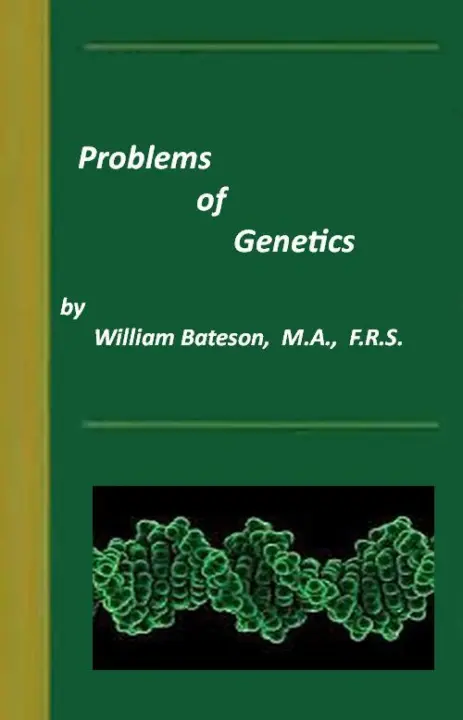
THE CLASSIC COLLECTION · 1913
"Problems of Genetics" by William Bateson is a scientific publication written in the early 20th century. The book explores the foundational concepts of genetics, particularly focusing on the phenomena of variation and heredity through the lens of Mendelian methods. Bateson dives into the critical examination of biological principles, seeking to provide insights on the relationship between genetics and the theory of evolution. At the start of the book, Bateson introduces the context of his lectures, expressing the importance of investigating variation and heredity as crucial components for understanding evolution. He reflects on the historical views on species and varieties, emphasizing the need for more rigorous analysis to overcome the vague definitions that have traditionally surrounded these concepts. By rediscovering Mendel's work, he argues for a systematic inquiry into genetic phenomena, asserting that the regularity and distinctions found in variations can shed light on the fundamental characteristics of living organisms. This opening portion sets the stage for a more detailed discussion of genetic factors and the implications for evolution, inviting readers into a complex yet fascinating discussion of biology.
Introduction adapted from the source catalogue; source summaries may be automatically generated.
Free to read · English · 91,567 words · No account needed
MAKE TIME FOR A GOOD BOOK
On by default. Untick to stop anonymous reading totals. Each page counts after 10 seconds in view. How this works.
Anonymous counting is on unless you have switched it off.
Schröder's second example is not more convincing, in my opinion, though Semon regards it as one of the most important pieces of evidence. It concerns a leaf-rolling moth, Gracilaria stigmatella, the larva of which is said normally to make its house by bending over the tips of the sallow leaves on which it feeds. Schröder placed larvae on leaves from which the tips had been cut, and these larvae made their houses by rolling over the sides of the leaves. Their offspring were again fed on leaves without tips, and as before, they rolled in the leaf-margins either on one side or both. The offspring of this second generation were then fed on entire leaves. There were 19 houses made by these (?19) larvae, and of them 15 were normal, made by folding down the tips of the leaves, while 4 were abnormal, made by rolling in the leaf-margins. Schröder says that in nature he has only twice seen abnormal houses; but it is clearly essential not only that the frequency of such variability in nature should be thoroughly examined, but also that we should know whether when the species is bred in captivity these irregularities of behaviour do or do not occur when the larvae are fed on uninjured leaves.
The famous case of Schübeler's wheat is revived by Semon. The story will be familiar to most readers of the literature of the subject. Briefly it is that annuals, especially wheat and maize, raised from seed in Central Europe take more time in coming to maturity and ripening than similar plants raised in Norway, where the summer days are much longer. The received account is that he imported seed especially of maize and of wheat from Central Europe to Norway and found that in successive years the period of growth and ripening was increasingly reduced. After two generations seed of the accelerated wheat was sent back to Breslau where it was grown, and was found to ripen rather more slowly than in Norway, but much more quickly than the original stock had done. The facts recorded by Schübeler[6] are that he received seed from Eldena, which is on the Baltic near Greifswald. The variety is described as "100 tägiger Sommer Weizen," but no more exact record of its behaviour in Germany is given. This wheat, grown at Christiania in 1857, took 103 days to harvest. Its seed was again grown in Christiania in 1858, and took 93 days, and sown again in 1859 it took only 75 days, 28 days less than in the first year of cultivation in Norway. Seed of the 1858 crop was sent to Breslau, and grown there by Roedelius in 1859; it took 80 days. Evidently before such a record can be used as proving an inheritance of acquired characters numbers of particulars should be forthcoming. The view that Johannsen has taken is that the result was probably due to unconscious selection of the earlier individuals among a population consisting of many types of various compositions. Some effect may no doubt be ascribed to that cause, but I cannot think that alone it would account for the results. My impression is rather that they were produced by differences in the cultivation and especially in the seasons. Research of an elaborate character would be necessary in order to eliminate the various sources of error, and nothing of the kind has been done; nor does Semon allude to these difficulties in prominently adducing Schübeler's evidence. A difference of even three weeks in time of harvesting may easily be due to variation in the season. It would in any case be difficult to analyse the meteorological conditions, and to decide how much effect in postponing or accelerating the harvest might be due to cold days, to cloudy days, to wet weather, to fluctuations in average temperature, to hot days, and other such incidents occurring at the different periods of growth, even if they were specially watched while the experiments were in progress, and at this distance of time such analysis is practically impossible. Without careful simultaneous control-experiments this evidence is almost worthless. The director of the Meteorological Office[7] has, however, kindly sent me some details of the weather at Breslau from 1857 to 1860, and I notice that as a matter of fact July, 1859, was an exceptionally hot month, having an average of 2.67° C. above the mean for the twenty years 1848-1867. June in that year was slightly (0.31° C.) below the mean and May slightly above it (0.18° C.). August was also abnormally hot, 2.35° C. above the average. The Breslau wheat was sown on May 19 and harvested on August 6. There was a cold spell from May 11 to 14, which this wheat escaped, as it was sown on May 19. In the other years the cold spell came much later. These elements of the weather may possibly have done something to hurry the ripening in 1859. It unfortunate that we are not told how long similar wheat from Breslau seed took to ripen in that year.
Your reading position is saved on this browser. Take it to another device with a library code. Reading pages adapt to text, rather than matching a printed edition.
BEHIND THE BOOK
This eBook is for the use of anyone anywhere in the United States and most other parts of the world at no cost and with almost no restrictions whatsoever. You may copy it, give it away or re-use it under the terms of the Project Gutenberg License included with this eBook or online at www.gutenberg.org. If you are not located in the United States, you will have to check the laws of the country where you are located before using this eBook. Read the source licence.
The original source file, including credits and licence, is retained by this library. Request an original-format copy at no charge. Please include the book title and Project Gutenberg identifier #44582.
KEEP YOUR CURIOSITY GOING

John Muir

Asa Gray
Asa Gray

Florence Nightingale
Elizabeth Robins Pennell
Denison Olmsted