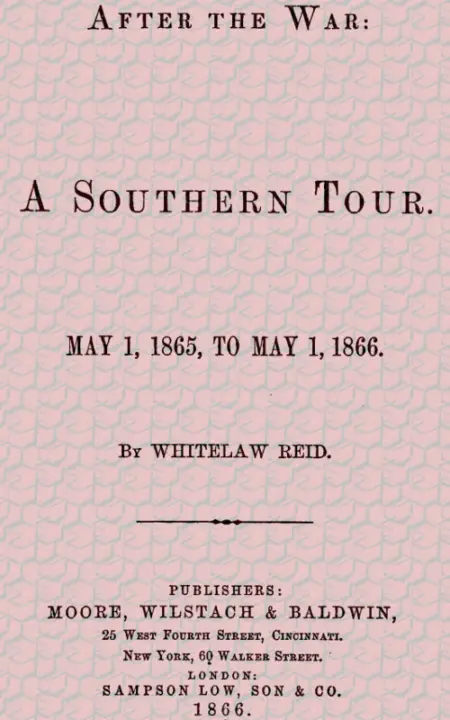
After the War: A Southern Tour. May 1, 1865 to May 1, 1866
Whitelaw Reid
THE CLASSIC COLLECTION · 1898
"Problems of Expansion" by Whitelaw Reid is a collection of political essays and addresses written in the late 19th century. The work predominantly discusses the implications of America's territorial gains following the Spanish-American War, notably focusing on Cuba, Puerto Rico, and the Philippines. Reid articulates the responsibilities and challenges associated with American expansionism, emphasizing the moral and strategic obligations of the United States in maintaining control over these newly acquired territories. The opening of the book provides a broad context for the discussions to follow, reflecting on the national debate surrounding the acquisition of territories from Spain. It introduces concerns about the future governance of these lands, the ethical considerations of American intervention, and the constitutional implications of potential statehood for the inhabitants of these territories. Reid poses fundamental questions about the responsibilities the United States has toward the people of the acquired lands and insists on a national duty to establish a civilized and just government in the regions from which Spain has been expelled. His arguments set the stage for a thorough examination of America's evolving role as a global power in the wake of the war.
Introduction adapted from the source catalogue; source summaries may be automatically generated.
Free to read · English · 59,033 words · No account needed
MAKE TIME FOR A GOOD BOOK
On by default. Untick to stop anonymous reading totals. Each page counts after 10 seconds in view. How this works.
Anonymous counting is on unless you have switched it off.
They were able to base a stronger claim on the precedents of the New World. They were, indeed, betrayed into some curious errors. One was that the thirteen original States, at the close of the Revolutionary War, paid over to Great Britain fifteen million pounds as their share of the public debt. Another was that the payment of the Texas debt by the United States must be a precedent now for its payment of the Cuban debt--whereas the Texas debt was incurred by the Texas insurgents in their successful war for independence, while the Cuban debt was incurred by the mother country in her unsuccessful effort to put down the Cuban insurgents. But as to the Spanish-American republics, they were more nearly on solid ground. It was true, and was more to the point than most of their other citations, that every one of these Spanish-American republics assumed its debt, that most of them did it before their independence was recognized, and that they gave these debts contracted by Spain the preference over later debts contracted by themselves. The language in the treaty with Bolivia was particularly sweeping. It assumed as its own these debts of every kind whatsoever, "including all incurred for pensions, salaries, supplies, advances, transportation, forced loans, deposits, contracts, and any other debts incurred during war-times or prior thereto, chargeable to said treasuries; provided they were contracted by direct orders of the Spanish government or its constituted authorities in said territories." The Argentine Republic and Uruguay, in negotiating their treaties, expressed the same idea more tersely: "Just as it acquires the rights and privileges belonging to the crown of Spain, so it also assumes all the duties and obligations of the crown."
The argument was certainly obvious, and at first sight seemed fair, that what every other revolted American colony of Spain had done, on gaining its independence, the last of the long line should also do. But an examination shows that in no case were the circumstances such as to make it a fair precedent for Cuba. In the other colonies the debts were largely due to their own people. To a considerable extent they had been incurred for the prosecution of improvements of a pacific character, generally for the public good and often at the public desire. Another part had been spent in the legitimate work of preserving public order and extending the advantages of government over wild regions and native tribes.[3] The rich, compact, populous island of Cuba had called for no such loans up to the time when Spain had already lost all of her American colonies on the continent, and had consequently no other dependency on which to fasten her exacting governor-generals and hosts of other official leeches. There was no Cuban debt. Any honest administration had ample revenues for all legitimate expenses, and a surplus; and this surplus seems not to have been used for the benefit of the island, but sent home. Between 1856 and 1861 over $20,000,000 of Cuban surplus were thus remitted to Madrid. Next began a plan for using Cuban credit as a means of raising money to re-conquer the lost dominions; and so "Cuban bonds" (with the guaranty of the Spanish nation) were issued, first for the effort to regain Santo Domingo, and then for the expedition to Mexico. By 1864 $3,000,000 had been so issued; by 1868 $18,000,000--not at the request or with the consent of the Cubans, and not for their benefit. Then commenced the Cuban insurrection; and from that time on, all Spain could wring from Cuba or borrow in European markets on the pledge of Cuban revenues and her own guaranty went in the effort to subdue a colony in revolt against her injustice and bad government. The lenders knew the facts and took the risk. Two years after this first insurrection was temporarily put down, these so-called Cuban debts had amounted to over $170,000,000. They were subsequently consolidated into other and later issues; but whatever change of form or date they underwent, they continued to represent practically just three things: the effort to conquer Santo Domingo, the expedition to Mexico, and the efforts to subdue Cuba. A movement to refund at a lower rate of interest was begun in 1890, and for this purpose an issue of $175,000,000 of Spanish bonds was authorized, to be paid out of the revenues of Cuba, but with the guaranty of the Spanish nation. Before many had been placed the insurrection had again broken out. Thenceforward they were used not to refund old bonds, but to raise money for the prosecution of the new war. Before its close this indebtedness had been swollen to over double the figure named above, and a part of the money must have been used directly in the war against the United States.
Your reading position is saved on this browser. Take it to another device with a library code. Reading pages adapt to text, rather than matching a printed edition.
BEHIND THE BOOK
This eBook is for the use of anyone anywhere in the United States and most other parts of the world at no cost and with almost no restrictions whatsoever. You may copy it, give it away or re-use it under the terms of the Project Gutenberg License included with this eBook or online at www.gutenberg.org. If you are not located in the United States, you will have to check the laws of the country where you are located before using this eBook. Read the source licence.
The original source file, including credits and licence, is retained by this library. Request an original-format copy at no charge. Please include the book title and Project Gutenberg identifier #26064.
KEEP YOUR CURIOSITY GOING

David Patterson (Spirit) Hatch

David Patterson (Spirit) Hatch

David Patterson (Spirit) Hatch
Cécile Tormay

Moritz Busch
John L. Ransom