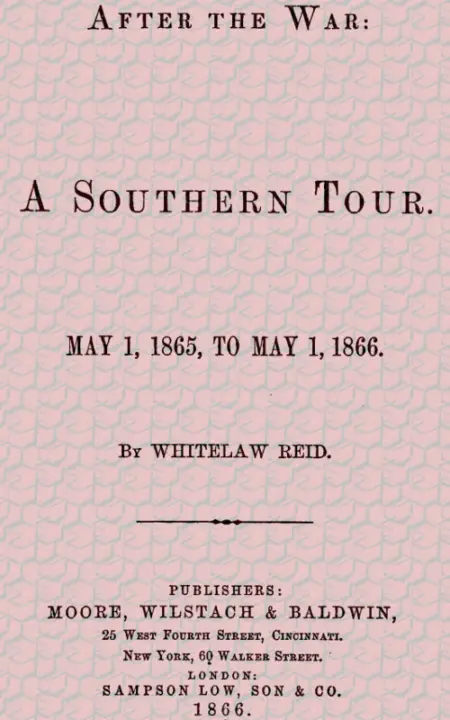
After the War: A Southern Tour. May 1, 1865 to May 1, 1866
Whitelaw Reid
THE CLASSIC COLLECTION · 1898
"Problems of Expansion" by Whitelaw Reid is a collection of political essays and addresses written in the late 19th century. The work predominantly discusses the implications of America's territorial gains following the Spanish-American War, notably focusing on Cuba, Puerto Rico, and the Philippines. Reid articulates the responsibilities and challenges associated with American expansionism, emphasizing the moral and strategic obligations of the United States in maintaining control over these newly acquired territories. The opening of the book provides a broad context for the discussions to follow, reflecting on the national debate surrounding the acquisition of territories from Spain. It introduces concerns about the future governance of these lands, the ethical considerations of American intervention, and the constitutional implications of potential statehood for the inhabitants of these territories. Reid poses fundamental questions about the responsibilities the United States has toward the people of the acquired lands and insists on a national duty to establish a civilized and just government in the regions from which Spain has been expelled. His arguments set the stage for a thorough examination of America's evolving role as a global power in the wake of the war.
Introduction adapted from the source catalogue; source summaries may be automatically generated.
Free to read · English · 59,033 words · No account needed
MAKE TIME FOR A GOOD BOOK
On by default. Untick to stop anonymous reading totals. Each page counts after 10 seconds in view. How this works.
Anonymous counting is on unless you have switched it off.
Upon the conclusion and signing of this protocol, hostilities between the two countries shall be suspended, and notice to that effect shall be given as soon as possible by each Government to the commanders of its military and naval forces.
Done at Washington in duplicate, in English and in French, by the undersigned, who have hereunto set their hands and seals the twelfth day of August, 1898.
(Seal) WILLIAM R. DAY.
(Seal) JULES CAMBON.
Negotiations begun in Paris, October 1, 1898. Treaty signed in Paris, 8:45 P.M., December 10. Delivered by United States Commissioners to the President, December 24; transmitted to the Senate with the official report of the negotiations, January 4, 1899; ratified by Senate in executive session, February 6, by a vote of 57 against 27. Formal exchange of ratifications at Washington, April 11. Twenty millions paid through Jules Cambon, May 1. Treaty ratified by Spanish Senate, July 3, 1899.
The United States of America and Her Majesty the Queen Regent of Spain, in the name of her august son, Don Alfonso XIII, desiring to end the state of war now existing between the two countries, have for that purpose appointed as plenipotentiaries:
The President of the United States,
William R. Day, Cushman K. Davis, William P. Frye, George Gray, and Whitelaw Reid, citizens of the United States;
And Her Majesty the Queen Regent of Spain,
Don Eugenio Montero Rios, President of the Senate; Don Buenaventura de Abarzuza, Senator of the Kingdom and ex-Minister of the Crown; Don Jose de Garnica, Deputy to the Cortes and Associate Justice of the Supreme Court; Don Wenceslao Ramirez de Villa Urrutia, Envoy Extraordinary and Minister Plenipotentiary at Brussels; and Don Rafael Cerero, General of Division;
Who, having assembled in Paris and having exchanged their full powers, which were found to be in due and proper form, have, after discussion of the matters before them, agreed upon the following articles:
Article I. Spain relinquishes all claim of sovereignty over and title
to Cuba.
And as the island is, upon its evacuation by Spain, to be occupied by the United States, the United States will, so long as such occupation shall last, assume and discharge the obligations that may under international law result from the fact of its occupation for the protection of life and property.
Article II. Spain cedes to the United States the island of Porto Rico and other islands now under Spanish sovereignty in the West Indies, and the island of Guam, in the Marianas or Ladrones.
Article III. Spain cedes to the United States the archipelago known as the Philippine Islands, and comprehending the islands lying within the following lines:
Your reading position is saved on this browser. Take it to another device with a library code. Reading pages adapt to text, rather than matching a printed edition.
BEHIND THE BOOK
This eBook is for the use of anyone anywhere in the United States and most other parts of the world at no cost and with almost no restrictions whatsoever. You may copy it, give it away or re-use it under the terms of the Project Gutenberg License included with this eBook or online at www.gutenberg.org. If you are not located in the United States, you will have to check the laws of the country where you are located before using this eBook. Read the source licence.
The original source file, including credits and licence, is retained by this library. Request an original-format copy at no charge. Please include the book title and Project Gutenberg identifier #26064.
KEEP YOUR CURIOSITY GOING

David Patterson (Spirit) Hatch

David Patterson (Spirit) Hatch

David Patterson (Spirit) Hatch
Cécile Tormay

Moritz Busch
John L. Ransom