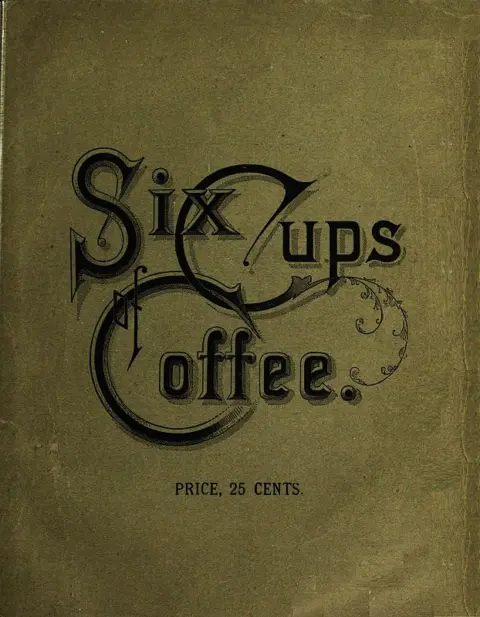
Six Cups of Coffee Prepared for the Public Palate by the Best Authorities on Coffee Making
Maria Parloa & Helen Campbell & Juliet Corson & Marion Harland & Mary J. (Mary Johnson) Lincoln & Catherine Owen & Hester M. (Hester Martha) Poole
THE CLASSIC COLLECTION · 1887
"Prisoners of Poverty: Women Wage-Workers, Their Trades and Their Lives" by Helen Campbell is a social investigation written in the late 19th century. The volume is a detailed account that sheds light on the working conditions and struggles of women employed in various trades, particularly in New York City. Campbell aims to uncover the plight and systemic injustices faced by these working women, seeking to provide an understanding of their lives and the socioeconomic factors influencing their situation. The opening of the book sets the stage for Campbell's exploration by presenting a preface that explains her methodology, which includes personal research and interviews with workers. She introduces the stark realities of poverty that women face, outlining how many are forced to accept inadequate wages in overcrowded and unsanitary conditions due to a lack of options. Campbell emphasizes the importance of understanding these working conditions in order to initiate genuine change, framing the struggles of characters like Rose Haggerty, a young girl who assumes the weight of familial responsibilities amidst harsh employment practices that ultimately lead her to despair. The text presents a vivid cross-section of society where grinding poverty collides with the often invisible labor of women, setting a critical tone for the chapters to follow.
Introduction adapted from the source catalogue; source summaries may be automatically generated.
Free to read · English · 67,915 words · No account needed
MAKE TIME FOR A GOOD BOOK
On by default. Untick to stop anonymous reading totals. Each page counts after 10 seconds in view. How this works.
Anonymous counting is on unless you have switched it off.
Here and there the conditions of this form of labor are of the best, but as a whole the saleswoman suffers not only from long-continued standing, but from bad air, ventilation having no place in the construction of the ordinary store. Separate dressing-rooms are a necessity, yet are only occasionally found, the system demanding that no outlay shall be made when it is possible to avoid it. Overheating and overcrowding, hastily eaten and improper food, are all causes of the weakness and anæmic condition so perceptible among shop and factory workers, these being divided into many classes. For a large proportion it can be said that they are tolerably educated, so far as our public-school system can be said to educate, and are hard-working, self-sacrificing, patient girls who have the American knack of dressing well on small outlay, and who have tastes and aspirations far beyond any means of gratifying them. For such girls the working-women's guilds and the Friendly societies--these last of English origin--have proved of inestimable service, giving them the opportunities long denied. In such guilds many of them receive the first real training of eye and hand and mind, learn what they can best do, and often develop a practical ability for larger and better work. Even in the lowest order filling the cheaper stores there is always a proportion eager to learn. But here, as in all ordinary methods of learning, the market is overstocked, and even the best-trained girl may sometimes fail of employment. Now and then one turns toward household service, but the mass prefer any cut in wages and any form of privation to what they regard as almost a final degradation. A multitude of their views on this point are recorded and will in time find place.
In the mean time a minute examination of the causes that determine their choice and of the conditions surrounding it as a whole go to prove the justice of the conviction that penetrates the student of social problems. Again, the shop-girl as a class demonstrates the fact that not with her but with the class above her, through accident of birth or fortune, lies the real responsibility for the follies over which we make moan. The cheaper daily papers record in fullest detail the doings of that fashionable world toward which many a weak girl or woman looks with unspeakable longing; and the weekly "story papers" feed the flame with unending details of the rich marriage that lifted the poor girl into the luxury which stands to her empty mind as the sole thing to be desired in earth or heaven. She knows far better what constitutes the life of the rich than the rich ever know of the life of the poor. From her post behind the counter the shop-girl examines every detail of costume, every air and grace of these women whom she despises, even when longing most to be one of them. She imitates where she can, and her cheap shoe has its French heel, her neck its tin dog-collar. Gilt rings and bracelets and bangles, frizzes and bangs and cheap trimmings of every order, swallow up her earnings. The imitation is often more effective than the real, and the girl knows it. She aspires to a "manicure" set, to an opera-glass, to anything that will simulate the life daily more passionately desired; and it is small wonder that when sudden temptation comes and the door opens into that land where luxury is at least nearer, she falls an easy victim. The class in which she finally takes rank is seldom recruited from sources that would seem most fruitful. The sewing-woman, the average factory worker, is devitalized to such an extent that even ambition dies and the brain barely responds to even the allurements of the weekly story paper. It is the class but a grade removed, to whom no training has come from which strength or simplicity or any virtue of honest living could grow, that makes the army of women who have chosen degradation.
Your reading position is saved on this browser. Take it to another device with a library code. Reading pages adapt to text, rather than matching a printed edition.
Maria Parloa & Helen Campbell & Juliet Corson & Marion Harland & Mary J. (Mary Johnson) Lincoln & Catherine Owen & Hester M. (Hester Martha) Poole
Helen Campbell
Helen Campbell
BEHIND THE BOOK
This eBook is for the use of anyone anywhere in the United States and most other parts of the world at no cost and with almost no restrictions whatsoever. You may copy it, give it away or re-use it under the terms of the Project Gutenberg License included with this eBook or online at www.gutenberg.org. If you are not located in the United States, you will have to check the laws of the country where you are located before using this eBook. Read the source licence.
The original source file, including credits and licence, is retained by this library. Request an original-format copy at no charge. Please include the book title and Project Gutenberg identifier #34060.
KEEP YOUR CURIOSITY GOING
Cécile Tormay

Moritz Busch
John L. Ransom
Frances Wright
Cécile Tormay

Mabel Potter Daggett