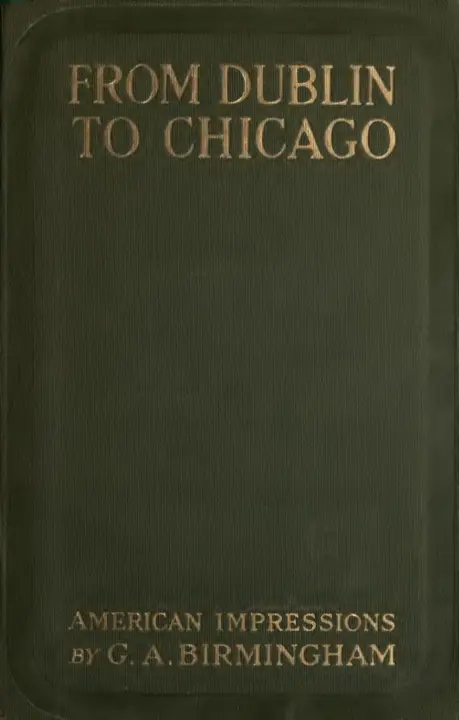
From Dublin to Chicago: Some Notes on a Tour in America
George A. Birmingham
THE CLASSIC COLLECTION · 1912
"Priscilla's Spies" by George A. Birmingham is a novel written in the early 20th century. The story begins in a setting of English public school life, focusing on the character of Frank Mannix, a celebrated student returning from a successful school term, and his cousin Priscilla, a spirited girl with a determined attitude. The opening chapters suggest themes of youth, adventure, and perhaps an exploration of societal expectations, particularly as both characters navigate the complexities of family relationships and personal ambitions. At the start of the novel, Frank Mannix is hailed as a hero for his achievements in sports at his school, which leads to an excited departure for the summer holidays. However, his journey takes a turn when he gets involved in an accident on the way to visit his uncle, resulting in a sprained ankle. Meanwhile, his cousin Priscilla is introduced as a lively and independent character, determined to take matters into her own hands. The narrative hints at an adventure as they plan to explore the bay, with Priscilla playfully suggesting they may even be hunting down a German spy. This mix of light-hearted banter and impending adventure sets the tone for the unfolding story, indicating that the novel will blend humor with elements of mystery and youthful escapades.
Introduction adapted from the source catalogue; source summaries may be automatically generated.
Free to read · English · 75,723 words · No account needed
MAKE TIME FOR A GOOD BOOK
On by default. Untick to stop anonymous reading totals. Each page counts after 10 seconds in view. How this works.
Anonymous counting is on unless you have switched it off.
“That’s the wrong tack altogether,” said Lord Torrington. “Isabel would never think of going in a boat. I tell you she can’t row.”
“Now, Frank,” said Sir Lucius, “did you see or hear anything of her?”
Frank would have liked very much to deny that he had seen any lady. His dislike of Lord Torrington was strong in him. He had been snubbed in the train, injured while leaving the steamer, and actually insulted that very afternoon. He felt, besides, the strongest sympathy with any daughter who ran away from a home ruled by Lord and Lady Torrington. But he had been asked a straight question and it was not in him to tell a lie deliberately.
“We did meet a lady,” he said, “in fact we lunched with her today, but her name was Rutherford.”
“Was she rowing about alone in a boat?” said Lord Torrington.
“She had a boy to row her,” said Frank. “She’d hired the boat. She said she came from the British Museum and was collecting sponges.”
“Sponges!” said Sir Lucius. “How could she collect sponges here, and what does the British Museum want sponges for?”
“They weren’t exactly sponges,” said Frank, “they were zoophytes.”
“It’s just possible,” said Lord Torrington, “that she might--Sponges, you say? I don’t know what would put sponges into her head. But, of course, she had to say something. What was she like to look at?”
“She had a dark blue dress,” said Frank, “and was tallish.”
“Fuzzy fair hair?” said Lord Torrington.
“I don’t remember her hair.”
“Slim?”
“I’d call Miss Rutherford fat,” said Frank. “At least, she’s decidedly
stout.”
“Not her,” said Lord Torrington. “Nobody could call Isabel fat. That police sergeant of yours is a fool, Lentaigne. I always said he was. If Isabel is in this neighbourhood at all she’s living in some country inn.”
“The sergeant said he’d make inquiries about the lady he mentioned,” said Sir Lucius. “We shall hear more about her tomorrow.”
“She had a Primus stove with her,” said Frank.
“That’s no help,” said Lord Torrington. “Anybody might have a Primus
stove.”
“She said she’d borrowed it from Professor Wilder,” said Frank.
“Who the devil is Professor Wilder?”
“He’s doing the rotifers,” said Frank. “At least Miss Rutherford said he was. I don’t know who he is.”
“That’s not Isabel,” said Lord Torrington. “She wouldn’t have the intelligence to invent a professor who collected rotifers. I don’t suppose she ever heard of rotifers. I never did. What are they?”
Your reading position is saved on this browser. Take it to another device with a library code. Reading pages adapt to text, rather than matching a printed edition.
George A. Birmingham
George A. Birmingham
George A. Birmingham
George A. Birmingham
BEHIND THE BOOK
This eBook is for the use of anyone anywhere in the United States and most other parts of the world at no cost and with almost no restrictions whatsoever. You may copy it, give it away or re-use it under the terms of the Project Gutenberg License included with this eBook or online at www.gutenberg.org. If you are not located in the United States, you will have to check the laws of the country where you are located before using this eBook. Read the source licence.
The original source file, including credits and licence, is retained by this library. Request an original-format copy at no charge. Please include the book title and Project Gutenberg identifier #21394.
KEEP YOUR CURIOSITY GOING
Coulson Kernahan

Maurice Baring
Frances Wright
Cécile Tormay

Frederic Jesup Stimson

W. H. P. (William Henry Pope) Jarvis