THE CLASSIC COLLECTION✦The intelligence of invertebrate animalsCLASSIC FREE BOOKS
The intelligence of invertebrate animals
Maynard Shipley
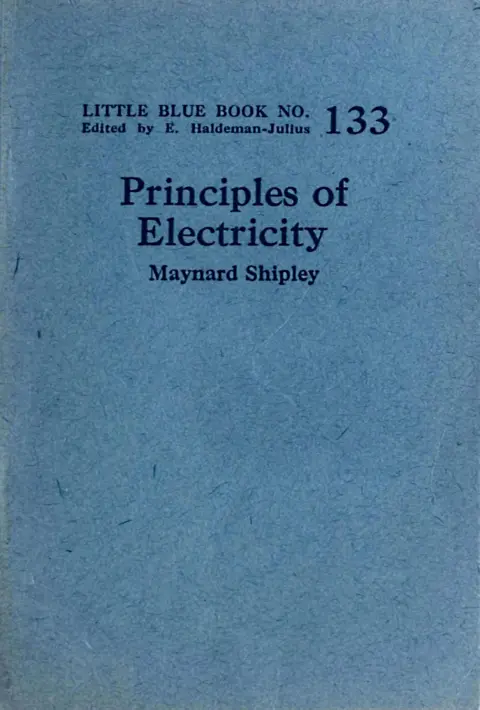
THE CLASSIC COLLECTION · 1925
"Principles of Electricity" by Maynard Shipley is a scientific publication written during the early 20th century. This book aims to explain the fundamental principles of electricity and magnetism, exploring concepts from basic definitions to the relationships between various electrical phenomena and their historical context. In the book, Shipley begins with a clear definition of electricity and its nature as a form of energy. He discusses the historical perspectives of early philosophers and scientists like Thales and Faraday, tracing the development of theories relating to electricity and magnetism. Key concepts covered include electrostatics, magnetic phenomena, and the pioneering experiments that led to the advancement of wireless telegraphy, ultimately explaining how electricity functions and its various applications. The text also delves into the contributions made to electromagnetic theory by notable figures from history while addressing contemporary understanding—and ongoing questions—about the nature of electricity.
Introduction adapted from the source catalogue; source summaries may be automatically generated.
Free to read · English · 14,751 words · No account needed
MAKE TIME FOR A GOOD BOOK
On by default. Untick to stop anonymous reading totals. Each page counts after 10 seconds in view. How this works.
Anonymous counting is on unless you have switched it off.
The lamented Dr. P. S. Epstein, a gifted pupil of Sommerfeld, who—like Mosely—fell a martyr to the World War, succeeded in applying the quantum dynamics to the Stark effect, whereby the motions of the electron in producing the H-beta (in the blue-green) and H-gamma (in the violet) lines observed, “are accounted for with great accuracy” (Loring, “Atomic Theories,” Page 67).
It may be said in conclusion, that the most promising attempts fully to explain the phenomena of the Zeeman and Stark effects seem to be made from the point of view of Planck’s Quantum Theory of Light. On the other hand, it must be admitted that there has not been, so far as I can ascertain, any theory proposed which explains all of the phenomena involved.
[23] For a good summary of the main results concerning the Zeeman effect, see von Auerbach, Felix, “Moderne Magnetik,” Leipsic, 1921. An excellent account of the quantum treatment of the Zeeman effect may be found in Chapter XV (Series Spectra) of Dr. N. R. Campbell’s “Modern Electrical Theory, Supplementary Chapters,” Cambridge University Press, 1921.
[24] It seems that this phenomenon had previously been observed by M. Fievez. (Cf. Michelson, Dr. Albert A., “Light Waves and Their Uses,” Page 107.) “He thought that each separate line was doubled or quadrupled.” Lockyer, in 1866, observed that some of the lines in a sun spot spectrum were widened. Prof. Charles Young and W. M. Mitchell observed that some of the lines were even double, but it was not suspected that these phenomena were caused by a strong magnetic field in sun-spots, brought about by free electrons being driven around in a vortex movement. In fact, Mitchell referred to the doublets as “reversals.”
[25] Zeeman, “Les Lignes Spectrales et les Theories Modernes,” Scientia, January 1, 1921, Page 18 (Vol. XIX, No. CV—I).
[26] Hale, “Ten Years Work of a Mountain Observatory,” Pages 29-30, Washington, D. C. (Carnegie Institution of Washington), 1915. See also, Babcock, Harold D., “The Zeeman Effect for Chromium,” Contributions from Mount Wilson Observatory, Vol. II, Paper No. 52; also “The Correspondence between Zeeman Effect and Pressure Displacement for the Spectra of Iron, Chromium and Titanium,” Arthur S. King, Loc. cit., Paper No. 46; and “The Zeeman Effect on the Sun,” Adriaan van Maanen, Publications of the Astronomical society of the Pacific, Page 24, Vol. XXXIV, No. 197 (February, 1922).
[27] Zeeman, Loc. cit., Page 18. See also the classical
monograph by the same author, “Researches in Magneto-Optics,” London,
1913.
[28] Millikan, Physical Review, 2, 143 (1913); “The Electron,” 1917 (revised edition, 1924). See also, Proceedings of the National Academy of Sciences, 3, 314 (1917).
[29] “The New Heavens,” Page 70, New York, 1922.
[30] Cf. Stark, “Die Atomionen chemischere Elemente und ihre Kanastrahlenspektra,” Berlin, 1913. See also, “Elektrische Spektralanalyse chemischen Atome,” Leipsic, 1914.
Your reading position is saved on this browser. Take it to another device with a library code. Reading pages adapt to text, rather than matching a printed edition.
Maynard Shipley
Maynard Shipley
Maynard Shipley
Maynard Shipley
BEHIND THE BOOK
This eBook is for the use of anyone anywhere in the United States and most other parts of the world at no cost and with almost no restrictions whatsoever. You may copy it, give it away or re-use it under the terms of the Project Gutenberg License included with this eBook or online at www.gutenberg.org. If you are not located in the United States, you will have to check the laws of the country where you are located before using this eBook. Read the source licence.
The original source file, including credits and licence, is retained by this library. Request an original-format copy at no charge. Please include the book title and Project Gutenberg identifier #75464.
KEEP YOUR CURIOSITY GOING

John Muir

Asa Gray
Asa Gray

Florence Nightingale
Elizabeth Robins Pennell
Denison Olmsted