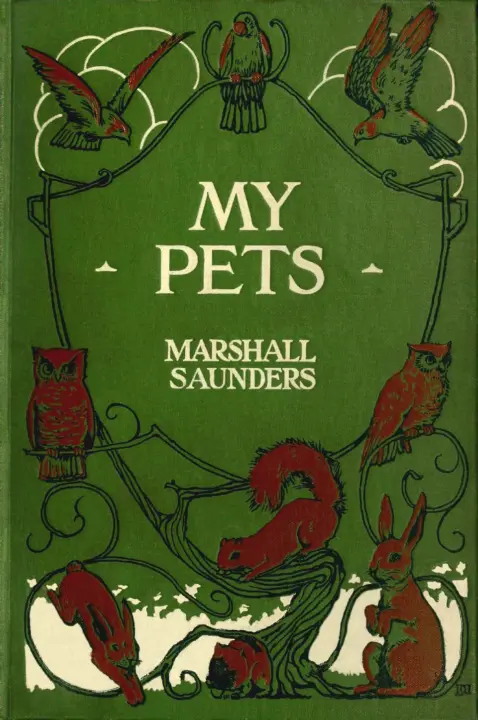
My pets
Marshall Saunders
THE CLASSIC COLLECTION · 1905
"Princess Sukey: The story of a pigeon and her human friends" by Marshall Saunders is a children's novel written in the early 20th century. The story revolves around Princess Sukey, a Jacobin pigeon who begins her life frail and abandoned but is rescued by a boy named Titus Sancroft. The book explores themes of compassion and friendship through the bond between the pigeon and her human companions, particularly focusing on how they navigate their troubles together. The opening of the story introduces Princess Sukey as she dreams by the fire, reflecting on her past and the series of events that led her to her new home. As a sickly chick, she is discarded by her father and nearly left to die when she is discovered by young Titus, who insists on saving her. Supported by a comical series of interactions with Titus, his grandfather Judge Sancroft, and the household staff, the narrative sets the stage for the unfolding relationship between the characters and Princess Sukey. It hints at the themes of kindness toward animals and the emotional journeys of both the boy and the bird as they cope with life’s challenges. The beginnings of friendship and the contrast between wealth and poverty become apparent, suggesting a rich layering of narrative to come.
Introduction adapted from the source catalogue; source summaries may be automatically generated.
Free to read · English · 84,299 words · No account needed
MAKE TIME FOR A GOOD BOOK
On by default. Untick to stop anonymous reading totals. Each page counts after 10 seconds in view. How this works.
Anonymous counting is on unless you have switched it off.
They went upstairs together, and Dr. Reynald, after giving a sharp glance round his patient’s room, went to the windows and pulled back the curtains. Then he sat down by the bed and fixed his bright, gray eyes on the boy.
Dallas became a more furious red than ever under his glance, and when the doctor said, “Let me feel your pulse,” he half hesitated.
Dr. Reynald, however, gave a peremptory tap on the bedclothes, and the
boy put out his hand.
It was only detained a short time. The doctor bent over him, passed a hand over his forehead, whispered a question, to which the boy gave a reluctant reply, then, getting up, he nodded to the Judge and went out of the room, followed by an ashamed, despairing glance from his patient.
The Judge took him in his study and shut the door. “Nothing dangerous, I hope; not smallpox, for example.”
“Worse than that,” replied Dr. Reynald, shortly.
“Worse? What can it be?”
“A touch of moral leprosy—the boy is shamming.”
“Shamming!” exclaimed the Judge.
“Yes. I don’t know the reason; perhaps you can tell me.”
“He looks sick,” said the Judge, uneasily. “I don’t want to distrust your word, but is it possible that you are mistaken?”
“Not possible. We sometimes have such cases at the hospital. Then I made him confess himself that he was. Tell me something about this boy.”
The Judge immediately told him all that he knew, and he had only uttered a few sentences when he became convinced that Dr. Reynald was right.
“It’s the old, old story,” he said, when he had finished what he knew of Dallas’s antecedents. “I ought to know it better than most people. It is easier to do wrong than to do right.”
Dr. Reynald smiled. “Yes, you ought to know; and yet I envy you your beautiful faith in human nature which you have kept, in spite of your profession.”
“God knows I have tried to hold on to it,” said the Judge, earnestly. “I would be willing to lie down and die if for a moment I gave up my belief that there is good in every human heart.”
“This is not a heinous case,” said Dr. Reynald. “In fact, it is rather flattering. That storm-tossed lad finds this a quiet haven. He dreads to leave it.”
“But his duplicity,” said the Judge. “I must be severe with him for that. Now, evidently last evening when I told him he must leave he was much shocked. Yet he hid his real feelings.”
Your reading position is saved on this browser. Take it to another device with a library code. Reading pages adapt to text, rather than matching a printed edition.
Marshall Saunders
Marshall Saunders
Marshall Saunders
Marshall Saunders
BEHIND THE BOOK
This eBook is for the use of anyone anywhere in the United States and most other parts of the world at no cost and with almost no restrictions whatsoever. You may copy it, give it away or re-use it under the terms of the Project Gutenberg License included with this eBook or online at www.gutenberg.org. If you are not located in the United States, you will have to check the laws of the country where you are located before using this eBook. Read the source licence.
The original source file, including credits and licence, is retained by this library. Request an original-format copy at no charge. Please include the book title and Project Gutenberg identifier #69707.
KEEP YOUR CURIOSITY GOING
Coulson Kernahan

Maurice Baring
Frances Wright
Cécile Tormay

Frederic Jesup Stimson

W. H. P. (William Henry Pope) Jarvis