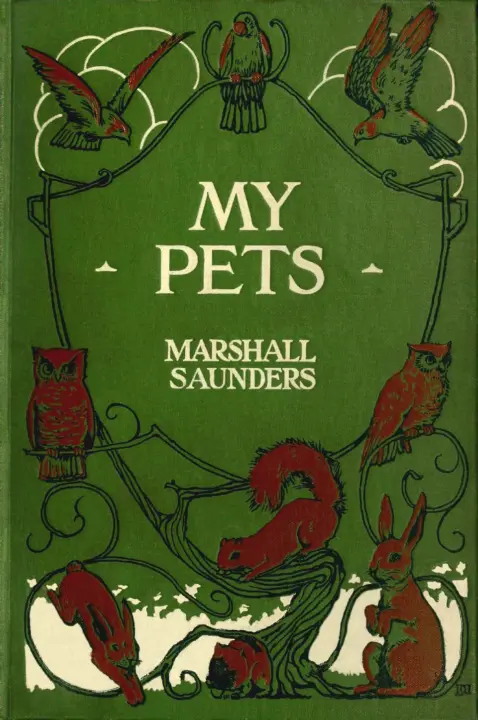
My pets
Marshall Saunders
THE CLASSIC COLLECTION · 1905
"Princess Sukey: The story of a pigeon and her human friends" by Marshall Saunders is a children's novel written in the early 20th century. The story revolves around Princess Sukey, a Jacobin pigeon who begins her life frail and abandoned but is rescued by a boy named Titus Sancroft. The book explores themes of compassion and friendship through the bond between the pigeon and her human companions, particularly focusing on how they navigate their troubles together. The opening of the story introduces Princess Sukey as she dreams by the fire, reflecting on her past and the series of events that led her to her new home. As a sickly chick, she is discarded by her father and nearly left to die when she is discovered by young Titus, who insists on saving her. Supported by a comical series of interactions with Titus, his grandfather Judge Sancroft, and the household staff, the narrative sets the stage for the unfolding relationship between the characters and Princess Sukey. It hints at the themes of kindness toward animals and the emotional journeys of both the boy and the bird as they cope with life’s challenges. The beginnings of friendship and the contrast between wealth and poverty become apparent, suggesting a rich layering of narrative to come.
Introduction adapted from the source catalogue; source summaries may be automatically generated.
Free to read · English · 84,299 words · No account needed
MAKE TIME FOR A GOOD BOOK
On by default. Untick to stop anonymous reading totals. Each page counts after 10 seconds in view. How this works.
Anonymous counting is on unless you have switched it off.
“Very well,” said Titus, “you eat your meat and I’ll go see what room you’re to have.”
Catching sight of Mrs. Blodgett in the big upstairs pantry he rushed in.
“Blodgieblossom,” he said, “there’s a boy here—he’s going to stay all night. Which room shall I take him to?”
“Bless me, Master Titus,” said the woman, withdrawing her gaze from the china closet, “give me a little notice. The bed has to be aired and clean sheets put on, and dusting to be done.”
“I tell you, he’s got to go in it now,” said Titus, imperiously. “I want him to hurry up and come with me to the pigeon loft.”
Mrs. Blodgett smiled. She took to herself the credit of the acquisition of so many handsome birds. Everything had to give way to the pigeons, and, feeling in one of the pockets of her big apron for her bunch of keys, she said, “You can follow me, dear lad, in five minutes to the wee clock room. I guess that will do, won’t it?”
“Yes, if it’s large enough,” said Titus, doubtfully.
“It’s big enough for a night or two,” she said, easily, and she proceeded on her way upstairs.
Near the front hall door she met Higby.
“Say,” he whispered, seizing her by the sleeve, “say, I believe the Judge has ad-d-dopted another boy.”
Mrs. Blodgett could not speak. She stared at him silently for a few instants, then with a strange weakness at her knees began ascending the stairs.
Titus went back to the dining room. The new boy had eaten his crackers and drunk the wine, but he had the plate of meat in his hand.
“I think I will take this upstairs,” he said, pleasantly.
“All right,” said Titus, and he slowly led the way to the hall.
Everything was gone that belonged to the boy—leather bag, coat, and
wooden box.
His face fell, and he looked almost angry.
“The servants have taken them up,” said Titus, noticing his
discomposure.
“O, very kind of them,” said the boy, hurriedly. “I am so unused to be waited on,” and he went upstairs so quickly that, although not knowing the way, he kept ahead of Titus.
Mrs. Blodgett and Higby were both fussing about the little room, where a Swiss cuckoo clock hung in the corner.
The English boy tried to subdue his impatience as he glanced at them, and as soon as they left the room he put his plate of meat down on the dressing table and looked at Titus.
Your reading position is saved on this browser. Take it to another device with a library code. Reading pages adapt to text, rather than matching a printed edition.
Marshall Saunders
Marshall Saunders
Marshall Saunders
Marshall Saunders
BEHIND THE BOOK
This eBook is for the use of anyone anywhere in the United States and most other parts of the world at no cost and with almost no restrictions whatsoever. You may copy it, give it away or re-use it under the terms of the Project Gutenberg License included with this eBook or online at www.gutenberg.org. If you are not located in the United States, you will have to check the laws of the country where you are located before using this eBook. Read the source licence.
The original source file, including credits and licence, is retained by this library. Request an original-format copy at no charge. Please include the book title and Project Gutenberg identifier #69707.
KEEP YOUR CURIOSITY GOING
Coulson Kernahan

Maurice Baring
Frances Wright
Cécile Tormay

Frederic Jesup Stimson

W. H. P. (William Henry Pope) Jarvis