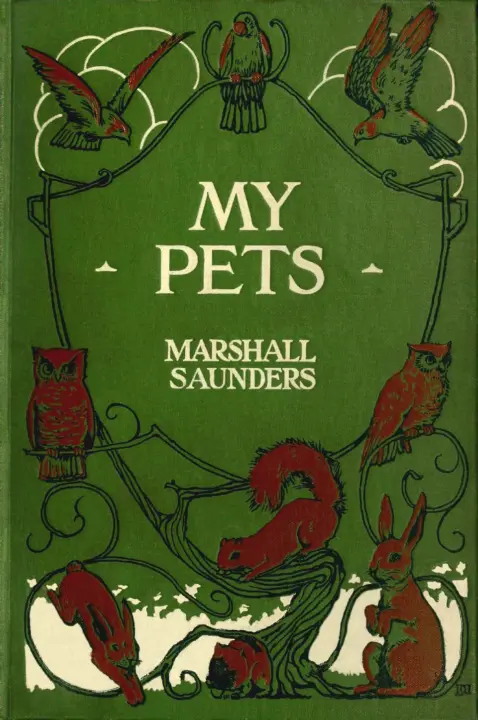
My pets
Marshall Saunders
THE CLASSIC COLLECTION · 1905
"Princess Sukey: The story of a pigeon and her human friends" by Marshall Saunders is a children's novel written in the early 20th century. The story revolves around Princess Sukey, a Jacobin pigeon who begins her life frail and abandoned but is rescued by a boy named Titus Sancroft. The book explores themes of compassion and friendship through the bond between the pigeon and her human companions, particularly focusing on how they navigate their troubles together. The opening of the story introduces Princess Sukey as she dreams by the fire, reflecting on her past and the series of events that led her to her new home. As a sickly chick, she is discarded by her father and nearly left to die when she is discovered by young Titus, who insists on saving her. Supported by a comical series of interactions with Titus, his grandfather Judge Sancroft, and the household staff, the narrative sets the stage for the unfolding relationship between the characters and Princess Sukey. It hints at the themes of kindness toward animals and the emotional journeys of both the boy and the bird as they cope with life’s challenges. The beginnings of friendship and the contrast between wealth and poverty become apparent, suggesting a rich layering of narrative to come.
Introduction adapted from the source catalogue; source summaries may be automatically generated.
Free to read · English · 84,299 words · No account needed
MAKE TIME FOR A GOOD BOOK
On by default. Untick to stop anonymous reading totals. Each page counts after 10 seconds in view. How this works.
Anonymous counting is on unless you have switched it off.
He had been guided to this boy. What a brother he would make for Titus—that is, and he prudently added an afterthought, if he was without incumbrances, and his antecedents were good—and meanwhile the little child slept on.
“B-b-boy,” said Titus, presently, “wake up, and eat your victuals.”
The child opened his eyes, smiled sweetly at him, and calmly took up a
fork.
He went to sleep between oysters and bouillon, and bouillon and ice cream. He slept putting a piece of bread to his mouth—indeed, he slept with such frequency that Titus wondered how he managed to tuck away so much food.
At last he had finished, and then he did something that considerably mystified the Judge and Titus.
After wiping his mouth with his napkin he put the napkin on the table, and unbuttoning his coat he slipped a hand in the front of it.
As he did this the sleepy look left his eyes, and a sorrowful one came in its place. Drawing out a small handkerchief with a border of marvelous lions and tigers, he unrolled it, pretended to take something out of it and put it on the table. Then he placed crumbs of bread and cake before this imaginary thing.
“W-w-what are you doing?” asked Titus, bluntly.
“Feeding the little one,” said the child, solemnly.
“W-w-what little one? There isn’t any there.”
“Don’t you see my little mouse?” he asked, impatiently.
“A-a-a mouse!” exclaimed Titus, “je-whillikens! I don’t like mice.”
“He’s dead,” said the child, softly; “a strange pussy killed him—not our
pussy.”
“H-h-how can you feed him if he’s dead?” pursued Titus, with boyish
callousness.
“But he has a little ghost,” said the strange child, gently shaking his head, “and I carry it here—have you had enough, mousie?” and he tenderly lowered his head to the table.
“Yes,” he said, softly speaking to himself; then he took up the ghost, wrapped it in his handkerchief, and put it back in his little bosom.
The Judge felt a strange misgiving. Another animal enthusiast—and this one worse than Titus, for Titus had little imagination, and interested himself only with the live bodies of animals, not their dead shades.
The mouse episode over, the child again became sleepy. Titus, who had managed to dispose of some ice cream himself, jammed the boy’s fur cap down on his head, and guided his steps behind the Judge to the door of the restaurant.
There the child sank down on the doorstep.
“U-u-upon my word,” stuttered Titus, “he’s saying his prayers. T-t-this time he’ll be off for good—must have been drugged.”
Your reading position is saved on this browser. Take it to another device with a library code. Reading pages adapt to text, rather than matching a printed edition.
Marshall Saunders
Marshall Saunders
Marshall Saunders
Marshall Saunders
BEHIND THE BOOK
This eBook is for the use of anyone anywhere in the United States and most other parts of the world at no cost and with almost no restrictions whatsoever. You may copy it, give it away or re-use it under the terms of the Project Gutenberg License included with this eBook or online at www.gutenberg.org. If you are not located in the United States, you will have to check the laws of the country where you are located before using this eBook. Read the source licence.
The original source file, including credits and licence, is retained by this library. Request an original-format copy at no charge. Please include the book title and Project Gutenberg identifier #69707.
KEEP YOUR CURIOSITY GOING
Coulson Kernahan

Maurice Baring
Frances Wright
Cécile Tormay

Frederic Jesup Stimson

W. H. P. (William Henry Pope) Jarvis