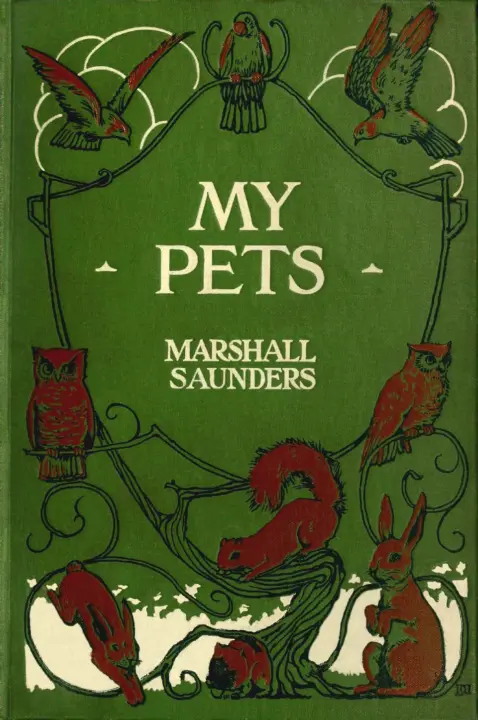
My pets
Marshall Saunders
THE CLASSIC COLLECTION · 1905
"Princess Sukey: The story of a pigeon and her human friends" by Marshall Saunders is a children's novel written in the early 20th century. The story revolves around Princess Sukey, a Jacobin pigeon who begins her life frail and abandoned but is rescued by a boy named Titus Sancroft. The book explores themes of compassion and friendship through the bond between the pigeon and her human companions, particularly focusing on how they navigate their troubles together. The opening of the story introduces Princess Sukey as she dreams by the fire, reflecting on her past and the series of events that led her to her new home. As a sickly chick, she is discarded by her father and nearly left to die when she is discovered by young Titus, who insists on saving her. Supported by a comical series of interactions with Titus, his grandfather Judge Sancroft, and the household staff, the narrative sets the stage for the unfolding relationship between the characters and Princess Sukey. It hints at the themes of kindness toward animals and the emotional journeys of both the boy and the bird as they cope with life’s challenges. The beginnings of friendship and the contrast between wealth and poverty become apparent, suggesting a rich layering of narrative to come.
Introduction adapted from the source catalogue; source summaries may be automatically generated.
Free to read · English · 84,299 words · No account needed
MAKE TIME FOR A GOOD BOOK
On by default. Untick to stop anonymous reading totals. Each page counts after 10 seconds in view. How this works.
Anonymous counting is on unless you have switched it off.
Once or twice before, the Judge had seen her act so in the presence of poor people, and he had laid her indignation down to a sense of smell, like that of the average dog, who hates a poor or dirty person. But Airy was a very clean child. The Judge knew what kind of a mother Mrs. Tingsby was, so his theory of smell would scarcely hold good in this case.
Possibly Sukey was sympathizing with Bethany, whom she had got to love devotedly. Anyway, the Judge must answer the child, so he said, kindly, “The bird is a pigeon; she is called a Jacobin.”
“She’s an ugly thing, anyway,” replied Airy, sulkily, “an’ she hates me. Shoo!” and she clapped her hands.
The indignant Sukey, who was no heroine, turned tail and scuttled under Bethany’s table, where the Judge heard a low growl of welcome greet her. Then, his two pets safely disposed of, he looked expectantly at Airy, hoping that she would remember his question as to her motive for calling on him.
She did remember, and, sinking back in her chair with a weary gesture, she said, “I’ve come to tell you that I wants to be a lady.”
“Poor child!” murmured the Judge, involuntarily. Then he tried to realize the enormity of the question thrust upon him.
“Why warn’t I born a lady?” pursued Airy, uncompromisingly. “Why warn’t I born your darter?”
“Well,” said the Judge, hesitatingly, “well, I suppose it pleased Providence to place you in another sphere.”
“Sphere!” she repeated, sneeringly, “that’s no word I ever heard. ’Pears to me you rich folks make up words to suit yourselves. But if I don’t know ‘sphere,’ I do not know one word, an’ that’s ‘Fiddlesticks!’”
“Well,” replied the Judge, with a polite movement of his head, “your word is a good old English one used by Southey, Thackeray, and others, though I believe it is unknown just how and why it became an expression of contempt.”
“I don’t know what you’re drivin’ at,” replied Airy, wearily, “but I’m goin’ to say my proposition over again: I wants to be a lady!”
The Judge, having heard the announcement before, bore it this time with
fortitude.
“An’ what’s more,” she went on, “I wants you to help me.”
“What can I do?” inquired the Judge, in mild surprise.
“You can gab a bit with me now an’ then,” she said, earnestly. “Why, I took to you the first time I see you.”
“Did you,” replied the Judge. “Well—ahem!—I fancied that you were not much taken with me.”
Your reading position is saved on this browser. Take it to another device with a library code. Reading pages adapt to text, rather than matching a printed edition.
Marshall Saunders
Marshall Saunders
Marshall Saunders
Marshall Saunders
BEHIND THE BOOK
This eBook is for the use of anyone anywhere in the United States and most other parts of the world at no cost and with almost no restrictions whatsoever. You may copy it, give it away or re-use it under the terms of the Project Gutenberg License included with this eBook or online at www.gutenberg.org. If you are not located in the United States, you will have to check the laws of the country where you are located before using this eBook. Read the source licence.
The original source file, including credits and licence, is retained by this library. Request an original-format copy at no charge. Please include the book title and Project Gutenberg identifier #69707.
KEEP YOUR CURIOSITY GOING
Coulson Kernahan

Maurice Baring
Frances Wright
Cécile Tormay

Frederic Jesup Stimson

W. H. P. (William Henry Pope) Jarvis