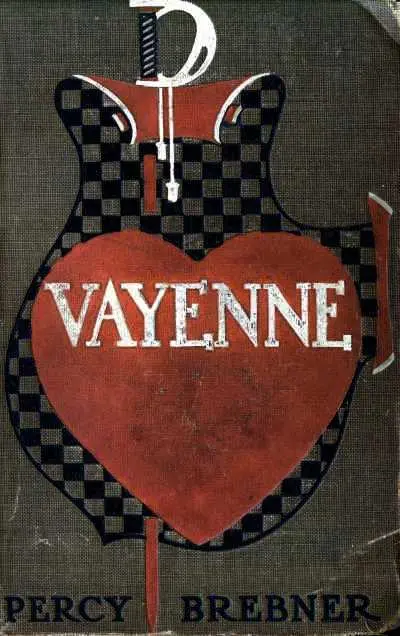
Vayenne
Percy James Brebner
THE CLASSIC COLLECTION · 1906
"Princess Maritza" by Percy James Brebner is a novel likely written in the early 20th century. The story revolves around Princess Maritza, a strong-willed young woman with royal blood who is caught in the political struggles and power dynamics of her homeland, Wallaria. In the opening chapters, she crosses paths with Desmond Ellerey, a man grappling with his own past and ambitions, setting the stage for a tale of adventure, romance, and political intrigue. At the start of the novel, the narrative introduces Desmond Ellerey, who is reflecting on his troubled past on a beautiful morning in the English countryside. As he navigates his thoughts, he encounters a spirited young woman who reveals herself to be Princess Maritza and expresses her fierce ambition to reclaim her rightful place in Wallaria. Their conversation touches on themes of desire, ambition, and the constraints posed by gender roles and political circumstances. Ellerey's fascination with Maritza sparks a sense of hope and ambition within him. Throughout the opening chapters, the political landscape of Wallaria is hinted at, setting up the inevitable conflicts and alliances that will challenge both characters as they seek their respective destinies.
Introduction adapted from the source catalogue; source summaries may be automatically generated.
Free to read · English · 100,815 words · No account needed
MAKE TIME FOR A GOOD BOOK
On by default. Untick to stop anonymous reading totals. Each page counts after 10 seconds in view. How this works.
Anonymous counting is on unless you have switched it off.
At last they came out on to a level piece of turf surrounded on all sides by high hedges, through which were many openings leading to other parts of the garden, and through one of which they had come. There were trees here and there, the long shadows thrown across the turf, and without absolutely obscuring the moonlight, they made it extremely difficult to fight a duel by. Baron Petrescu walked to one end of the lawn, and Ellerey to the other, leaving the two seconds together to make final arrangements. Once convinced that his adversary contemplated no treachery, Ellerey sank again into his indifferent state, paying no attention to the choosing of the ground, taking no note of the light, nor considering how he might best use his position to the full advantage. The Baron, on the other hand, was quick to observe exactly how the shadows fell, and to calculate every chance which might help him.
"We are ready, Captain Ellerey."
Without a word Ellerey threw off his cloak and coat, and taking his sword, weighed it in his hand, testing its poise and balance.
"In case of accident is there anything you wish me to do?" asked his companion; "anything to take charge of, any message to send? The affair has been so hurried that there has been no time to make these small arrangements."
"Thank you, there is nothing," Ellerey answered. "Under the circumstances I am fortunate in not possessing a friend in the world who cares a snap of his fingers whether I am living or dead."
"Nor a woman?"
Ellerey hesitated for a moment.
"The Countess Mavrodin might be interested to learn that I was dead. Yes, if anything should happen, please tell her."
"But in England?"
"There is no one," Ellerey answered.
A cloud passed over the moon as the combatants faced each other, and not until it had passed was the signal given. Then steel rang on steel with a music which sounded weirdly in the night. No other sound was there save a rustling in the leaves now and again as though they trembled in sympathy to some swift lunge or quickly parried thrust. The moon shone clearly for a space, touching the swords into two streaks of flashing light, and painting the men's set faces with a cold hue, ghostly, and deathlike. The Baron had a reputation as a swordsman, had stood face to face with an antagonist many times before, and more than once had seen his adversary turn sightless eyes to the morning sky. It was therefore, perhaps, only natural that he should have contemplated his encounter with the Englishman with equanimity. At the same time Ellerey's determination to settle the quarrel at once and by moonlight may have had the effect of making him more cautious than usual. Certainly his second, who had often seen him fight before, marvelled at his deliberation to-night. The well-known brilliancy of his attacks was wanting, and he could only suppose that the Englishman was a more worthy swordsman than he had imagined. Whatever deliberation the Baron used, he at first pressed the fight far more than Ellerey, whose whole attention seemed occupied in defending himself. He was less attractive to watch than the Baron, slower, it seemed, in his movements, and with less invention and resource, yet Petrescu appeared to gain no advantage. Every thrust he made was parried, if rather late sometimes, still parried, and he found that his adversary's wrist, if less flexible than his own, was of iron. He changed his tactics, he pressed the fight less and less, hoping to make the Englishman careless, and tempt him to attack more vigorously. In a measure the device succeeded. Ellerey's point began to flash toward him with a persistency he had not expected, but there was no less caution. Twice, thrice, the Baron used a feint and thrust which had seldom missed their intention, and had proved the undoing of many an adversary; but now they were met in the only manner it seemed that they could be met successfully. At the third failure the Baron's computation of the Englishman's skill underwent a rapid change. He had met his match, a foeman worthy of his steel, as consummate a swordsman as himself; and if for a moment there was a sense of disappointment, it was quickly followed by one of keen satisfaction not unmingled with a feeling of friendship for his antagonist. There was that in Baron Petrescu which he had received no credit for, even from his friends. What contempt he had had for Ellerey disappeared, and a desire to win for the mere sake of winning took possession of him. All the thoughts which had prompted him to this duel were forgotten; he was no longer intent on killing his adversary. Now to verify his superiority and to prove it to this worthy foeman was his ambition, and it was in this spirit he pressed the contest with increased energy. The night became full of eyes for him, eager eyes, watchful of his skill, and hushed in the silence a thousand voices seemed ready to proclaim his victory.
Your reading position is saved on this browser. Take it to another device with a library code. Reading pages adapt to text, rather than matching a printed edition.
Percy James Brebner
Percy James Brebner
Percy James Brebner
Percy James Brebner
BEHIND THE BOOK
This eBook is for the use of anyone anywhere in the United States and most other parts of the world at no cost and with almost no restrictions whatsoever. You may copy it, give it away or re-use it under the terms of the Project Gutenberg License included with this eBook or online at www.gutenberg.org. If you are not located in the United States, you will have to check the laws of the country where you are located before using this eBook. Read the source licence.
The original source file, including credits and licence, is retained by this library. Request an original-format copy at no charge. Please include the book title and Project Gutenberg identifier #6374.
KEEP YOUR CURIOSITY GOING
Coulson Kernahan

Maurice Baring
Frances Wright
Cécile Tormay

Frederic Jesup Stimson

W. H. P. (William Henry Pope) Jarvis