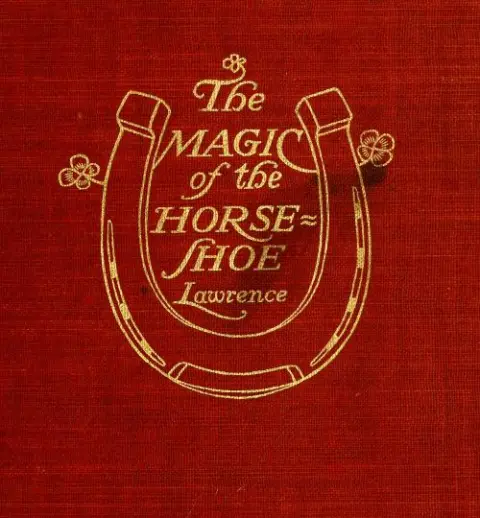
The Magic of the Horse-shoe, with other folk-lore notes
Robert Means Lawrence
THE CLASSIC COLLECTION · 1910
"Primitive Psycho-Therapy and Quackery" by Robert Means Lawrence is a scientific publication written in the early 20th century. This work explores the historical practices of healing and the psychological factors that contribute to their efficacy, particularly focusing on amulets, magical charms, and the role of imagination in therapeutic settings. The author argues that many primitive methods of therapy and the success of quack treatments can be attributed to the power of suggestion and mental influence rather than any intrinsic medicinal properties. The opening of the text introduces the idea that amulets and charms, often understood through the lens of superstition, played a significant role in the development of medical practices over the ages. Lawrence elucidates how these objects were believed to possess protective or healing powers, largely stemming from the faith and imagination of those who utilized them. He also hints at the transition from these archaic practices to modern psychological approaches to healing, establishing a connection between historical beliefs in the supernatural and contemporary understandings of mental health and therapy.
Introduction adapted from the source catalogue; source summaries may be automatically generated.
Free to read · English · 59,021 words · No account needed
MAKE TIME FOR A GOOD BOOK
On by default. Untick to stop anonymous reading totals. Each page counts after 10 seconds in view. How this works.
Anonymous counting is on unless you have switched it off.
One Egil went on a journey to Vermaland, and on the way he came to the house of a farmer named Thorfinn, whose daughter, Helga, had long been ill of a wasting sickness. "Has anything been tried for her illness?" asked Egil. "Runes have been traced by the son of a farmer in the neighborhood," said Thorfinn.
Then Egil examined the bed, and found a piece of whalebone with runes on it. He read them, cut them off, and scraped the chips into the fire. He also burned the whalebone, and had Helga's clothes carried into the open air. Then Egil sang:
As man shall not trace runes,
except he can read them well,
it is thus with many a man,
that the dark letters bewilder him.
I saw on the cut whalebone ten hidden
letters carved, that have caused the woman
a very long sorrow.
Egil traced runes and placed them under Helga's pillow. It seemed to her as if she awoke from a sleep, and she said that she was then healed.[138:1]
The ancient northern peoples wore protective and defensive amulets, which were fastened around the arm, waist, or neck. These amulets were styled ligamenta, ligaturae, or phylacteria, by the writers of the early Middle Ages. They were usually fashioned as gold, silver, or glass pendants. Cipher-writing and runes were commonly inscribed upon them, often for healing, but contrariwise, to bewitch and injure.[138:2]
Among the peoples of Western Europe, ancient magical healing formulas, relics of previous ages, were employed in medieval times by rural charlatans, who professed to cure ophthalmic disorders by the recitation of ritualistic phrases, together with suitable gestures of the arms and fingers over the affected eyes. Dislocations were said to have been promptly reduced by means of runic enchantments, which were doubtless supplemented by mechanical treatment; while fractured bones of man or beast were alleged to unite readily under the influence of Odinic charms. Wherever the Teutonic races were found, a knowledge of runic remedies appears to have prevailed.[138:3]
[135:1] M. Mallet, Northern Antiquities, p. 226.
[136:1] John Thrupp, The Anglo-Saxon Home.
[136:2] Nelson's Encyclopaedia.
[136:3] H. D. Traill, Social England, vol. ii, p. 110.
[136:4] Joseph Strutt, Manners of the English, vol. i, p. 17.
[136:5] Vol. iii, p. 455.
[138:1] The Egil's Saga, chap. 72.
[138:2] Jacob Grimm, Teutonic Mythology, pp. 1173-1174.
[138:3] George F. Fort, Medical Economy in the Middle Ages.
Your reading position is saved on this browser. Take it to another device with a library code. Reading pages adapt to text, rather than matching a printed edition.
Robert Means Lawrence
BEHIND THE BOOK
This eBook is for the use of anyone anywhere in the United States and most other parts of the world at no cost and with almost no restrictions whatsoever. You may copy it, give it away or re-use it under the terms of the Project Gutenberg License included with this eBook or online at www.gutenberg.org. If you are not located in the United States, you will have to check the laws of the country where you are located before using this eBook. Read the source licence.
The original source file, including credits and licence, is retained by this library. Request an original-format copy at no charge. Please include the book title and Project Gutenberg identifier #23293.
KEEP YOUR CURIOSITY GOING
Cécile Tormay

Moritz Busch
John L. Ransom
Frances Wright
Cécile Tormay

Mabel Potter Daggett