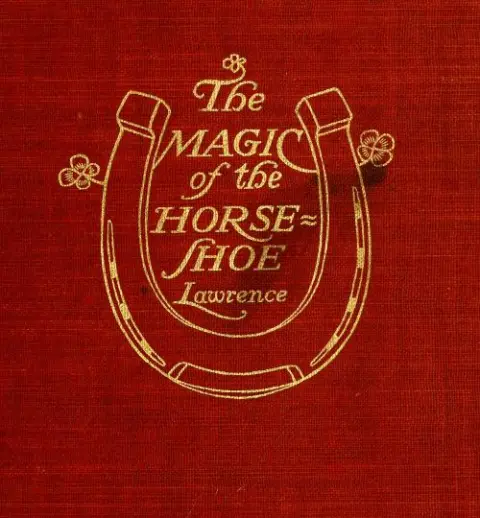
The Magic of the Horse-shoe, with other folk-lore notes
Robert Means Lawrence
THE CLASSIC COLLECTION · 1910
"Primitive Psycho-Therapy and Quackery" by Robert Means Lawrence is a scientific publication written in the early 20th century. This work explores the historical practices of healing and the psychological factors that contribute to their efficacy, particularly focusing on amulets, magical charms, and the role of imagination in therapeutic settings. The author argues that many primitive methods of therapy and the success of quack treatments can be attributed to the power of suggestion and mental influence rather than any intrinsic medicinal properties. The opening of the text introduces the idea that amulets and charms, often understood through the lens of superstition, played a significant role in the development of medical practices over the ages. Lawrence elucidates how these objects were believed to possess protective or healing powers, largely stemming from the faith and imagination of those who utilized them. He also hints at the transition from these archaic practices to modern psychological approaches to healing, establishing a connection between historical beliefs in the supernatural and contemporary understandings of mental health and therapy.
Introduction adapted from the source catalogue; source summaries may be automatically generated.
Free to read · English · 59,021 words · No account needed
MAKE TIME FOR A GOOD BOOK
On by default. Untick to stop anonymous reading totals. Each page counts after 10 seconds in view. How this works.
Anonymous counting is on unless you have switched it off.
French tradition ascribes the origin of the gift of healing by royal touch, to Saint Marculf, a monk whose Frankish ancestry is shown by his name, which signifies forest wolf. This personage was a native of Bayeux, and is reputed to have flourished in the sixth century A. D. His relics were preserved in an abbey at Corbigny, and thither the French monarchs were accustomed to resort, after their coronation at Rheims, to obtain the pretended power of curing the King's Evil, by touching the relics of this saint. But according to the historian, Francois Eudes de Mezeray (1610-1683), the gift was bestowed upon King Clovis (466-511) at the time of his baptism.
In 1515, the year of his accession, Francis I laid his hands on a number of persons in the presence of the Pope, during the prevalence of an epidemic at Bologna, Italy. And in 1542 he issued the following statement: "On our return from Rheims, we went to Corbigny, where we and our predecessors have been accustomed to make oblations, and pay reverence to the precious relics of Saint Marculf for the admirable gift of healing the King's Evil, which he imparted miraculously to the kings of France, at the pleasure of the Creator. The grace we exercised in the usual way, by touching the parts affected, and signing them with the sign of the cross."
Louis XIII of France (1601-1643) is said to have bestowed upon Cardinal Richelieu all of his prerogatives, except the Royal Touch.
His successor, Louis the Great, is credited with having touched sixteen hundred people on Easter Sunday, 1686, using the words, "Le Roy te touche, Dieu te guerisse." Every French patient received a present of fifteen sous, while foreigners were given double that amount.[91:1]
According to the Swiss theologian, Samuel Werenfels (1657-1740), who published a treatise on "The Power of curing the King's Evil," this prerogative was shared by the members of the House of Hapsburg. And the same authority relates that the kings of Hungary were able to heal various affections by the Royal Touch, and to neutralize by this method the toxic effects of the bite of venomous creatures.
[74:1] Joseph Ennemoser, The History of Magic, vol. i, p. 209.
[74:2] 1 Timothy, iv, 14.
[74:3] Mark, xvi, 18; vi, 5.
[75:1] H. Addington Bruce, in The Outlook, September, 1909.
[76:1] Lady Wilde, Ancient Cures, Charms, and Usages of Ireland.
[77:1] J. Cordy Jeaffreson, A Book about Doctors.
[77:2] Chambers's Encyclopaedia.
[81:1] Pettigrew, op. cit., p. 132.
[82:1] John Morgan Richards, A Chronology of Medicine.
[83:1] Lord Macaulay, The History of England, vol. iii, p. 379.
[85:1] Thomas Joseph Pettigrew, Medical Superstitions.
[86:1] The Lancet, vol. ii, 1901.
[88:1] Once a Week, vol. xv (1866), p. 219.
[88:2] E. Cobham Brewer, A Dictionary of Miracles.
[89:1] Common-sense, August 13, 1737.
[91:1] Hon. Daines Barrington, Observations upon the Statutes, 1766.
Your reading position is saved on this browser. Take it to another device with a library code. Reading pages adapt to text, rather than matching a printed edition.
Robert Means Lawrence
BEHIND THE BOOK
This eBook is for the use of anyone anywhere in the United States and most other parts of the world at no cost and with almost no restrictions whatsoever. You may copy it, give it away or re-use it under the terms of the Project Gutenberg License included with this eBook or online at www.gutenberg.org. If you are not located in the United States, you will have to check the laws of the country where you are located before using this eBook. Read the source licence.
The original source file, including credits and licence, is retained by this library. Request an original-format copy at no charge. Please include the book title and Project Gutenberg identifier #23293.
KEEP YOUR CURIOSITY GOING
Cécile Tormay

Moritz Busch
John L. Ransom
Frances Wright
Cécile Tormay

Mabel Potter Daggett