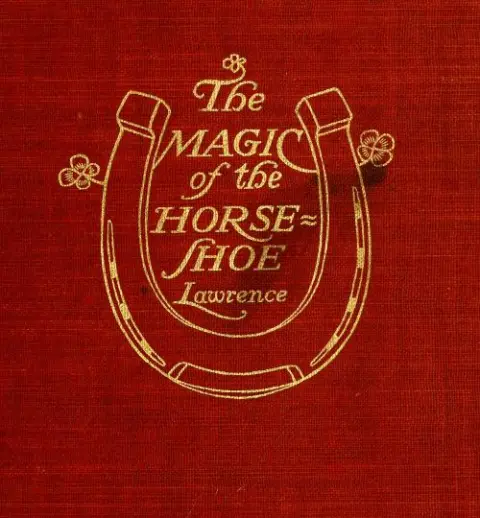
The Magic of the Horse-shoe, with other folk-lore notes
Robert Means Lawrence
THE CLASSIC COLLECTION · 1910
"Primitive Psycho-Therapy and Quackery" by Robert Means Lawrence is a scientific publication written in the early 20th century. This work explores the historical practices of healing and the psychological factors that contribute to their efficacy, particularly focusing on amulets, magical charms, and the role of imagination in therapeutic settings. The author argues that many primitive methods of therapy and the success of quack treatments can be attributed to the power of suggestion and mental influence rather than any intrinsic medicinal properties. The opening of the text introduces the idea that amulets and charms, often understood through the lens of superstition, played a significant role in the development of medical practices over the ages. Lawrence elucidates how these objects were believed to possess protective or healing powers, largely stemming from the faith and imagination of those who utilized them. He also hints at the transition from these archaic practices to modern psychological approaches to healing, establishing a connection between historical beliefs in the supernatural and contemporary understandings of mental health and therapy.
Introduction adapted from the source catalogue; source summaries may be automatically generated.
Free to read · English · 59,021 words · No account needed
MAKE TIME FOR A GOOD BOOK
On by default. Untick to stop anonymous reading totals. Each page counts after 10 seconds in view. How this works.
Anonymous counting is on unless you have switched it off.
Gradually he acquired a reputation as a healer by means of the methods of laying on of hands, conjuration and prayer. Many of the Tyrolese peasantry flocked to him, as did their Irish brethren to Greatrakes. Gassner treated them all without recompense. He believed that the efficiency of his methods was dependent upon the degree of faith of his patients. Some cases he affected to benefit by drugs, others by touch, and still others by exorcism. He was a pioneer in the employment of suggestion, while summoning to his aid the forces of religious faith, prayer and material remedies.
The Bishop of Constance sent for Gassner, and after a careful examination of his methods and beliefs, became convinced of the purity of his character, and of his good faith. The bishop therefore permitted him to continue his practice at Coire and its neighborhood.
Gassner's reputation as a thaumaturge spread throughout Germany and adjacent countries, and he numbered among his patrons many persons of influence. In 1774, upon invitation of the Bishop of Ratisbon, he removed to Ellwangen, in Wuertemberg, where he is said to have cured many by the mere word of command, Cesset. He died at Bondorf, in the Diocese of Ratisbon, in the year 1779.
The celebrated Dutch physician, Antoine de Haen, who was a contemporary of Gassner, described the latter as a man of jovial temperament, and a sworn foe to melancholy. He did not take advantage of the popular credulity for his own pecuniary gain, and was therefore morally far above the plane of an ordinary charlatan.
[244:1] Encyclopaedia Britannica, art. "Paracelsus."
[244:2] Edward Theodore Withington, Medical History, p. 225.
[246:1] The History of Medicine.
[246:2] P. V. Renouard, History of Medicine, p. 368.
[247:1] Encyclopaedia Britannica, art. "Medicine."
[247:2] Century Dictionary.
[248:1] Blackwood's Edinburgh Magazine, June, 1854.
[257:1] The Gentleman's Magazine, part i; 1856.
[258:1] John Timbs, Doctors and Patients, vol. ii, p. 33.
[260:1] Joseph Thomas, Universal Dictionary of Biography, art. "Van
Helmont."
[261:1] Rev. Hugh James Rose, A New General Biographical Dictionary.
[261:2] The Century Dictionary.
[264:1] The New International Encyclopaedia.
[268:1] Henry Lee, Dictionary of National Biography.
Abracadabra, 126.
Amulets, 5, 6, 14, 60-62, 138.
Ancient Irish physicians, 12, 13, 40.
Ancient medical prescriptions, 155-164.
Angel of gold, 83, 85.
Animal magnetism, 143-154.
Animals, effect of music upon, 176, 177, 180.
Atharva-Veda, 133.
Auto-suggestion, 217, 231.
Blue-glass mania, 93-96.
Chaldean medical amulets, 112.
Charlatans, 201-238.
Charms, 6, 9, 122-123, 125.
Christian Science, 53-55.
Correspondence between Christ and King Abgar, 35-37.
Curative spells, 41, 42, 45.
Demonology, the doctrine of, 209, 210.
Demons of disease, 206.
Devil, the, 205-211.
Divination, 117.
Dreams, the interpretation of, 98.
Druids, the, 12, 13, 75, 129.
Edible letters, 50.
Edible prescriptions, 51.
Egyptian medicine, 117-120.
Ephesian letters, 128-129.
Fairy-women, 13, 109.
Grigris, 45.
Healing by manual stroking, 76.
Healing-spells, 111-134, 138.
Hydro-therapy, 97, 101.
Hypnotism, 153, 154.
Imagination, the curative power of, 53-72, 145, 151.
Incantations, 9, 39, 47, 109, 113, 114, 134, 205.
Incubation, 101-104.
Intermittent fever, remarkable cure for, 131, 132.
King's Evil, 73-92.
Kneipp cure, 53.
Laying on of hands, 73-92.
Magical healing formulas, 10, 11, 13, 26.
Mantras, 37, 60.
Medical amulets, 3, 9, 15, 17.
Your reading position is saved on this browser. Take it to another device with a library code. Reading pages adapt to text, rather than matching a printed edition.
Robert Means Lawrence
BEHIND THE BOOK
This eBook is for the use of anyone anywhere in the United States and most other parts of the world at no cost and with almost no restrictions whatsoever. You may copy it, give it away or re-use it under the terms of the Project Gutenberg License included with this eBook or online at www.gutenberg.org. If you are not located in the United States, you will have to check the laws of the country where you are located before using this eBook. Read the source licence.
The original source file, including credits and licence, is retained by this library. Request an original-format copy at no charge. Please include the book title and Project Gutenberg identifier #23293.
KEEP YOUR CURIOSITY GOING
Cécile Tormay

Moritz Busch
John L. Ransom
Frances Wright
Cécile Tormay

Mabel Potter Daggett