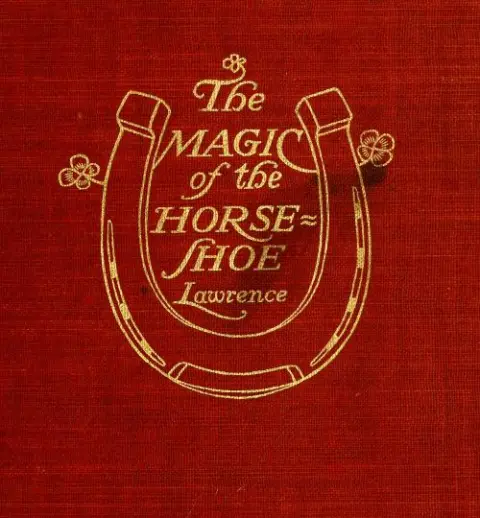
The Magic of the Horse-shoe, with other folk-lore notes
Robert Means Lawrence
THE CLASSIC COLLECTION · 1910
"Primitive Psycho-Therapy and Quackery" by Robert Means Lawrence is a scientific publication written in the early 20th century. This work explores the historical practices of healing and the psychological factors that contribute to their efficacy, particularly focusing on amulets, magical charms, and the role of imagination in therapeutic settings. The author argues that many primitive methods of therapy and the success of quack treatments can be attributed to the power of suggestion and mental influence rather than any intrinsic medicinal properties. The opening of the text introduces the idea that amulets and charms, often understood through the lens of superstition, played a significant role in the development of medical practices over the ages. Lawrence elucidates how these objects were believed to possess protective or healing powers, largely stemming from the faith and imagination of those who utilized them. He also hints at the transition from these archaic practices to modern psychological approaches to healing, establishing a connection between historical beliefs in the supernatural and contemporary understandings of mental health and therapy.
Introduction adapted from the source catalogue; source summaries may be automatically generated.
Free to read · English · 59,021 words · No account needed
MAKE TIME FOR A GOOD BOOK
On by default. Untick to stop anonymous reading totals. Each page counts after 10 seconds in view. How this works.
Anonymous counting is on unless you have switched it off.
Great care was taken in the preparation of phylacteries, and no Christian, apostate, or woman was allowed to write the inscriptions upon them. Even at the present time, there are Jews in Russia and Poland, who wear them during the whole day.[28:1]
It was customary to tie certain kinds of phylacteries into a knot. Reference to this ancient practice is found in certain Assyrian talismans, now in the British Museum. Following is a translation of one of them: "Hea says: 'Go, my son! take a woman's kerchief, bind it round thy right hand; loose it from the left hand. Knot it with seven knots; do so twice. Sprinkle it with bright wine; bind it round the head of the sick man. Bind it round his hands and feet, like manacles and fetters; sit down on his bed; sprinkle water over him. He shall hear the voice of Hea. Darkness shall protect him, and Marduk, eldest son of Heaven, shall find him a happy habitation.'"[28:2]
While the practice of wearing phylacteries may not have originated in a superstitious belief in their virtues as "appurtenances to make prayers more powerful," it would appear that they came to be regarded not only as protective charms, which is indicated by their name, but also as magical remedies, having occult healing properties.[29:1] Their power was supposed to inhere in the written words, enclosed in the small leathern case.
At the present day, verses from the Scriptures, the Koran, and other sacred writings are sometimes worn upon the person and are also placed upon horses or camels, by Arabs, Turks, Grecians, and Italians, with the avowed purpose of averting malignant glances.[29:2]
[25:1] Encyclopaedia Britannica.
[25:2] Samuel Burder, Oriental Customs, vol. ii, p. 226.
[25:3] Smith and Cheetham, A Dictionary of Christian Antiquities.
[26:1] William George Black, Folk-Medicine, p. 165.
[27:1] Joseph Barclay, The Talmud.
[27:2] Scroll of parchment, inscribed with passages of Scripture.
[27:3] Psalm xxxiv, 7.
[27:4] James Hastings, D.D., A Dictionary of Christ and the Gospels, 1908, p. 360. Matthew, xxiii, 5.
[28:1] Philip Schaff, D.D., A Religious Encyclopaedia.
[28:2] Biblical Things not generally known, 1879, pp. 177-8. Marduk,
the Chaldean Hercules.
[29:1] James Hastings, A Dictionary of the Bible.
[29:2] Frederick Thomas Elworthy, The Evil Eye.
Your reading position is saved on this browser. Take it to another device with a library code. Reading pages adapt to text, rather than matching a printed edition.
Robert Means Lawrence
BEHIND THE BOOK
This eBook is for the use of anyone anywhere in the United States and most other parts of the world at no cost and with almost no restrictions whatsoever. You may copy it, give it away or re-use it under the terms of the Project Gutenberg License included with this eBook or online at www.gutenberg.org. If you are not located in the United States, you will have to check the laws of the country where you are located before using this eBook. Read the source licence.
The original source file, including credits and licence, is retained by this library. Request an original-format copy at no charge. Please include the book title and Project Gutenberg identifier #23293.
KEEP YOUR CURIOSITY GOING
Cécile Tormay

Moritz Busch
John L. Ransom
Frances Wright
Cécile Tormay

Mabel Potter Daggett