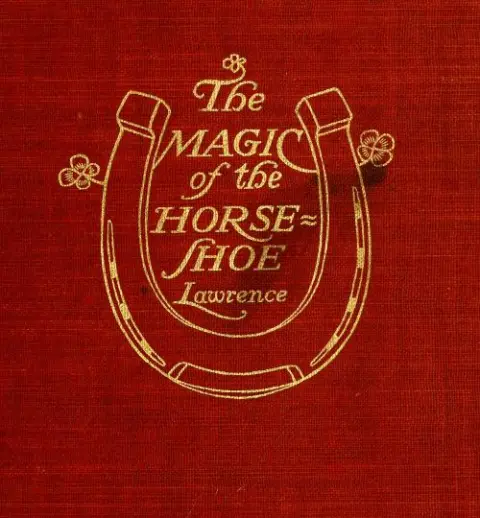
The Magic of the Horse-shoe, with other folk-lore notes
Robert Means Lawrence
THE CLASSIC COLLECTION · 1910
"Primitive Psycho-Therapy and Quackery" by Robert Means Lawrence is a scientific publication written in the early 20th century. This work explores the historical practices of healing and the psychological factors that contribute to their efficacy, particularly focusing on amulets, magical charms, and the role of imagination in therapeutic settings. The author argues that many primitive methods of therapy and the success of quack treatments can be attributed to the power of suggestion and mental influence rather than any intrinsic medicinal properties. The opening of the text introduces the idea that amulets and charms, often understood through the lens of superstition, played a significant role in the development of medical practices over the ages. Lawrence elucidates how these objects were believed to possess protective or healing powers, largely stemming from the faith and imagination of those who utilized them. He also hints at the transition from these archaic practices to modern psychological approaches to healing, establishing a connection between historical beliefs in the supernatural and contemporary understandings of mental health and therapy.
Introduction adapted from the source catalogue; source summaries may be automatically generated.
Free to read · English · 59,021 words · No account needed
MAKE TIME FOR A GOOD BOOK
On by default. Untick to stop anonymous reading totals. Each page counts after 10 seconds in view. How this works.
Anonymous counting is on unless you have switched it off.
The Tyrolese physician, Joseph Ennemoser, in his "History of Magic" (1844), observed that in his time a peculiar influence was attributed by mesmerists to certain metals and precious stones. And he expressed the belief that the popular faith in talismans, prevalent in the early ages, originated through similar ideas. The Buddhists credited the sapphire with magical power. Probably the magnetic polarities of jewels, rather than their brilliancy, constitute their chief potency as talismans. Yet the latter quality doubtless strongly influences the imagination.
Talismans were formerly divided into three classes, astronomical,
magical, and mixed.
The first-named consisted usually of a magical figure, cut or engraved under certain superstitious observances of the configuration of the heavens.
It has been defined as the seal, figure, character, or image of a heavenly sign, constellation, or planet, engraved on a sympathetic stone, or on a metal corresponding to the star, in order to receive its influences.[22:1]
Magical talismans were inscribed with mysterious symbols, words of superstitious import, and the names of unknown angels; they were well adapted to inspire with awe the minds of the ignorant. The so-called mixed talismans bore various unintelligible devices and barbaric names. Some of the most ancient protective and healing charms were fashioned out of roots, twigs, and plants. Whatever its form, the talisman was believed to exert an extraordinary influence over the bearer, especially in warding off disease or injury.
In its widest sense, the word talisman is synonymous with amulet.
The Dutch historian, Johann Busch (1400-1477), told of his meeting a woman, the wife or daughter of a soldier, on some public festal occasion at Halle in Prussian Saxony. Observing that she wore a little bag suspended from her neck, he asked her what it contained. Thereupon the woman showed him a bit of parchment bearing divers mystic inscriptions, and the statement that Pope Leo guaranteed the bearer thereof against bodily injuries, fainting spells, and drowning. Then followed the words, Christus vincit; Christus regnat, together with the names of the twelve apostles, and those of the three Wise Men, Balthasar, Melchior, and Kaspar.[23:1]
This doubtless was a fair specimen of the inscribed amulets, worn by German peasants in the fifteenth century.
Even nowadays the names of the three magi are often to be seen, as talismanic symbols, upon the doors and walls of dwellings in certain Roman Catholic countries; a fact noted by the present writer, while sojourning in the Austrian Tyrol a few years ago.
[20:1] M. F. Blumler, A History of Amulets.
[22:1] The Century Dictionary.
[23:1] Johann Heinrich Zedler, Grosses Universal Lexicon, art. "Talismans." Leipzig und Halle, 1744.
Your reading position is saved on this browser. Take it to another device with a library code. Reading pages adapt to text, rather than matching a printed edition.
Robert Means Lawrence
BEHIND THE BOOK
This eBook is for the use of anyone anywhere in the United States and most other parts of the world at no cost and with almost no restrictions whatsoever. You may copy it, give it away or re-use it under the terms of the Project Gutenberg License included with this eBook or online at www.gutenberg.org. If you are not located in the United States, you will have to check the laws of the country where you are located before using this eBook. Read the source licence.
The original source file, including credits and licence, is retained by this library. Request an original-format copy at no charge. Please include the book title and Project Gutenberg identifier #23293.
KEEP YOUR CURIOSITY GOING
Cécile Tormay

Moritz Busch
John L. Ransom
Frances Wright
Cécile Tormay

Mabel Potter Daggett