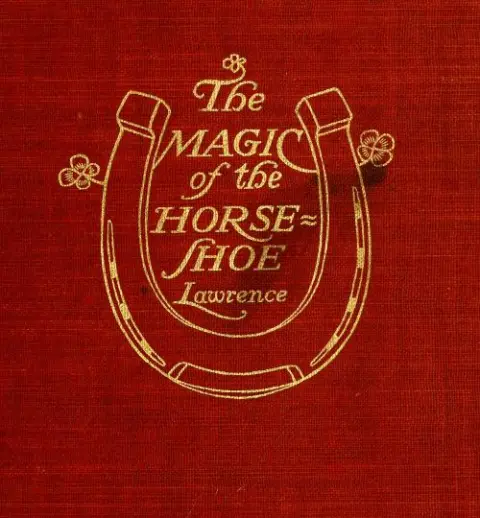
The Magic of the Horse-shoe, with other folk-lore notes
Robert Means Lawrence
THE CLASSIC COLLECTION · 1910
"Primitive Psycho-Therapy and Quackery" by Robert Means Lawrence is a scientific publication written in the early 20th century. This work explores the historical practices of healing and the psychological factors that contribute to their efficacy, particularly focusing on amulets, magical charms, and the role of imagination in therapeutic settings. The author argues that many primitive methods of therapy and the success of quack treatments can be attributed to the power of suggestion and mental influence rather than any intrinsic medicinal properties. The opening of the text introduces the idea that amulets and charms, often understood through the lens of superstition, played a significant role in the development of medical practices over the ages. Lawrence elucidates how these objects were believed to possess protective or healing powers, largely stemming from the faith and imagination of those who utilized them. He also hints at the transition from these archaic practices to modern psychological approaches to healing, establishing a connection between historical beliefs in the supernatural and contemporary understandings of mental health and therapy.
Introduction adapted from the source catalogue; source summaries may be automatically generated.
Free to read · English · 59,021 words · No account needed
MAKE TIME FOR A GOOD BOOK
On by default. Untick to stop anonymous reading totals. Each page counts after 10 seconds in view. How this works.
Anonymous counting is on unless you have switched it off.
The banquets of the Anglo-Saxons were enlivened by minstrels and gleemen, whose visits were welcome breaks in the monotony of the people's lives. They added to their musical performances mimicry and other means of promoting mirth, as well as dancing and tumbling, with sleights of hand, and a variety of deceptions to amuse the company.[183:1] In the intervals between the musical exercises, the guests talked, joked, propounded and answered riddles, and boasted of their own exploits, while disparaging those of others. Later, when the liquor took effect, they were wont to become noisy and quarrelsome.[183:2] "Then wine wets the man's breast-passions; suddenly rises clamour in the company, an outcry they send forth various."[183:3]
In the great houses of the nobility and gentry, minstrels' music was the usual seasoning of food. It is true, wrote Mons. J. J. Jusserand, in "English Wayfaring Life of the Fourteenth Century," that "the voices of the singers were at times interrupted by the crunching of the bones, which the dogs were gnawing under the tables, or by the sharp cry of some ill-bred falcon; for many lords kept these favorite birds on perches behind them."
We learn from the same authority that in the great dining-halls of the castles of the wealthy, galleries were placed for the accommodation of the minstrels, above the door of entrance, and opposite to the dais upon which stood the master's table.
[173:1] Boston Transcript, March 10, 1900.
[173:2] George Rawlinson, History of Ancient Egypt, vol. ii, p. 49.
[174:1] J. G. Millingen, M.D., Curiosities of Medical Experience.
[175:1] London, 1749.
[176:1] Boston Sunday Herald, May 2, 1909.
[176:2] George J. Romanes, Animal Intelligence.
[177:1] The Mourning Bride, Act I, Scene 1.
[178:1] Joseph Ennemoser, The History of Magic, vol. i, p. 358.
[178:2] Music, vol. ix, p. 361; 1896.
[178:3] Daniel G. Brinton, The Myths of the New World, p. 306.
[178:4] Book iv, chap. 13.
[179:1] Larousse, Dictionnaire, art. "Incantation."
[179:2] Brand, Popular Antiquities, vol. iii, p. 1226.
[179:3] M. Mallet, Northern Antiquities, p. 351.
[180:1] Century Dictionary, under "Minstrel."
[180:2] Thomas Keightley, The Fairy Mythology, p. 98.
[180:3] George F. Fort, Medical Economy during the Middle Ages, p.
365.
[182:1] Music, vol. ix; 1896.
[182:2] William Smith, A Dictionary of Greek and Roman Antiquities,
art. "Coena."
[182:3] Ecclus. xxxii, 1-6.
[183:1] Joseph Strutt, Sports and Pastimes of the People of England.
[183:2] Thomas Wright, A History of Domestic Manners and Sentiments in England during the Middle Ages.
[183:3] Exeter Manuscript; British Museum.
Your reading position is saved on this browser. Take it to another device with a library code. Reading pages adapt to text, rather than matching a printed edition.
Robert Means Lawrence
BEHIND THE BOOK
This eBook is for the use of anyone anywhere in the United States and most other parts of the world at no cost and with almost no restrictions whatsoever. You may copy it, give it away or re-use it under the terms of the Project Gutenberg License included with this eBook or online at www.gutenberg.org. If you are not located in the United States, you will have to check the laws of the country where you are located before using this eBook. Read the source licence.
The original source file, including credits and licence, is retained by this library. Request an original-format copy at no charge. Please include the book title and Project Gutenberg identifier #23293.
KEEP YOUR CURIOSITY GOING
Cécile Tormay

Moritz Busch
John L. Ransom
Frances Wright
Cécile Tormay

Mabel Potter Daggett