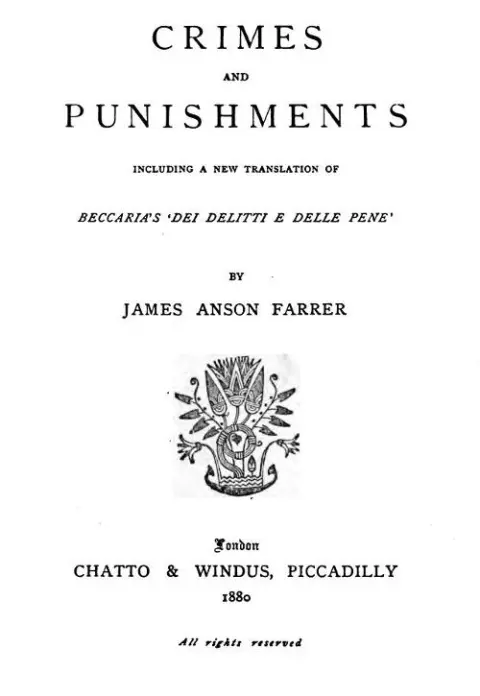
Crimes and Punishments Including a New Translation of Beccaria’s ‘Dei Delitti e delle Pene’
James Anson Farrer
THE CLASSIC COLLECTION · 1879
"Primitive Manners and Customs" by James Anson Farrer is an anthropological study written in the late 19th century. This work explores the cultural and social practices of various primitive societies, examining their beliefs, customs, and moral values as they relate to our understanding of human civilization. The book likely presents a detailed account of the intricate belief systems, social regulations, and moral philosophies found among so-called savage tribes, aiming to provide a more sympathetic and nuanced view of their way of life. The opening of the book establishes a framework for analyzing savage beliefs, suggesting that these beliefs are often misconceived through a biased lens. Farrer discusses the nature of savage intelligence and the complexities of their moral and political systems, revealing contradictions within their cultural practices. For instance, he notes the apparent sophistication of certain rituals juxtaposed with extreme moral behaviors, emphasizing that notions of ethics and community responsibilities often mirror those found in more advanced societies. The author attempts to reclaim the dignity and respects of these tribes by gently critiquing the superficial judgments often placed upon them by outsiders.
Introduction adapted from the source catalogue; source summaries may be automatically generated.
Free to read · English · 82,387 words · No account needed
MAKE TIME FOR A GOOD BOOK
On by default. Untick to stop anonymous reading totals. Each page counts after 10 seconds in view. How this works.
Anonymous counting is on unless you have switched it off.
The Basutos of South Africa are savages, yet the following proverbs are
current among them:—
A good name makes one sleep well.
Stolen goods do not make one grow.
Famine dwells in the house of the quarrelsome.
The thief catches himself.
A lent knife does not come back alone. (i.e. a good deed is
never thrown away.)[122]
Compare, for elevation of mind, these Yoruban proverbs with those already noticed as current in Italy:—
He that forgives gains the victory.
He who injures another injures himself.
Anger benefits no one.
We should not treat others with contempt.[123]
On the other hand, ‘If a great man should wrong you, smile on him,’ may be compared with the Arabic advice about dangerous friends, ‘If a serpent love thee, wear him as a necklace;’ or with the Pashto proverb of the same intention, ‘Though your enemy be a rope of reeds, call him a serpent.’
Here are some more proverbs with whose European equivalents everyone will
be familiar:—
If you can pull out, pull out your own grey hairs. (Oji.)
Before healing others, heal yourself. (Wolof.)
With which we may compare the Chinese:—
Sweep the snow from your own doors without troubling about the frost on your neighbour’s tiles.
Nobody is twice a fool. (Accra.)
Nobody is twice ashamed. (Accra.)
He is a fool whose sheep run away twice. (Oji.)
He dreads a slowworm who has been bitten by a serpent. (Oji.)
With which we may compare our own—
It’s a silly fish that’s caught twice with the same bait.
Or the German—
An old fox is not caught twice in the same trap.
To which both Italy and Holland have exactly similar proverbs.
Perseverance always triumphs. (Basuto.)
The moon does not grow full in a day. (Oji.)
Perseverance is everything.
Who has patience has all things. (Yoruba.)
By going and coming a bird builds its nest. (Oji.)
Which latter may be compared with the Dutch proverb—
By slow degrees a bird builds its nest.
And all of them with the Chinese—
A mulberry-leaf becomes satin with time.
The thread follows the needle.
Its shell follows the snail wherever it goes. (Yoruba.)
As is the sword so is the scabbard. (Oji.)
To which again China supplies a good parallel in
The growth of the mulberry tree follows its early bent.
If nothing touches the palm-leaves they do not rustle. (Oji.)
Nobody hates another without a cause. (Accra.)
A feather does not stick without gum. (A Pashto proverb.)
Your reading position is saved on this browser. Take it to another device with a library code. Reading pages adapt to text, rather than matching a printed edition.
James Anson Farrer
James Anson Farrer
James Anson Farrer
BEHIND THE BOOK
This eBook is for the use of anyone anywhere in the United States and most other parts of the world at no cost and with almost no restrictions whatsoever. You may copy it, give it away or re-use it under the terms of the Project Gutenberg License included with this eBook or online at www.gutenberg.org. If you are not located in the United States, you will have to check the laws of the country where you are located before using this eBook. Read the source licence.
The original source file, including credits and licence, is retained by this library. Request an original-format copy at no charge. Please include the book title and Project Gutenberg identifier #60943.
KEEP YOUR CURIOSITY GOING

Maurice Baring
Francis Greenleaf Allinson & Anne C. E. (Anne Crosby Emery) Allinson
Stuart Dodgson Collingwood
Percy Keese Fitzhugh
Mary Macleod & Edmund Spenser

Cooke Don-Carlos