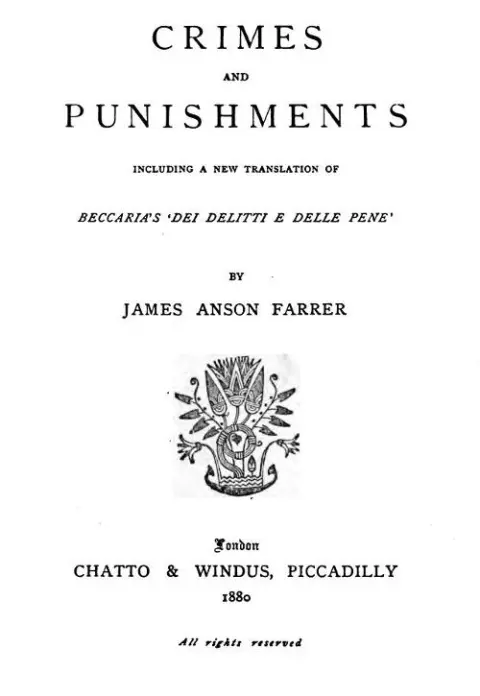
Crimes and Punishments Including a New Translation of Beccaria’s ‘Dei Delitti e delle Pene’
James Anson Farrer
THE CLASSIC COLLECTION · 1879
"Primitive Manners and Customs" by James Anson Farrer is an anthropological study written in the late 19th century. This work explores the cultural and social practices of various primitive societies, examining their beliefs, customs, and moral values as they relate to our understanding of human civilization. The book likely presents a detailed account of the intricate belief systems, social regulations, and moral philosophies found among so-called savage tribes, aiming to provide a more sympathetic and nuanced view of their way of life. The opening of the book establishes a framework for analyzing savage beliefs, suggesting that these beliefs are often misconceived through a biased lens. Farrer discusses the nature of savage intelligence and the complexities of their moral and political systems, revealing contradictions within their cultural practices. For instance, he notes the apparent sophistication of certain rituals juxtaposed with extreme moral behaviors, emphasizing that notions of ethics and community responsibilities often mirror those found in more advanced societies. The author attempts to reclaim the dignity and respects of these tribes by gently critiquing the superficial judgments often placed upon them by outsiders.
Introduction adapted from the source catalogue; source summaries may be automatically generated.
Free to read · English · 82,387 words · No account needed
MAKE TIME FOR A GOOD BOOK
On by default. Untick to stop anonymous reading totals. Each page counts after 10 seconds in view. How this works.
Anonymous counting is on unless you have switched it off.
Thus, according to Castren, an antagonism between absolute good and absolute evil finds no place among the Samoyeds. They have no extreme divinities corresponding in their attributes to Ahriman and Ormuzd. ‘The human temper is the divine temper also, good and bad mixed.’[65] Mburri, who, according to one writer, is the evil spirit in Equatorial Africa, is, according to another, the good spirit, or at least the less wicked of the two, both the good and bad receiving worship, and being endowed with much the same powers.[66] The Beetjuans, venerating Morimo as the source of all good and evil that happened to them, were not agreed as to whether he was entirely a beneficent or a malevolent being; and, if they thanked him for benefits, they never hesitated to curse him for ills or for wishes unfulfilled.[67] ‘To the very same image,’ says Bosman of the negroes, ‘they at one time make offerings to God and at another to the devil, so that one image serves them in the capacity of god and devil.’ It was untrue, he declares, that the negroes prayed and made offerings to the devil, though some of them would try to appease a devil by leaving thousands of pots of victuals standing ever ready for his gratification; on the contrary, the devil was annually banished from their towns with great ceremony, being hunted away with dismal cries, and his spirit pelted with wood and stones.[68]
The evidence, again, in this respect concerning the aborigines of America is important. The Winnebagoes are said to have had a tradition that soon after the creation a bad spirit appeared on the scene, whose attempts to vie with the products of the Good Spirit resulted in making a negro in failure of an Indian, a grizzly bear in failure of a black one, and snakes which were endowed with venom; he also it was who made all the worthless trees, thistles, and weeds, who tempted Indians to lie, murder, and steal, and who receives bad Indians when they die. The suspicion, however, of Christian influence among this tribe makes the tradition of little value to the argument. Turning to other evidence, amid Schoolcraft’s reiterated statements of the original dualism of Indian theology, whereby the Indian was careful ‘to guard his good and merciful God from all evil acts and intentions, by attributing the whole catalogue of evil deeds among the sons of men to the Great Bad Spirit of his theology,’ we yet find this admission, that ‘it is impossible to witness closely the rites and ceremonies which the tribes practise in their sacred and ceremonial societies without perceiving that there is no very accurate or uniform discrimination between the powers of the two antagonistical deities.’[69] Mr. Pond, who resided with the Sioux Indians for eighteen years and had every opportunity to become acquainted with such matters, declares that it was ‘next to impossible to penetrate’ into the subject of their divinities; but he was never able to discover ‘the least degree of evidence that they divide the gods into classes of good and evil,’ nor did he believe that they ever distinguished the Great Spirit from other divinities ‘till they learnt to do so from intercourse with the whites;’ for they had no chants, feasts, dances, nor sacrificial rites which had any reference to such a being, or which, if they had, were not of recent origin.[70] Of the same people says Mr. Prescott, a man related to and resident among them many years: ‘As to their belief in evil spirits, they do not understand the difference between a great good spirit and a great evil spirit, as we do. The idea the Indians have is that a spirit can be good if necessary, and do evil if it thinks fit.’ They ‘know very little about whether the Great Spirit has anything to do with their affairs, present or future.’ Their idea of the Great Spirit is of the vaguest possible kind, since they lack entirely any conception of his power, or of the mode of, or of a reason for, man’s creation. The Great Spirit they believe made everything but the wild rice and the thunder; and they have been known to accuse their deity of badness in sending storms to cause them misery.[71] In the same way the Comanches of Texas neither worship the evil spirit nor are aware of his existence, ‘attributing everything to arise from the Great Spirit, whether of good or evil.’[72] Had the ancient Jews been described by Greek travellers instead of by themselves, we may fairly suspect that they would have been introduced to posterity as a people, consciously theistic indeed, but at the same time as addicted, in most of their rites, to demonolatry and the propitiation of imaginary evil beings. The true view would seem to be that the theology of the lower races does not admit of that preciseness of terminology, of that clear distinction of qualities, of that systematic marshalling of powers, which has been so often predicated of it, but that in its growth it undergoes a period of flux and change similar to that which may be seen to occur in the evolution of the lowest forms of physical life into more determinate types of being.
Your reading position is saved on this browser. Take it to another device with a library code. Reading pages adapt to text, rather than matching a printed edition.
James Anson Farrer
James Anson Farrer
James Anson Farrer
BEHIND THE BOOK
This eBook is for the use of anyone anywhere in the United States and most other parts of the world at no cost and with almost no restrictions whatsoever. You may copy it, give it away or re-use it under the terms of the Project Gutenberg License included with this eBook or online at www.gutenberg.org. If you are not located in the United States, you will have to check the laws of the country where you are located before using this eBook. Read the source licence.
The original source file, including credits and licence, is retained by this library. Request an original-format copy at no charge. Please include the book title and Project Gutenberg identifier #60943.
KEEP YOUR CURIOSITY GOING

Maurice Baring
Francis Greenleaf Allinson & Anne C. E. (Anne Crosby Emery) Allinson
Stuart Dodgson Collingwood
Percy Keese Fitzhugh
Mary Macleod & Edmund Spenser

Cooke Don-Carlos