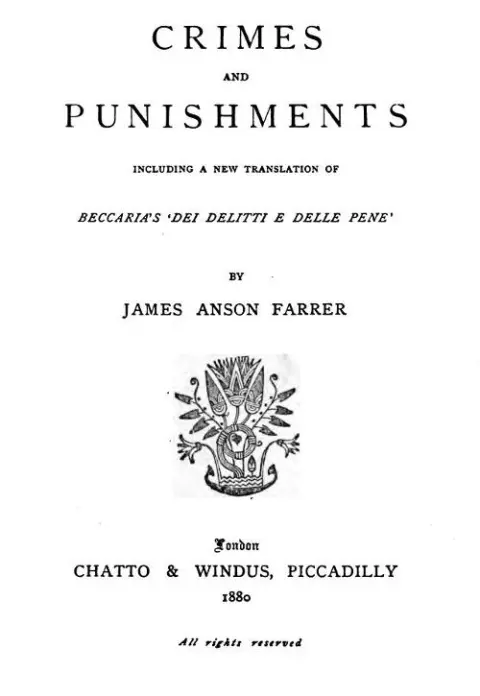
Crimes and Punishments Including a New Translation of Beccaria’s ‘Dei Delitti e delle Pene’
James Anson Farrer
THE CLASSIC COLLECTION · 1879
"Primitive Manners and Customs" by James Anson Farrer is an anthropological study written in the late 19th century. This work explores the cultural and social practices of various primitive societies, examining their beliefs, customs, and moral values as they relate to our understanding of human civilization. The book likely presents a detailed account of the intricate belief systems, social regulations, and moral philosophies found among so-called savage tribes, aiming to provide a more sympathetic and nuanced view of their way of life. The opening of the book establishes a framework for analyzing savage beliefs, suggesting that these beliefs are often misconceived through a biased lens. Farrer discusses the nature of savage intelligence and the complexities of their moral and political systems, revealing contradictions within their cultural practices. For instance, he notes the apparent sophistication of certain rituals juxtaposed with extreme moral behaviors, emphasizing that notions of ethics and community responsibilities often mirror those found in more advanced societies. The author attempts to reclaim the dignity and respects of these tribes by gently critiquing the superficial judgments often placed upon them by outsiders.
Introduction adapted from the source catalogue; source summaries may be automatically generated.
Free to read · English · 82,387 words · No account needed
MAKE TIME FOR A GOOD BOOK
On by default. Untick to stop anonymous reading totals. Each page counts after 10 seconds in view. How this works.
Anonymous counting is on unless you have switched it off.
It is easy to conceive how, when once the idea had been reached that the brave deserved compensation in the next world for their earthly courage, the poor for their earthly wretchedness, or the sick for their earthly sufferings, and all men for the misfortune of premature death, it should also be inferred, as soon as any criterion between goodness and badness more refined than the mere difference between courage and cowardice had been attained, that the good should have some advantage over the bad, and from such an inference to a complete theory of retribution and punishment of the bad the logical steps seem fairly obvious. Few things, indeed, are more remarkable among the lower races than the general absence of the ideas we associate with hell.[26] At most the idea of future punishment is negative, the lives of slaves and cowards terminating in a total cessation of consciousness, as opposed to its continuance for warriors and chiefs. Still, the idea of difficulty in attaining the blessed abodes, such as that above noticed as prevalent in Greenland—an idea, as Mr. Tylor suggests, probably connected with the sun’s passage across the sky to the west, where the happy land is so generally figured to lie—is very common, and from such an idea it is natural to connect the difficulty of the journey to Paradise with the destruction of those whose presence in it would mar its blessedness.
The trial of merit, varying with experiences of physical geography, generally lies either in the passage of a river or gulf by a narrow bridge, or in the climbing of a steep mountain. The Choctaws, for instance, believe that the dead have to pass a long and slippery pine-log, across a deep and rapid river, on the other side of which stand six persons, who pelt new-comers with stones and cause the bad ones to fall in.[27] In Khond theology the judge of the dead resides beyond the sea, on the smooth and slippery Leaping Rock, below which flows a black unfathomable river; and the souls of men take bold leaps to reach the rock, those that fail contracting a deformity which is transferred to the next soul animated on earth. The Blackfoot Indians, on the other hand, believe that departed souls have to climb a steep mountain, from the summit of which is seen a great plain, with new tents and swarms of game; that the dwellers in that happy plain advance to them and welcome those who have led a good life, but reject the bad—those who have soiled their hands in the blood of their countrymen—and throw them headlong from the mountain; whilst women who have been guilty of infanticide never reach the mountain at all, but hover round the seat of their crimes with branches of trees tied to their legs. The Fijians think that even the brave have some difficulty in reaching the judgment-seat of Ndengei, and they provide the dead with war-clubs to resist Sama and his host, who will dispute their passage. But celibacy is in their eyes apparently the only offence which calls for peremptory and hopeless punishment. Unmarried Fijians are dashed to pieces by Nangananga as in vain attempts to steal round to a certain reef they are driven ashore by the rising tide.[28] The Norwegian Lapps consider that abstinence from stealing, lying, and quarrelling entitles a man to compensation hereafter. Such receive after death a new body, and live with the higher gods in Saiwo, and indulge in hunting and magic, brandy-drinking and smoking, to a far higher degree than was possible on earth. Wicked men, perjurers, and thieves go to the place of the bad spirits, to Gerre-Mubben-Aimo.[29] The idea of compensation of the good leads naturally to the idea of retribution for the bad; and even among the Guinea Coast negroes we find future inducements to the practice of such moral duties as they recognise. For they are wont to make for themselves idols, called Sumanes whose favour they endeavour to secure by abstinence from certain kinds of foods, believing that after death those who have been constant in their vows of abstinence and in offerings to the Sumanes will come to a large inland river, where a god inquires of everyone how he has lived his days on earth, and those who have not kept their vows are drowned and destroyed for ever. The inland-dwelling negroes declare that at this river dwells a powerful god in a beautiful house, which, though always exposed, is never touched by rain. He knows all past and present things; he can send any kind of weather, he can heal sicknesses and work miracles. Before him must all the dead appear; the good to receive a happy and peaceful life, the bad to be killed for ever by the large wooden club which hangs before his door. Lastly, it may be noticed that negro tribes believe that death will take them to the land of the European and give them the white man’s skin; but, as they generally paint their devil white, we cannot be sure that such a change is not rather dreaded as a punishment for the bad than regarded as a change for the better.
Your reading position is saved on this browser. Take it to another device with a library code. Reading pages adapt to text, rather than matching a printed edition.
James Anson Farrer
James Anson Farrer
James Anson Farrer
BEHIND THE BOOK
This eBook is for the use of anyone anywhere in the United States and most other parts of the world at no cost and with almost no restrictions whatsoever. You may copy it, give it away or re-use it under the terms of the Project Gutenberg License included with this eBook or online at www.gutenberg.org. If you are not located in the United States, you will have to check the laws of the country where you are located before using this eBook. Read the source licence.
The original source file, including credits and licence, is retained by this library. Request an original-format copy at no charge. Please include the book title and Project Gutenberg identifier #60943.
KEEP YOUR CURIOSITY GOING

Maurice Baring
Francis Greenleaf Allinson & Anne C. E. (Anne Crosby Emery) Allinson
Stuart Dodgson Collingwood
Percy Keese Fitzhugh
Mary Macleod & Edmund Spenser

Cooke Don-Carlos