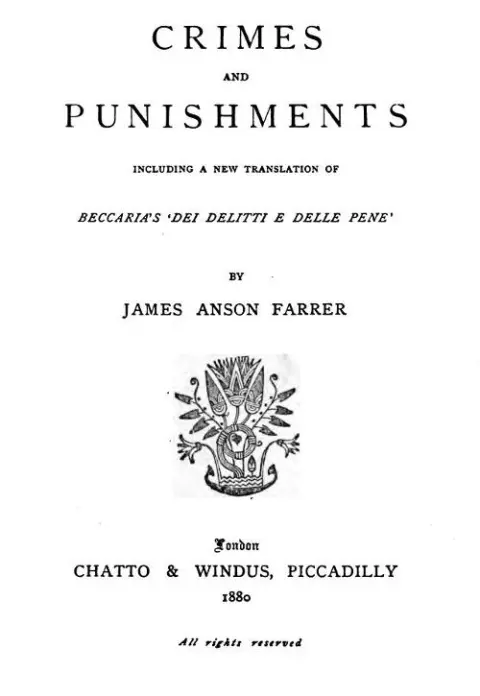
Crimes and Punishments Including a New Translation of Beccaria’s ‘Dei Delitti e delle Pene’
James Anson Farrer
THE CLASSIC COLLECTION · 1879
"Primitive Manners and Customs" by James Anson Farrer is an anthropological study written in the late 19th century. This work explores the cultural and social practices of various primitive societies, examining their beliefs, customs, and moral values as they relate to our understanding of human civilization. The book likely presents a detailed account of the intricate belief systems, social regulations, and moral philosophies found among so-called savage tribes, aiming to provide a more sympathetic and nuanced view of their way of life. The opening of the book establishes a framework for analyzing savage beliefs, suggesting that these beliefs are often misconceived through a biased lens. Farrer discusses the nature of savage intelligence and the complexities of their moral and political systems, revealing contradictions within their cultural practices. For instance, he notes the apparent sophistication of certain rituals juxtaposed with extreme moral behaviors, emphasizing that notions of ethics and community responsibilities often mirror those found in more advanced societies. The author attempts to reclaim the dignity and respects of these tribes by gently critiquing the superficial judgments often placed upon them by outsiders.
Introduction adapted from the source catalogue; source summaries may be automatically generated.
Free to read · English · 82,387 words · No account needed
MAKE TIME FOR A GOOD BOOK
On by default. Untick to stop anonymous reading totals. Each page counts after 10 seconds in view. How this works.
Anonymous counting is on unless you have switched it off.
It is possible, indeed, that in many cases the attention shown by savages to their dead, by the burial of property which would have been of use to the survivors, or by the placing of food on their graves at periodical feasts, arose rather from fear than from any kinder motive, dictated by the dread always felt by the living of the dead and the wish to satisfy them, if possible, by some peace-offering. The Samoyed sorcerer, after a funeral, goes through the ceremony of soothing the departed, that he may not trouble the survivors nor take their best game; a feeling still further illustrated by their habit of not taking the dead out to be buried by the regular hut door, but by a side-opening, that if possible they may not find their way back—a habit found also in Greenland and in many other parts of the world. For the fear of the dead is a universal sentiment, common no less to the Abipones, who thought that sorcerers could bring the dead from their graves to visit the living, or to the Kaffirs, who think that bad men alone live a second time and try to kill the living by night, than it is to the ignorant who still believe in the blood-sucking vampire, a belief which little more than a century ago amounted to a kind of epidemic in Hungary, resulting in a general disinterment and the burning or staking of the suspected bodies. In the sepulture, therefore, of men with their possessions, it was probably the original thought that the dead would be less likely to haunt the dwellings of the living, if they were not compelled to re-seek upon earth those articles of daily use which they knew were to be found there.
But the savage belief in a future is very variable; nor could we expect to find it much affected by ideas of earthly morality, when such ideas themselves hardly appear to exist. At most it is men of rank and courage who live again, while cowards and the commonalty perish utterly; generally there is no qualification of any kind. The Bedouins have no fixed belief at all, some thinking that after death they are changed into screech-owls, and others that if a camel is slain on their graves they will return to life riding on it, but otherwise on foot. All North American Indians are said to believe in the continual life of the soul, and, because they think themselves the highest beings on earth, postulate a hereafter where all their earthly longings will be satisfied.[23] But they trouble themselves little about it, thinking that the god they recognise as supreme is too good to punish them. Thus the Indians of Arauco look forward to an eternal life in a beautiful land which lies to the west, far over the sea, whither souls are taken by the sailor Tempulazy and where no punishment is expected: for Pillican, their god, the Lord of the world, would not inflict pain.[24] The Tunguz Lapps look on the next life as simply a continuation of this one; in it there will be no punishment, for here everyone is as good as he can be, and the gods kill men reluctantly, but are thereby satisfied. In the Polynesian future there is a similar absence of any idea of retribution. There is, for instance, no moral qualification, but only one of rank, for Bolotu, that happy land of the dead which lies far away to the north-west of Tonga, beyond the reach of Tongan boats and greater than all the Tongan islands put together, wherein abound beautiful and useful trees, whose plucked fruit instantly grows again; where a delicious fragrance fills the air, and birds of the loveliest colours sit upon the trees; where the woods swarm with pigs, which are immortal so long as they are not eaten by the gods. Nothing, indeed, shows better how independent is imagination of race than the great similarity of those idealised earths which constitute the heavens of the most distant savage tribes. The American Indian, who visits in a dream the unseen world, reports of it, in language recalling that of Homer, that it is a land where there is neither day nor night, where the sun never rises nor sets; where rain and tomahawks and arrows are never seen; where pipes abound everywhere, lying ready to be smoked; where the earth is ever green, the trees ever in leaf; where there is no need of bearskin nor of hut; where, if you would travel, the rivers will take your boat whithersoever you will, without the need of rudder or of paddle. And just as in the Tongan Bolotu the plucked fruit is replaced, so there the goat voluntarily offers its shoulder to the hungry man, in full confidence that it will grow again, and the beaver for the same reason makes a ready sacrifice of its beautiful tail.[25]
Your reading position is saved on this browser. Take it to another device with a library code. Reading pages adapt to text, rather than matching a printed edition.
James Anson Farrer
James Anson Farrer
James Anson Farrer
BEHIND THE BOOK
This eBook is for the use of anyone anywhere in the United States and most other parts of the world at no cost and with almost no restrictions whatsoever. You may copy it, give it away or re-use it under the terms of the Project Gutenberg License included with this eBook or online at www.gutenberg.org. If you are not located in the United States, you will have to check the laws of the country where you are located before using this eBook. Read the source licence.
The original source file, including credits and licence, is retained by this library. Request an original-format copy at no charge. Please include the book title and Project Gutenberg identifier #60943.
KEEP YOUR CURIOSITY GOING

Maurice Baring
Francis Greenleaf Allinson & Anne C. E. (Anne Crosby Emery) Allinson
Stuart Dodgson Collingwood
Percy Keese Fitzhugh
Mary Macleod & Edmund Spenser

Cooke Don-Carlos