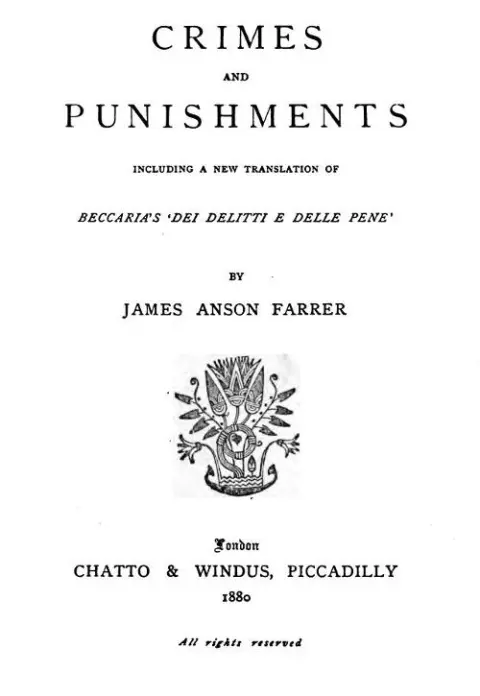
Crimes and Punishments Including a New Translation of Beccaria’s ‘Dei Delitti e delle Pene’
James Anson Farrer
THE CLASSIC COLLECTION · 1879
"Primitive Manners and Customs" by James Anson Farrer is an anthropological study written in the late 19th century. This work explores the cultural and social practices of various primitive societies, examining their beliefs, customs, and moral values as they relate to our understanding of human civilization. The book likely presents a detailed account of the intricate belief systems, social regulations, and moral philosophies found among so-called savage tribes, aiming to provide a more sympathetic and nuanced view of their way of life. The opening of the book establishes a framework for analyzing savage beliefs, suggesting that these beliefs are often misconceived through a biased lens. Farrer discusses the nature of savage intelligence and the complexities of their moral and political systems, revealing contradictions within their cultural practices. For instance, he notes the apparent sophistication of certain rituals juxtaposed with extreme moral behaviors, emphasizing that notions of ethics and community responsibilities often mirror those found in more advanced societies. The author attempts to reclaim the dignity and respects of these tribes by gently critiquing the superficial judgments often placed upon them by outsiders.
Introduction adapted from the source catalogue; source summaries may be automatically generated.
Free to read · English · 82,387 words · No account needed
MAKE TIME FOR A GOOD BOOK
On by default. Untick to stop anonymous reading totals. Each page counts after 10 seconds in view. How this works.
Anonymous counting is on unless you have switched it off.
[396] Callaway, Religious System of the Amazulu, Part i. 122-3.
[397] Pinkerton, xvi. 689.
[398] Callaway, Zulu Nursery Tales, i. 152.
[399] Leslie, 81, 98.
[400] Ibid. 79.
[401] Ibid. 169.
[402] Appleyard, Kafir Grammar, 13.
[403] Mrs. Cookson, Legends of the Manx, 23.
[404] Prof. Max Müller, Science of Language, ii. 444.
[405] Steller, 253-4.
[406] Léouzon le Duc, La Finlande, 51, 87. ‘À dire vrai, tous les dieux de la mythologie finnoise ne sont que les magiciens.’
[407] Bancroft, v. 23.
[408] Brinton, Myths of the New World, 164.
[409] Vishnu Purana, 575.
[410] Schirren, 144. Maui wird im Meere geformt, von einem Fisch verschluckt, mit diesem ans Land geworfen und herausgeschnitten. Der Fisch ist die Erde welche die Sonne zur Nacht verschlingt; der Himmel im Osten befreit die Sonne aus der Erde.
[411] Bancroft, v. 23.
[412] Brinton, 180.
[413] Waitz (Anthropologie, iv. 394, 448, 455) adopts the view of the human origin of Viracocha.
[414] Bleek, Hottentot Fables, 75.
[415] Schiefner, Kalewala, 129. In the lamentations over an approaching marriage, an old man says to the bride:
‘Seinen Mond nannt’ dich der Vater,
Sonnenschein nannt’ dich die Mutter,
Wasserschimmer dich der Bruder,’ &c.
[416] Fiske, 35, 76.
[417] Schweinfurth, Heart of Africa, ii. 326.
[418] Steller, 279.
[419] Williams, Fiji, 204.
[420] Rink, Tales, &c. of the Esquimaux, 90.
[421] Algic Researches, ii. 226.
[422] Hiawatha, Canto xxi.
[423] Steller, 267. ‘Die Italmanes geben nach ihrer ungemein lebhaften Phantasie von allen Dingen Raison, und lassen nicht das geringste ohne Critic vorbei.’ Yet they had neither reverence nor names for the stars, calling only the Great Bear the moving star, 281.
[424] Travels in Australia, i. 261, 297.
[425] Thompson, South Africa, ii. 34.
[426] Aubrey’s Miscellanies, 197.
[427] Those who doubt the existence of much popular superstition in this century may judge of the amount and value of the evidence by referring to the following books: 1. All the volumes of Notes and Queries, Index, Folk-Lore. 2. Harland and Wilkinson, Lancashire Folk-Lore, 1867. 3. Henderson’s Notes on the Folk-Lore of the Northern Counties of England and the Borders, 1866. 4. Kelly’s Curiosities of Indo-European Tradition and Folk-Lore, 1863. 5. Stewart’s Popular Superstitions of the Highlanders of Scotland, 1851. 6. Sternberg’s Dialect and Folk-Lore of Northamptonshire, 1851. 7. Thorpe’s Northern Mythology, 1851. 8. Birlinger, Volksthümliches aus Schwaben, 1861. 9. Koehler, Volksbrauch im Voigtlande, 1867. 10. Bosquet, La Normandie Romanesque, 1845.
[428] Origin of Civilisation, 33.
[429] Ibid., 23.
[430] Hammerton, Round my House, 254.
[431] Holderness, Journey from Riga to the Crimea, 254.
[432] Grimm, Deutsche Mythologie, ‘Aberglaube,’ cases 576, 664, 698, 898. These practices, even if no longer existent, throw light upon those that still are.
[433] Amélie Bosquet, La Normandie pittoresque, 217.
[434] Fletcher, Russe Commonweal, 78.
[435] Schoolcraft, Indian Tribes, v. 419.
[436] Kane, 216.
[437] Williams, 248.
[438] Brett, Indian Tribes of Guiana, 369.
[439] Grey, Polynesian Mythology, 111-114.
[440] Cook, vi. 192.
[441] Doolittle, Social Life of the Chinese, ii. 328.
Your reading position is saved on this browser. Take it to another device with a library code. Reading pages adapt to text, rather than matching a printed edition.
James Anson Farrer
James Anson Farrer
James Anson Farrer
BEHIND THE BOOK
This eBook is for the use of anyone anywhere in the United States and most other parts of the world at no cost and with almost no restrictions whatsoever. You may copy it, give it away or re-use it under the terms of the Project Gutenberg License included with this eBook or online at www.gutenberg.org. If you are not located in the United States, you will have to check the laws of the country where you are located before using this eBook. Read the source licence.
The original source file, including credits and licence, is retained by this library. Request an original-format copy at no charge. Please include the book title and Project Gutenberg identifier #60943.
KEEP YOUR CURIOSITY GOING

Maurice Baring
Francis Greenleaf Allinson & Anne C. E. (Anne Crosby Emery) Allinson
Stuart Dodgson Collingwood
Percy Keese Fitzhugh
Mary Macleod & Edmund Spenser

Cooke Don-Carlos