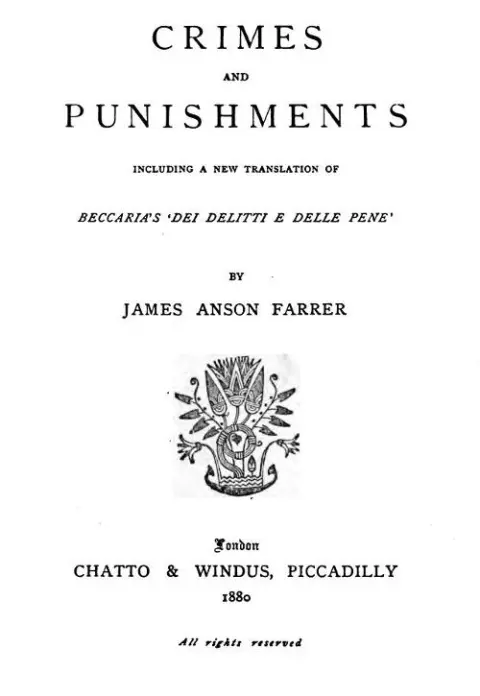
Crimes and Punishments Including a New Translation of Beccaria’s ‘Dei Delitti e delle Pene’
James Anson Farrer
THE CLASSIC COLLECTION · 1879
"Primitive Manners and Customs" by James Anson Farrer is an anthropological study written in the late 19th century. This work explores the cultural and social practices of various primitive societies, examining their beliefs, customs, and moral values as they relate to our understanding of human civilization. The book likely presents a detailed account of the intricate belief systems, social regulations, and moral philosophies found among so-called savage tribes, aiming to provide a more sympathetic and nuanced view of their way of life. The opening of the book establishes a framework for analyzing savage beliefs, suggesting that these beliefs are often misconceived through a biased lens. Farrer discusses the nature of savage intelligence and the complexities of their moral and political systems, revealing contradictions within their cultural practices. For instance, he notes the apparent sophistication of certain rituals juxtaposed with extreme moral behaviors, emphasizing that notions of ethics and community responsibilities often mirror those found in more advanced societies. The author attempts to reclaim the dignity and respects of these tribes by gently critiquing the superficial judgments often placed upon them by outsiders.
Introduction adapted from the source catalogue; source summaries may be automatically generated.
Free to read · English · 82,387 words · No account needed
MAKE TIME FOR A GOOD BOOK
On by default. Untick to stop anonymous reading totals. Each page counts after 10 seconds in view. How this works.
Anonymous counting is on unless you have switched it off.
[11] Klemm, Cultur-Geschichte, ii. 155-7, where the beliefs are referred to. Franklin’s Second Journey, p. 308. They are so remarkable as to arouse suspicion that European influence has affected the native imagination; but the influence, if any, seems beyond the reach of criticism in this as in other striking cases of analogy.
[12] Schoolcraft, I. T., iv. 255.
[13] Hutton, Voyage to Africa, p. 320; and Bosman in Pinkerton, xvi.
396.
[14] Schoolcraft, iv. 90.
[15] Klemm, Cultur-Geschichte, vii. 368.
[16] Trans. Eth. Soc. iii. 233, 234; Oldfield’s Aborigines of
Australia.
[17] Bancroft, Native Races of the Pacific States, iii. 112.
[18] Brinton, pp. 198, 199.
[19] Brinton, p. 210.
[20] Catlin, ii. 127. For some other deluge-myths of a similar kind see Bancroft, iii. 46, 47, 64, 75, 76, 88, 100; Turner’s Polynesia, p. 249; Ellis, Polynesian Researches, i. 386; Franklin, i. 113; Sir G. Grey, Polynesian Mythology, 61; Brett, Indian Tribes of Guiana, pp. 381, 385, 398, 399; Dall, Alaska, p. 423.
[21] Koehler, Volksbrauch im Voightland, p. 444. ‘Dem Verstorbenen giebt man die Gegenstände mit in das Grab, welche er im Leben am liebsten hatte: so ist es geschehen, dass man selbst Regenschirm und Gummischühe mitgab. (Reichenbach.) ... In Schweden hat man dem Todten Tabakspfeife, Tabaksbeutel, Geld und Feuerzeug mitgegeben, damit er nicht spuke.... In einem Grabe des Gottesackers zu Elsterberg wurde eine Anzahl Kupfermünzen gefunden.’
[22] This fact has been denied in King’s Greek Church, p. 358, but it is mentioned by most of the earliest English travellers in Russia; by Chancelor, in Hackluyt’s Voyages, i. 283; Jenkinson, ibid., p. 361; and Fletcher, Russe Commonwealth, 106; as well as by later ones.
[23] Klemm, Cultur-Geschichte, ii. 165.
[24] Stevenson, Travels in South America, i. 58.
[25] Klemm, Cultur-Geschichte, ii. 166.
[26] See Brinton, p. 242. ‘Nowhere (in the New World) was any well-defined doctrine that moral turpitude was judged and punished in the next world. No contrast is discoverable between a place of torments and a realm of joy; at the worst but a negative castigation awaited the liar, the coward, and the niggard.’
[27] For other instances of the myth of the heaven-bridge, and its wide range, see Mr. Tylor’s Early History of Mankind, p. 348.
[28] Williams, Fiji, i. 244.
[29] Klemm, Cultur-Geschichte, iii. 71-77.
[30] Mariner, ii. 137.
[31] Klemm, Cultur-Geschichte, ii. 315. ‘Jedes Thier, auch die kleinste Fliege, ersteht sofort nach ihrem Tode und lebt unter der Erde.’
[32] Klemm, Cultur-Geschichte, iii. 83. ‘Endlich wurden die besonderten Theile nebst den Knochen in der Kiste begraben. Man glaubte, das Opferthier werde von den Göttern wieder belebt und in den Saiwo versetzt.’
[33] Dall, Alaska, p. 89.
[34] Schoolcraft, I. T., v. 91, 403; ii. 68.
[35] Schoolcraft, Indian Tribes, iii. 268.
[36] Ellis, Polynesian Researches, i. 350.
[37] Reade, Savage Africa, p. 536.
[38] Cape Monthly Magazine, July 1874.
[39] Bleek, Bushman Folk-lore, pp. 15, 18.
[40] Steller, Kamschatka, p. 280.
[41] Waitz, Anthropologie der Naturvölker, ii. 170.
[42] Callaway, Religious System of the Amazulu, pt. ii. 182.
[43] Latham, Descriptive Ethnology, ii. 437-444.
[44] Waitz, ii. 169.
[45] Ellis, i. 402.
[46] Brinton, Myths of the New World, p. 297.
[47] Page 150.
[48] Pinkerton, xvi. 304.
[49] Pinkerton, xvi. 388, 874.
Your reading position is saved on this browser. Take it to another device with a library code. Reading pages adapt to text, rather than matching a printed edition.
James Anson Farrer
James Anson Farrer
James Anson Farrer
BEHIND THE BOOK
This eBook is for the use of anyone anywhere in the United States and most other parts of the world at no cost and with almost no restrictions whatsoever. You may copy it, give it away or re-use it under the terms of the Project Gutenberg License included with this eBook or online at www.gutenberg.org. If you are not located in the United States, you will have to check the laws of the country where you are located before using this eBook. Read the source licence.
The original source file, including credits and licence, is retained by this library. Request an original-format copy at no charge. Please include the book title and Project Gutenberg identifier #60943.
KEEP YOUR CURIOSITY GOING

Maurice Baring
Francis Greenleaf Allinson & Anne C. E. (Anne Crosby Emery) Allinson
Stuart Dodgson Collingwood
Percy Keese Fitzhugh
Mary Macleod & Edmund Spenser

Cooke Don-Carlos