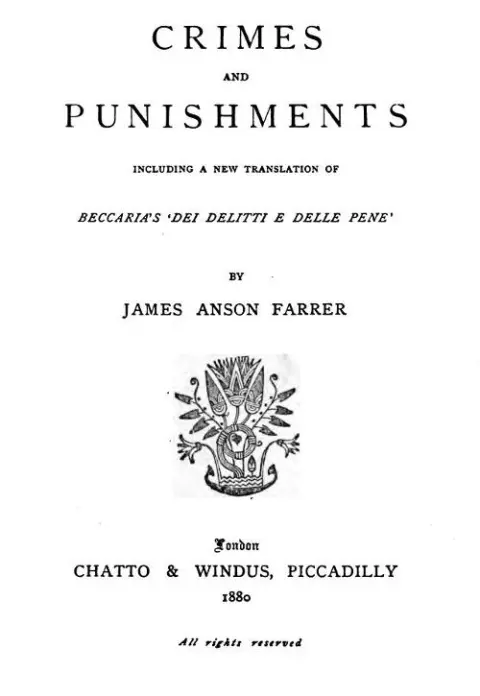
Crimes and Punishments Including a New Translation of Beccaria’s ‘Dei Delitti e delle Pene’
James Anson Farrer
THE CLASSIC COLLECTION · 1879
"Primitive Manners and Customs" by James Anson Farrer is an anthropological study written in the late 19th century. This work explores the cultural and social practices of various primitive societies, examining their beliefs, customs, and moral values as they relate to our understanding of human civilization. The book likely presents a detailed account of the intricate belief systems, social regulations, and moral philosophies found among so-called savage tribes, aiming to provide a more sympathetic and nuanced view of their way of life. The opening of the book establishes a framework for analyzing savage beliefs, suggesting that these beliefs are often misconceived through a biased lens. Farrer discusses the nature of savage intelligence and the complexities of their moral and political systems, revealing contradictions within their cultural practices. For instance, he notes the apparent sophistication of certain rituals juxtaposed with extreme moral behaviors, emphasizing that notions of ethics and community responsibilities often mirror those found in more advanced societies. The author attempts to reclaim the dignity and respects of these tribes by gently critiquing the superficial judgments often placed upon them by outsiders.
Introduction adapted from the source catalogue; source summaries may be automatically generated.
Free to read · English · 82,387 words · No account needed
MAKE TIME FOR A GOOD BOOK
On by default. Untick to stop anonymous reading totals. Each page counts after 10 seconds in view. How this works.
Anonymous counting is on unless you have switched it off.
Quite distinct, again, either from the real or pretended reluctance of a savage girl to become a bride, or from the custom of forcing an avaricious parent to a settlement by the shorter process of taking first and paying afterwards, is the custom of stealing women from the same or a neighbouring clan, a custom which prevailed widely in Ireland and Scotland in the seventeenth and eighteenth centuries, and which in the latter country has been ‘glorified in a whole literature of songs and ballads.’[348]
That polygamy and wife-purchase and artificial tribal regulations often lead to such a result cannot be denied; but that it is anywhere a system, sustained by prejudices, whencesoever derived, seems completely unwarranted by the evidence hitherto collected. The Coinmen of Patagonia, who made annual inroads on the Tekeenica tribe, killing the men and carrying off not only the women but the children, dogs, arrows, spears, and canoes, seem to have been actuated rather by the ordinary motives of freebooters (by such motives, for instance, as induced our early convict settlers in Tasmania to set off with their bullock-chains to make captives of the native women[349]) than by any scruples of marrying relations at home. Carib wives taken in war were accounted slaves; and so far were the Caribs from being dependent on aggression for their wives, that before their customs were modified by acquaintance with the Christians their only legitimate wives were their cousins.[350] If a man had no cousin to marry, or put off doing so till it was too late, he might then marry some non-relative, with the consent of her parents. At the festival that followed a successful war the parents vied with one another in offering their daughters as wives to those who were praised by their captains as having fought with bravery. The Caribs of the continent differed from those of the islands in that men and women spoke the same language, not having corrupted their native tongue by marriages with foreign women.[351] According to Humboldt, the language of the Caribs of the continent was the same, from the source of the Rio Branco to the steppes of Cumana; and the pride of race which led them to withdraw from every other people, and was the cause of the failure of all missionary efforts that tried to combine them with villages containing people of another nation and speaking another idiom, would surely have militated against making exogamy a preliminary condition of matrimony.[352] Humboldt, indeed, says that polygamy was more extensively practised by the Caribs and other nations that ‘preserved the custom of carrying off young girls from the neighbouring tribe;’ but it would be contrary to all previous accounts of the people to suppose these were their only wives, such a supplement to domestic felicity being everywhere the common reward, though seldom the chief object, of successful war. The curious difference in the language of the men and of the women found to exist among the Caribs of the West Indian Archipelago, and attributed by tradition to the conquest of a former people on the islands, whose wives the conquerors appropriated, has perhaps been rather exaggerated, for in a list of 488 words and phrases employed by both sexes, in only 36 is there any difference marked between the language of the men and that of the women. The origin of the difference may be doubted, as there were also words and phrases used by the old men of the people which the younger ones might not use; and there was a war-dialect of which neither women, girls, or boys had any knowledge.[353] But probably the difference arose from a custom similar to that of the Zulus, which makes it unlawful for a woman to use any word containing the sound of her father-in-law’s name or of the names of her husband’s male relations. ‘Whenever the emphatic syllable of either of their proper names occurs in any other word, she must avoid it, by either substituting an entirely new word, or at least another syllable in its place. Hence this custom has given rise to an almost distinct language among the women.’[354] In consequence of this Hlonipa custom, according to another witness, ‘the language at this present time almost presents the phenomenon of a double one.’[355] That the Caribs maintained the common etiquette of reserve between parents and children-in-law,[356] makes it not improbable that the reserve extended itself to their language, and thus produced the same phenomenon that we find in South Africa.
Your reading position is saved on this browser. Take it to another device with a library code. Reading pages adapt to text, rather than matching a printed edition.
James Anson Farrer
James Anson Farrer
James Anson Farrer
BEHIND THE BOOK
This eBook is for the use of anyone anywhere in the United States and most other parts of the world at no cost and with almost no restrictions whatsoever. You may copy it, give it away or re-use it under the terms of the Project Gutenberg License included with this eBook or online at www.gutenberg.org. If you are not located in the United States, you will have to check the laws of the country where you are located before using this eBook. Read the source licence.
The original source file, including credits and licence, is retained by this library. Request an original-format copy at no charge. Please include the book title and Project Gutenberg identifier #60943.
KEEP YOUR CURIOSITY GOING

Maurice Baring
Francis Greenleaf Allinson & Anne C. E. (Anne Crosby Emery) Allinson
Stuart Dodgson Collingwood
Percy Keese Fitzhugh
Mary Macleod & Edmund Spenser

Cooke Don-Carlos