
The Writing of News A Handbook with Chapters on Newspaper Correspondence and Copy Reading
Charles G. (Charles Griffith) Ross
THE CLASSIC COLLECTION · 1896
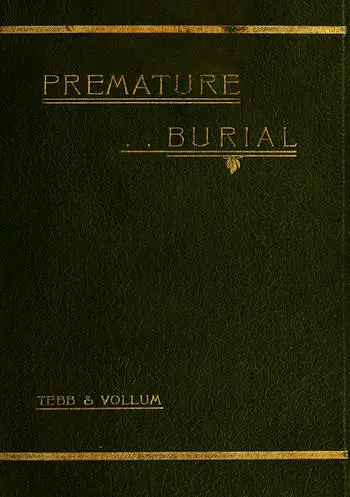
"Premature Burial and How It May Be Prevented" by William Tebb and Col. Edward Perry Vollum is a scientific publication written in the late 19th century. This work delves into the unsettling topic of premature burial, focusing on conditions such as trance, catalepsy, and other forms of suspended animation that can lead to misdiagnosis of death. The authors aim to both inform the public of the real dangers associated with hasty burials and propose reforms in burial practices to mitigate these risks. The opening of the book begins with a preface that sets the stage for the urgent discussion of premature burial, describing how personal experiences motivated the authors to investigate this distressing issue. Tebb recounts a family situation that highlighted the dangers of being declared dead incorrectly and discusses the collaborative inquiry undertaken with Vollum into various cases across Europe and America. The introduction follows, emphasizing renewed public interest in the last few years surrounding this topic and noting how a range of medical professionals remain skeptical about the existence of death-counterfeits. The authors stress the necessity of reform and attention to this issue, as their examination of evidence reveals a troubling history of negligence related to determining death.
Introduction adapted from the source catalogue; source summaries may be automatically generated.
Free to read · English · 119,296 words · No account needed
MAKE TIME FOR A GOOD BOOK
On by default. Untick to stop anonymous reading totals. Each page counts after 10 seconds in view. How this works.
Anonymous counting is on unless you have switched it off.
Speaking on the subject of premature burial the other day, a well-known London publisher told the author that he personally knew a lady, the daughter of a British Consul, who had been taken for dead on two separate occasions. On the first occasion the lady had been placed in her coffin, and the lid screwed down ready for interment. A friend who had known the supposed deceased called to condole with the family, and said:--“I should like to have a last look at dear L---- if you will only permit me.” The lid was accordingly removed, and the visitor detected, as it seemed to her, signs of life in her friend; she was taken out of her coffin, put in a warm bath, and recovered. Some years later the same lady fell into a cataleptic state after a fever, and was taken for dead. Preparations had been made for the funeral in both instances, but delayed beyond the usual time for interment. She returned to consciousness, and is now living.
Dr. Moore Russell Fletcher in “Suspended Animation and the Danger of Burying Alive,” p. 62, writes:--
“‘Seven hours in a coffin added ten years to my life,’ was the remark of Martin Strong, of Twelfth Street, Philadelphia, some time after quitting the coffin in which his family had placed him for burial, after Dr. Cummings had given a certificate of his death. Frank Stoop, of Clarinda, Iowa, was laid out for burial not long since, a physician having certified to his death; but fortunately he awoke from his state of coma in time to save his life.”
Dr. R. G. S. Chew, of Calcutta, writing to the author, says:--“In 1873 I was a student in the Bishop’s High School, Poonah (Bombay Presidency), where I used to be generally at the head of my class, and when competing for the Science Prizes I was fully determined to take the first prize or none. The Reverend---- Watson, Rector of St. Mary’s Church and Chaplain to our school, knew my disposition, and cautioned me against being too sanguine, lest disappointment might tell very keenly. The disappointment came, and with it much nervous excitability. Shortly after this (Christmas, 1873) my favourite sister was seized with convulsions that carried her off. From the moment of her decease to nearly a month after her interment I entirely lost the power of speech. On the day of the funeral I was parched with thirst, but could not drink, as the water seemed to choke me. My eyes were burning and my head felt like bursting, but I could neither sob nor cry. I felt quite dazed, and followed the procession to the cemetery, where I stood motionless by the open grave; but as soon as they lowered the little coffin into its resting-place I threw myself headlong into the grave and fainted away. Some one pulled me out and carried me home, where I lay in a sort of stupor for nine days, during which Dr. Donaldson attended me most patiently, and I regained consciousness, but was too weak to even sit up in bed. On the 16th January, 1874, I felt a peculiar sensation as of something filling up my throat--no swelling, no pain nor anything that pointed to throat affection--and this getting worse and worse, in spite of everything, I died, as was supposed, on the 18th of January, 1874, and was laid out for burial, as the most careful examination failed to show the slightest traces of life. I had been in this state for twenty hours, and in another three hours would have been closed up for ever, when my eldest sister, who was leaning over the head of my coffin crying over me, declared she saw my lips move. The friends who had come to take their last look at me tried to persuade her it was only fancy, but, as she persisted, Dr. Donaldson was sent for to convince her that I was really dead. For some unexplained reason he had me taken out of the coffin and examined very carefully from head to foot. Noticing a peculiar, soft fluctuating swelling at the base of my neck, just where the clavicles meet the sternum, he went to his brougham, came back with his case of instruments, and, before any one could stop him or ask what he was going to do, laid open the tumour and plunged in a tracheotomy tube, when a quantity of pus escaped, and, releasing the pressure on the carotids and thyroid, was followed by a rush of blood and some movement on my part that startled the doctor. Restoratives were used, and I was slowly nursed back to life; but the tracheotomy tube (I still carry the scar) was not finally removed till September, 1875.”
Your reading position is saved on this browser. Take it to another device with a library code. Reading pages adapt to text, rather than matching a printed edition.
BEHIND THE BOOK
This eBook is for the use of anyone anywhere in the United States and most other parts of the world at no cost and with almost no restrictions whatsoever. You may copy it, give it away or re-use it under the terms of the Project Gutenberg License included with this eBook or online at www.gutenberg.org. If you are not located in the United States, you will have to check the laws of the country where you are located before using this eBook. Read the source licence.
The original source file, including credits and licence, is retained by this library. Request an original-format copy at no charge. Please include the book title and Project Gutenberg identifier #50460.
KEEP YOUR CURIOSITY GOING
Charles G. (Charles Griffith) Ross
Hannah Webster Foster

Emily Lawless
Edwin Hamlin Carr

Charles De Lano Hine
Andrew Ure