
The Writing of News A Handbook with Chapters on Newspaper Correspondence and Copy Reading
Charles G. (Charles Griffith) Ross
THE CLASSIC COLLECTION · 1896
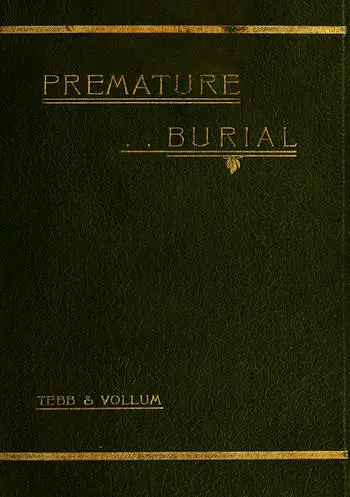
"Premature Burial and How It May Be Prevented" by William Tebb and Col. Edward Perry Vollum is a scientific publication written in the late 19th century. This work delves into the unsettling topic of premature burial, focusing on conditions such as trance, catalepsy, and other forms of suspended animation that can lead to misdiagnosis of death. The authors aim to both inform the public of the real dangers associated with hasty burials and propose reforms in burial practices to mitigate these risks. The opening of the book begins with a preface that sets the stage for the urgent discussion of premature burial, describing how personal experiences motivated the authors to investigate this distressing issue. Tebb recounts a family situation that highlighted the dangers of being declared dead incorrectly and discusses the collaborative inquiry undertaken with Vollum into various cases across Europe and America. The introduction follows, emphasizing renewed public interest in the last few years surrounding this topic and noting how a range of medical professionals remain skeptical about the existence of death-counterfeits. The authors stress the necessity of reform and attention to this issue, as their examination of evidence reveals a troubling history of negligence related to determining death.
Introduction adapted from the source catalogue; source summaries may be automatically generated.
Free to read · English · 119,296 words · No account needed
MAKE TIME FOR A GOOD BOOK
On by default. Untick to stop anonymous reading totals. Each page counts after 10 seconds in view. How this works.
Anonymous counting is on unless you have switched it off.
“In the cases in which the depression of the vital functions reaches an extreme degree, the patient appears dead to casual and sometimes to careful observation. This condition has been termed ‘death-trance,’ and has furnished the theme for many sensational stories, but the most ghastly incidents of fiction have been paralleled by well-authenticated facts. [The last clause appears in the new edition as follows:--“Persons have certainly been buried in this state, and during the recent epidemic of influenza an Italian narrowly escaped interment during the consequent trance.”]
“The duration of trance has varied from a few hours or days to several weeks, months, or even a year.
“Occasionally it is attended by some vaso-motor disturbance. In a well-authenticated case of death-trance the intense mental excitement produced by the preparations for fastening the coffin lid occasioned a sweat to break out over the body.”
Many notable men have at one time or another been subject to this disorder. Speaking of Benjamin Disraeli, Mr. J. Fitzgerald Molloy, in his “Life of the Gorgeous Lady Blessington,” vol. ii., pp. 37, 38, says that in his “youth he was seized with fits of giddiness, during which the world swung round him, he became abstracted, and once fell into a trance from which he did not recover for a week.”
The Lancet of December 22, 1883, pp. 1078-80, contains particulars from the pen of W. T. Gairdner, M.D., LL.D., etc., Professor of Medicine in the University of Glasgow, of a remarkable case of trance, extending continuously over more than twenty-three weeks, which attracted a considerable amount of notoriety at the time and led to an extensive discussion. In his comments upon the case, the author continues, in the issue of January 5, 1884, pp. 5, 6:--
“The case recorded in the Lancet of December 22, 1883, p. 1078, has been left up to this point without remarks, other than those obviously suggested by the direct observation of the facts in comparison or contrast with those of other cases coming more or less under the designation above mentioned. But in perusing, even in the most cursory manner, the multitudinous literature pertaining to the subjects of ‘trance,’ ‘ecstasy,’ ‘catalepsy,’ etc., not to speak of the popular narratives which from a very remote antiquity have handed down the tradition of preternatural sleep as an element in the fairy tales of almost all languages, one is struck by the almost uncontrollable disposition to regard such cases as altogether outside the limits of true physiological science: as being, according to the expressive Scotch phrase, ‘no canny’--or, in other words, miraculous--and as involving questions connected with the unseen world, ‘the undiscovered country from whose bourn no traveller returns.’ So much is this the case, that, if in this nineteenth century the questions which presented themselves to Hippocrates in the treatise, περὶ ἱερῆς νούσου (‘Concerning the Sacred Disease’), had to be rediscussed, it would certainly be in regard to some of the disorders mentioned above, and not as to epilepsy in its well-recognised clinical types, that the theory of a supernatural origin of the phenomena, whether favourably entertained or not, would fall to be argued. The irreconcilable differences of opinion in the Belgium Academy, as regards the quite modern instance of Louise Lateau, are sufficient to show that all the culture and the scientific instincts of the present age have not quite inaugurated the ‘reign of law,’ nor established finally the position that ‘miracles do not happen.’ On the other hand, the researches of M. Charcot and others seem to be ever extending the domain of science further into the region of the marvellous and the obscure, so that even the most pronounced cases of ‘demoniac possession’ of the olden time have become the commonplaces of hystero-epilepsy in the clinique of the Salpétrière. The peculiar interest of the present case is that it is altogether devoid of any of these adventitious, and more or less romantic, incidents. The patient is the mother of a family, and has lived a strictly domestic and (up to a short time before her seizure) healthy and regular life. There are no peculiar moral and religious problems to perplex the situation. There is no history of inveterate hysteria, or of long continued rapt contemplation; nor has there been the slightest evidence of any craving after notoriety, either before the attack or since its termination. The moral atmosphere, in short, surrounding the phenomena is altogether unfavourable to exaggeration and imposture, for which, indeed, no reasonable motive can be assigned. Nevertheless, under these very commonplace conditions, concurring with some degree of melancholy or mental despondency after delivery, but during a convalescence otherwise normal, Mrs. M’I---- presents to our notice a condition of suspended consciousness and disordered innervation in no degree less extreme than the ‘trances’ or cataleptic attacks which have been recorded as the result of the most aggravated hysteria, or as the miracles of religious ecstasy and profound mental emotion. She becomes for the long period of over a hundred and sixty days continuously an almost mindless automaton, connected with the external world only through a few insignificant reflexes and through the organic functions. She is absolutely passive as regards everything that demands spontaneous movement, and betrays almost no sign of sensation, general or special, when subjected to the severest tests that can be applied short of physical injury.”
Your reading position is saved on this browser. Take it to another device with a library code. Reading pages adapt to text, rather than matching a printed edition.
BEHIND THE BOOK
This eBook is for the use of anyone anywhere in the United States and most other parts of the world at no cost and with almost no restrictions whatsoever. You may copy it, give it away or re-use it under the terms of the Project Gutenberg License included with this eBook or online at www.gutenberg.org. If you are not located in the United States, you will have to check the laws of the country where you are located before using this eBook. Read the source licence.
The original source file, including credits and licence, is retained by this library. Request an original-format copy at no charge. Please include the book title and Project Gutenberg identifier #50460.
KEEP YOUR CURIOSITY GOING
Charles G. (Charles Griffith) Ross
Hannah Webster Foster

Emily Lawless
Edwin Hamlin Carr

Charles De Lano Hine
Andrew Ure