
The Writing of News A Handbook with Chapters on Newspaper Correspondence and Copy Reading
Charles G. (Charles Griffith) Ross
THE CLASSIC COLLECTION · 1896
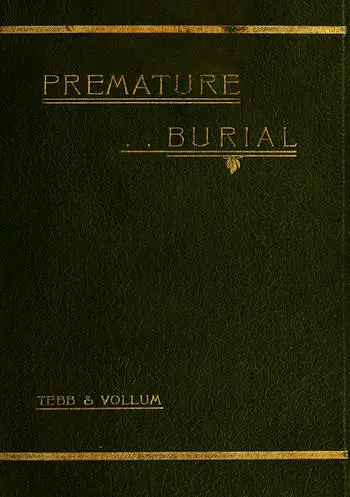
"Premature Burial and How It May Be Prevented" by William Tebb and Col. Edward Perry Vollum is a scientific publication written in the late 19th century. This work delves into the unsettling topic of premature burial, focusing on conditions such as trance, catalepsy, and other forms of suspended animation that can lead to misdiagnosis of death. The authors aim to both inform the public of the real dangers associated with hasty burials and propose reforms in burial practices to mitigate these risks. The opening of the book begins with a preface that sets the stage for the urgent discussion of premature burial, describing how personal experiences motivated the authors to investigate this distressing issue. Tebb recounts a family situation that highlighted the dangers of being declared dead incorrectly and discusses the collaborative inquiry undertaken with Vollum into various cases across Europe and America. The introduction follows, emphasizing renewed public interest in the last few years surrounding this topic and noting how a range of medical professionals remain skeptical about the existence of death-counterfeits. The authors stress the necessity of reform and attention to this issue, as their examination of evidence reveals a troubling history of negligence related to determining death.
Introduction adapted from the source catalogue; source summaries may be automatically generated.
Free to read · English · 119,296 words · No account needed
MAKE TIME FOR A GOOD BOOK
On by default. Untick to stop anonymous reading totals. Each page counts after 10 seconds in view. How this works.
Anonymous counting is on unless you have switched it off.
[5] The case referred to, being attended with considerable doubt, is
omitted.
[6] Evening News, Nottingham, January 10, 1896.
[7] Health, May 21, 1886, edited by Dr. Andrew Wilson, pp. 120-1. After relating other cases, Surgeon Curran continues:--“I have myself personally seen or heard on the spot of three such cases--cases that in other hands or in other localities might have passed as dead, were they not buried as such accordingly.”
[8] For the antiquity of the Jewish practice of early burial, see note
in Appendix.
[9] Dr. A. B. Granville, “Sudden Death,” p. 278.
[10] Ibid., p. 278.
[11] Ibid., p. 279.
[12] Tidy, “Legal Medicine,” part i., pp. 279-280.
[13] In the 3rd ed., by Dr. Pye Smith, the following occurs at p. 817 of vol. i., under “Trance”:--“These are the cases which have led to the popular belief that death is sometimes only apparent, and that there may be a danger of persons being buried alive; and it cannot be denied that a patient in such a condition might easily be allowed to die by careless or ignorant attendants, or might be buried before death.”
[14] Bulletin Therap. Méd., tome xxvii., p. 371.
[15] “Premature Burial: An Examination into the Occult Causes of Apparent Death, Trance, and Catalepsy.” By Franz Hartmann, M.D. Second Edition. London: Swan Sonnenschein & Co. (One Shilling).
[16] “Pour se convaincre de l’erreur où l’on tomberait en adoptant cette opinion populaire, il suffit de refléchir d’abord qu’un cercueil n’est pas exactement moulé sur les proportions du corps qu’il contient; que, par consequent, tous les intervalles sont remplis d’air respirable, en quantité très-grande, égale à-peu-près à un cube dont le côté aurait 50 centimètres de hauteur. Or, chaque inspiration absorbe environ 1,200 centimètres cubes d’air dont l’oxygène n’est employé dans l’hématose que pour sa cinquième partie, le reste étant rendu pendant l’expiration; il en resulte donc que chaque inspiration ne consomme en réalité que 240 centimètres cubes. L’homme, à l’état normal, respire à-peu-près 800 fois par heure; et, comme un cube de 50 centimètres de côté contient 125,000 centimètres cubes, on doit conclure que cette quantité d’air peut suffire à 520 inspirations normales, c’est à dire à soutenir la vie pendant près de trois quarts d’heure. Mais, d’un autre côté, il est démontré, en botanique, que l’air filtre dans la terre; celui contenu dans le cercueil peut donc en partie se renouveler. On doit nécessairement tenir compte de la nature du terrain où le cercueil à été déposé; s’il est sec, léger ou sablonneux, il laissera pénétrer, circuler pour, ainsi dire, l’air atmosphérique plus facilement, que des terres humides, grasses ou argileuses. Ajoutons enfin, que les quantités determinées plus haut pourraient être réduites de plus de moitié, sans causer directement la mort. On voit donc qu’un homme peut vivre sous terre pendant plusieurs heures, et que ce temps sera d’autant plus court que le sujet sera plus pléthorique, c’est-à-dire predisposé aux congestions cérébrales, puisque, dans ce cas, ses inspirations seront plus larges et plus frequentes.”
Your reading position is saved on this browser. Take it to another device with a library code. Reading pages adapt to text, rather than matching a printed edition.
BEHIND THE BOOK
This eBook is for the use of anyone anywhere in the United States and most other parts of the world at no cost and with almost no restrictions whatsoever. You may copy it, give it away or re-use it under the terms of the Project Gutenberg License included with this eBook or online at www.gutenberg.org. If you are not located in the United States, you will have to check the laws of the country where you are located before using this eBook. Read the source licence.
The original source file, including credits and licence, is retained by this library. Request an original-format copy at no charge. Please include the book title and Project Gutenberg identifier #50460.
KEEP YOUR CURIOSITY GOING
Charles G. (Charles Griffith) Ross
Hannah Webster Foster

Emily Lawless
Edwin Hamlin Carr

Charles De Lano Hine
Andrew Ure