
The Writing of News A Handbook with Chapters on Newspaper Correspondence and Copy Reading
Charles G. (Charles Griffith) Ross
THE CLASSIC COLLECTION · 1896
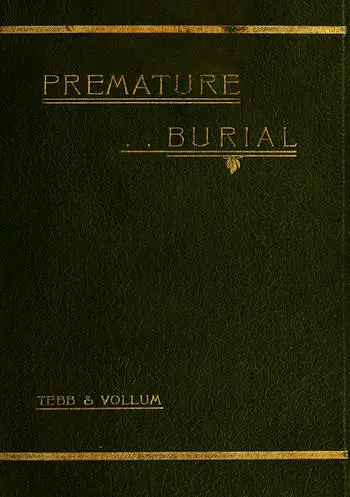
"Premature Burial and How It May Be Prevented" by William Tebb and Col. Edward Perry Vollum is a scientific publication written in the late 19th century. This work delves into the unsettling topic of premature burial, focusing on conditions such as trance, catalepsy, and other forms of suspended animation that can lead to misdiagnosis of death. The authors aim to both inform the public of the real dangers associated with hasty burials and propose reforms in burial practices to mitigate these risks. The opening of the book begins with a preface that sets the stage for the urgent discussion of premature burial, describing how personal experiences motivated the authors to investigate this distressing issue. Tebb recounts a family situation that highlighted the dangers of being declared dead incorrectly and discusses the collaborative inquiry undertaken with Vollum into various cases across Europe and America. The introduction follows, emphasizing renewed public interest in the last few years surrounding this topic and noting how a range of medical professionals remain skeptical about the existence of death-counterfeits. The authors stress the necessity of reform and attention to this issue, as their examination of evidence reveals a troubling history of negligence related to determining death.
Introduction adapted from the source catalogue; source summaries may be automatically generated.
Free to read · English · 119,296 words · No account needed
MAKE TIME FOR A GOOD BOOK
On by default. Untick to stop anonymous reading totals. Each page counts after 10 seconds in view. How this works.
Anonymous counting is on unless you have switched it off.
[In 1868 the Académie de Médecine of Paris threw open to competition the Prix d’Ourches of 20,000 francs for the discovery of a simple and popular means of detecting the signs of real death certainly and beyond doubt. The prize was not awarded, but premiums were given to several competitors.]
HOARAU (H.). La mort, sa constatation, ou procédé à l’aide du quel on peut la reconnaître et éviter des enterrements de vifs. Paris, 1874.
VEYNE (----). Mort apparente et mort réelle, artériotomie donnant le moyen de les reconnaître. Paris, 1874.
MONTEVERDI (A.). Note sur un moyen simple, facìle, prompt et certain de distinguer la mort vrai de la mort apparente de l’homme. Cremone, 1874.
MARTEL (----). La mort apparente chez les nouveaux-nés. Paris, 1874.
BOILLET (Ch.). Mort apparente et victimes ignorées. Paris, 1875.
DE COMEAU (----). Les signes certains de la mort mis à la portée de tout le monde. Limoges, 1876.
BELVAL (Th.). Les maisons mortuaires. Paris, 1877.
FRITZ-ANDRE (----). Du danger des inhumations précipitées. Bruxelles,
1879.
[The Prix Dusgate was founded by a decree of November 27, 1874, authorising the Académie des Sciences of Paris to accept the legacy of M. Dusgate of a quinquennial prize of 2,500 francs for the best work on the diagnostic signs of death and on the means of preventing premature burial. The essays of the first competition were received on June 1, 1880, and on March 14, 1881, the prize was divided among the three following competitors. In 1885 the prize was not awarded.]
ONIMUS (E. N. J.). Modification de l’excitabilité des nerfs et des muscles apres la mort. (Published.)
PEYRAND (H.). De la détermination de la mort réelle par le caustique de
Vienne.
LE BON (G.). Recherches experimentales sur les signes diagnostiques de la mort et sur les moyens de prevenir les inhumations précipitées. (A temperature of 25° C. on a thermometer kept in the mouth for a quarter of an hour.) Also, Article on Premature Interment in Monit. scient., viii. Paris.
ALLEN (F. D.). Remarks on the dangers and duties of sepulture, or
security for the living with respect and repose of the dead. Boston,
1873.
BURDETT (H. C.). The necessity and importance of mortuaries for towns and villages, with suggestions for their establishment and management. London, 1880.
FLETCHER (Moore Russell). One thousand persons buried alive by their best friends. A treatise on suspended animation, with directions for restoration. Boston, 1890.
“A Hygienic Physician.” Earth to earth burial and cremation by fire [includes cases of premature burial]. London, 1890.
HERNANDEZ (Maxime F.E.M.). Contribution à l’étude de la mort apparente.
Bordeaux, 1893.
LIGNIERES(Dr. D. De). Ne pas être enterré vivant. Paris, 1893.
Your reading position is saved on this browser. Take it to another device with a library code. Reading pages adapt to text, rather than matching a printed edition.
BEHIND THE BOOK
This eBook is for the use of anyone anywhere in the United States and most other parts of the world at no cost and with almost no restrictions whatsoever. You may copy it, give it away or re-use it under the terms of the Project Gutenberg License included with this eBook or online at www.gutenberg.org. If you are not located in the United States, you will have to check the laws of the country where you are located before using this eBook. Read the source licence.
The original source file, including credits and licence, is retained by this library. Request an original-format copy at no charge. Please include the book title and Project Gutenberg identifier #50460.
KEEP YOUR CURIOSITY GOING
Charles G. (Charles Griffith) Ross
Hannah Webster Foster

Emily Lawless
Edwin Hamlin Carr

Charles De Lano Hine
Andrew Ure