
The Writing of News A Handbook with Chapters on Newspaper Correspondence and Copy Reading
Charles G. (Charles Griffith) Ross
THE CLASSIC COLLECTION · 1896
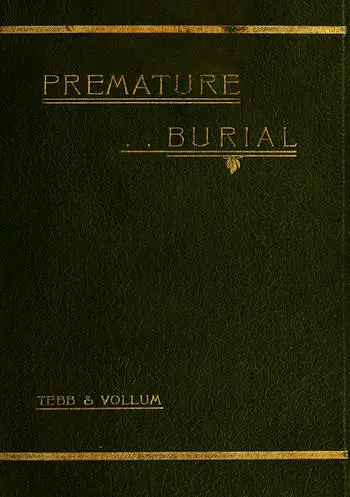
"Premature Burial and How It May Be Prevented" by William Tebb and Col. Edward Perry Vollum is a scientific publication written in the late 19th century. This work delves into the unsettling topic of premature burial, focusing on conditions such as trance, catalepsy, and other forms of suspended animation that can lead to misdiagnosis of death. The authors aim to both inform the public of the real dangers associated with hasty burials and propose reforms in burial practices to mitigate these risks. The opening of the book begins with a preface that sets the stage for the urgent discussion of premature burial, describing how personal experiences motivated the authors to investigate this distressing issue. Tebb recounts a family situation that highlighted the dangers of being declared dead incorrectly and discusses the collaborative inquiry undertaken with Vollum into various cases across Europe and America. The introduction follows, emphasizing renewed public interest in the last few years surrounding this topic and noting how a range of medical professionals remain skeptical about the existence of death-counterfeits. The authors stress the necessity of reform and attention to this issue, as their examination of evidence reveals a troubling history of negligence related to determining death.
Introduction adapted from the source catalogue; source summaries may be automatically generated.
Free to read · English · 119,296 words · No account needed
MAKE TIME FOR A GOOD BOOK
On by default. Untick to stop anonymous reading totals. Each page counts after 10 seconds in view. How this works.
Anonymous counting is on unless you have switched it off.
NAVIER (Pierre Toussaint). Réflexions sur les dangers des inhumations precipitées et sur les abus des inhumations dans les eglises, etc. Paris, 1775.
PINEAU (----). Mémoire sur le danger des inhumations precipitées, et sur la nécessité d’un règlement pour mettre les citoyens à l’abri du malheur d’etre enterées vivans. Niort, 1776.
MARET (Hugues). Mémoire pour rappeler à la vie les personnes en état de mort apparente. Dijon, 1776.
BRINKMANN (Joh. Pet.). Beweis der Möglichkeit dass einige Leute können lebendig begraben werden, etc. Düsseldorf, 1777.
SWIETEN (Baron Geerard Van). De morte dubia. Vienna, 1778.
TESTA (Antonio Guiseppe). Della morte apparente. Firenze, 1780.
DOPPET (F. A.). Des moyens de rappeler à la vie les personnes qui ont toutes les apparences de la mort. Chambery, 1785.
[In 1784 the Imperial and Royal Academy of Sciences, etc., of Brussels proposed as a subject for a prize essay, What are the means that can be employed by medicine and police to prevent the dangerous mistakes of premature burial?]
WAUTERS (Pierre Englebert). Responsum ad quaesitum, Quae tum medica, tum politica praesidia adversus periculosas inhumationum praefestinatarum abusus? Reprinted from the Mem. Acad. Imper. et Roy. de Sc. de Bruxelles. Bruxelles, 1787 [1788].
PREVINAIRE (P. J. B.). Mémoire sur la question suivante proposée en 1784 par l’academie imperiale et royal des sciences, belles-lettres, et arts de Bruxelles: Quels sont les moyens que la médecine et la police pourroient employer pour prévenir les erreurs dangereuses des enterremens precipités? Ouvrage qui a concouru pour la prix de l’annee 1786. Bruxelles, 1787.
---- The above in a German translation by Bernhard Gottlob Schreger.
Leipzig, 1790.
LEDULX (Gul. Petrus). De signis mortis rite aestimandis. Hardervici,
1787. Thesis.
THIERY (Franciscus). La vie de l’homme respectée et defendue dans ses derniers moments; ou instruction sur les soins qu’ on doit aux morts, et à ceux qui parroisent l’etre; sur les funerailles et les sepultures. Paris, 1787.
STEINFELD (Johannes Christianus). De signis mortis diagnosticis dubiis cautè admittendis et reprobandis. Thesis. Jena, 1788.
HERZ (Marcus). Ueber die frühe Beerdigung der Juden. Zweite vermehrte
Auflage. Berlin, 1788.
DURANDE (J. Fr.). Mémoire sur l’abus de l’ensevelissement des morts,
etc. Strasbourg, 1789.
DE HUPSCH (Baron Joh. Wilh. Carl Adolph). Nouvelle découverte d’une methode peu couteuse, efficace et assurée de traiter tous les hommes décédés afin de rappeler à la vie ceux qui ne sont morts qu’en apparance. Cologne, 1789.
ANON. Des inhumations precipitées. Paris, 1790. (Attributed by Barbier
to Madame Necker.)
HUFELAND (Christoph W.). Ueber die Ungewissheit des Todes, und des einzige untrügliche Mittel ... das Lebenigbegraben unmöglich zu machen, etc. Salzburg, 1791; Halle, 1824.
REINHARDT (Julius Christophorus). Dissertatio de vano praematurae
sepulturae metu. Jena, 1793.
Your reading position is saved on this browser. Take it to another device with a library code. Reading pages adapt to text, rather than matching a printed edition.
BEHIND THE BOOK
This eBook is for the use of anyone anywhere in the United States and most other parts of the world at no cost and with almost no restrictions whatsoever. You may copy it, give it away or re-use it under the terms of the Project Gutenberg License included with this eBook or online at www.gutenberg.org. If you are not located in the United States, you will have to check the laws of the country where you are located before using this eBook. Read the source licence.
The original source file, including credits and licence, is retained by this library. Request an original-format copy at no charge. Please include the book title and Project Gutenberg identifier #50460.
KEEP YOUR CURIOSITY GOING
Charles G. (Charles Griffith) Ross
Hannah Webster Foster

Emily Lawless
Edwin Hamlin Carr

Charles De Lano Hine
Andrew Ure