
The Writing of News A Handbook with Chapters on Newspaper Correspondence and Copy Reading
Charles G. (Charles Griffith) Ross
THE CLASSIC COLLECTION · 1896
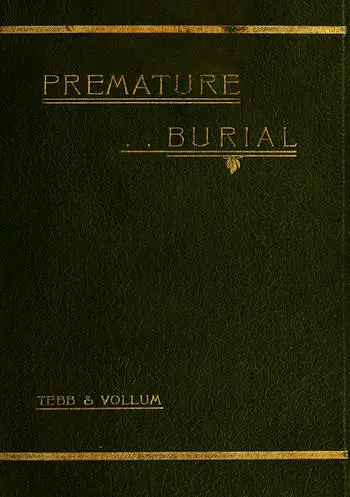
"Premature Burial and How It May Be Prevented" by William Tebb and Col. Edward Perry Vollum is a scientific publication written in the late 19th century. This work delves into the unsettling topic of premature burial, focusing on conditions such as trance, catalepsy, and other forms of suspended animation that can lead to misdiagnosis of death. The authors aim to both inform the public of the real dangers associated with hasty burials and propose reforms in burial practices to mitigate these risks. The opening of the book begins with a preface that sets the stage for the urgent discussion of premature burial, describing how personal experiences motivated the authors to investigate this distressing issue. Tebb recounts a family situation that highlighted the dangers of being declared dead incorrectly and discusses the collaborative inquiry undertaken with Vollum into various cases across Europe and America. The introduction follows, emphasizing renewed public interest in the last few years surrounding this topic and noting how a range of medical professionals remain skeptical about the existence of death-counterfeits. The authors stress the necessity of reform and attention to this issue, as their examination of evidence reveals a troubling history of negligence related to determining death.
Introduction adapted from the source catalogue; source summaries may be automatically generated.
Free to read · English · 119,296 words · No account needed
MAKE TIME FOR A GOOD BOOK
On by default. Untick to stop anonymous reading totals. Each page counts after 10 seconds in view. How this works.
Anonymous counting is on unless you have switched it off.
FROM the time of Kornmann, Terilli, and Zacchia (see “Bibliography,” seventeenth century), certain notable instances, from old authors, of restoration from apparent death have been cited, with a good deal of uniformity, in essays or theses on this subject. One of the most convenient (to English readers) of these compilations is to be found in an anonymous essay, “The Uncertainty of the Signs of Death,” Dublin, 1748 (printed by George Faulkner), from which the following extracts are taken verbatim:--
Plutarch informs us that a certain person fell from an eminence, but did not show the least appearance of any wound, for, three days after, he suddenly resumed his strength, and returned to life as his friends were conveying him to the grave.
Asclepiades, a celebrated physician, on his return from his country seat, met a large company conveying a corpse to the grave. A principle of curiosity induced him to ask the name of the deceased person, but grief and sorrow reigned so universally that no one returned him answer; upon which, approaching the corpse, he found the whole of it rubbed over with perfumes, and the mouth moistened with precious balm, according to the custom of the Greeks; then carefully feeling every part, and discovering latent signs of life, he forthwith affirmed that the person was not dead, and the person was saved.--Celsus ii., 6, “De re Medica.”
In the tenth book of Plato’s Republic is related the story of one Er, an Armenian, who was slain in battle. Ten days after, when the surviving soldiers came with a view to inter the dead, they found all the bodies corrupted except his; for which reason they conveyed him to his own house in order to inter him in the usual manner. But two days after, to the great surprise of all present, he returned to life when laid on the funeral pile. Quenstedt remarks upon this case, which he took from Kornmann’s treatise “De Miraculis Mortuorum,” “That the soul sometimes remains in the body when the senses are so fettered, and, as it were, locked up, that it is hard to determine whether a person is dead or alive.” Pliny in his “Natural History,” book vii., chap. 52, which treats of those who have returned to life when they were about to be laid in the grave, tells us that Acilius Aviola, a man of so considerable distinction that he had formerly been honoured with the consulship, returned to life when he was upon the funeral pile; but, as he could not be rescued from the violence of the flames, he was burnt alive. The like misfortune also happened to Lucius Lamia, who had been praetor. These two shocking accidents are also related by Valerius Maximus. Celius Tubero had a happier fate than his two fellow-citizens, since, according to Pliny, he discovered the signs of life before it was too late. His state, however, was far from eligible, since, being laid on the funeral pile, he stood a fair chance of being exposed to the like misfortune. Pliny, from the testimony of Varro, adds that when a distribution of land was making at Capua, a certain man, when carried a considerable way from his own house in order to be interred, returned home on foot. The like surprising accident also happened at Aquinum. The last instance of this nature related by the author occurred at Rome, and Pliny must, no doubt, have been intimately acquainted with all its most minute circumstances, since the person was one Cerfidius, the husband of his mother’s sister, who returned to life after an agreement had been made for his funeral with the undertaker, who was probably much disappointed when he found him alive and in good health.
Your reading position is saved on this browser. Take it to another device with a library code. Reading pages adapt to text, rather than matching a printed edition.
BEHIND THE BOOK
This eBook is for the use of anyone anywhere in the United States and most other parts of the world at no cost and with almost no restrictions whatsoever. You may copy it, give it away or re-use it under the terms of the Project Gutenberg License included with this eBook or online at www.gutenberg.org. If you are not located in the United States, you will have to check the laws of the country where you are located before using this eBook. Read the source licence.
The original source file, including credits and licence, is retained by this library. Request an original-format copy at no charge. Please include the book title and Project Gutenberg identifier #50460.
KEEP YOUR CURIOSITY GOING
Charles G. (Charles Griffith) Ross
Hannah Webster Foster

Emily Lawless
Edwin Hamlin Carr

Charles De Lano Hine
Andrew Ure