
The Writing of News A Handbook with Chapters on Newspaper Correspondence and Copy Reading
Charles G. (Charles Griffith) Ross
THE CLASSIC COLLECTION · 1896
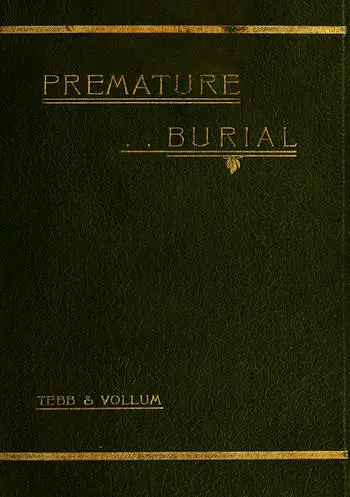
"Premature Burial and How It May Be Prevented" by William Tebb and Col. Edward Perry Vollum is a scientific publication written in the late 19th century. This work delves into the unsettling topic of premature burial, focusing on conditions such as trance, catalepsy, and other forms of suspended animation that can lead to misdiagnosis of death. The authors aim to both inform the public of the real dangers associated with hasty burials and propose reforms in burial practices to mitigate these risks. The opening of the book begins with a preface that sets the stage for the urgent discussion of premature burial, describing how personal experiences motivated the authors to investigate this distressing issue. Tebb recounts a family situation that highlighted the dangers of being declared dead incorrectly and discusses the collaborative inquiry undertaken with Vollum into various cases across Europe and America. The introduction follows, emphasizing renewed public interest in the last few years surrounding this topic and noting how a range of medical professionals remain skeptical about the existence of death-counterfeits. The authors stress the necessity of reform and attention to this issue, as their examination of evidence reveals a troubling history of negligence related to determining death.
Introduction adapted from the source catalogue; source summaries may be automatically generated.
Free to read · English · 119,296 words · No account needed
MAKE TIME FOR A GOOD BOOK
On by default. Untick to stop anonymous reading totals. Each page counts after 10 seconds in view. How this works.
Anonymous counting is on unless you have switched it off.
Mortuaries have continued in high favour with the people wherever they have once been properly established; none, so far as the author has been able to learn, have ever been abolished. At the present time the city of Munich is constructing a mortuary at the Southern cemetery upon a costly scale, surpassing in sumptuous accessories anything of the kind before attempted in Germany. It will be not unworthy of the public buildings of the city. This is an emphatic endorsement of the necessity of the system by a people that for more than fifty years has given it a thorough trial; and it is a strong argument for its adoption elsewhere.
The question suggests itself here: Why should not the English-speaking peoples accept the long experience of a philosophical, painstaking, clear-minded people like the Germans, supported as it is by many sanitary and medical authorities in France, England, and the United States, and establish these institutions in connection with existing cemeteries, with such modifications as national habits, local tastes, and customs may dictate?
The following practical suggestions are from a paper in the Medical Times, vol. xvi., No. 415, p. 574, September 11, 1847, entitled, “On the construction of houses for the reception of the dead; and on the means to be used for the recovery of those who are only in trances or fits, or in whom life is only impassive,” by Robert Brandon, Esq., Great Russell Street, Bloomsbury:--
“The building should be large enough to provide means for resuscitation, and have room enough for the deposition of bodies when epidemics are prevalent. There should be hot baths, for these often are alone enough to recall the vital spark; and a kitchen to prepare nourishment for those who are recovered, and for the porter and other officers who would live on the building. The room for the deposit of the bodies should communicate with the porter’s room by means of a glass door, and every body should have a wire fixed to the feet and hands, in communication with a bell, which bell must ring in the porter’s room, in order to warn him should there be any motion in those thought to be dead. There should be men and women on the premises to use friction, a galvanic machine, and the implements necessary for transfusion and artificial respiration. As the usual and accepted signs of death are not signs to be relied on, so is decomposition a true sign, and none should be buried until this be present; but as the presence of decomposed animal matter would be injurious, not only to the inmates of houses, but to the surrounding inhabitants, and as it is inconvenient to the poor man who has but one room to keep a body in that room, where he and his family eat, drink, and sleep, asylums for the reception of those thought to be dead should be constructed, and are absolutely necessary. Nor is it enough to wait for decomposition, but we should endeavour to prevent this by endeavouring to restore vitality by means of hot baths, external heat, artificial respiration, galvanism, or transfusion; the first of these is oftentimes enough. Now, I think it probable that many persons would be recovered, thought to be dead, for, out of a number of those reputed dead, a certain number have recovered--some by the sticking of the pins into them which fixed the shrouds, some under the surgeon’s knife, some from delays in the burial, and others from the accidental overturning of the coffins, as we learn from a paper published on premature burials. Some time since a woman was kept above ground for a considerable time, as medical men could not decide if she were dead or no. And at Constantinople a sailor the other day was attacked with apoplexy, and a vein was opened in his arm; no blood came, and the man was thought to be dead, but on the road to the grave blood began to flow, and the supposed dead man recovered. There is now living in Brussels a man who escaped from the grave; and another built a house at Cologne to commemorate his escape. These cases will be enough to show that we have no certain sign of death but decomposition; and, if this be true, we must have asylums for the reception of bodies previous to decomposition, and for the application of means which can do no harm, and may do much good, such as those before indicated. Medical men think that the absence of respiration and want of heart’s action, with loss of motion and sensation, are signs of death; but this is not the case, for many bodies which have been drowned have all these signs present and yet recover. Again, infants are often born without any action of the heart or lungs, and yet are recovered by very simple means, such as the hot bath; and I myself have recovered persons by stimulants who were thought to be dead. Many may be recovered by transfusion (first introduced into this country by the celebrated Dr. Blundel) when the heart still palpitates, but the brain is insensible; or by stimulants given at that period; or by hot bath, and the external application of heat; by galvanism, where other means have failed; and these can do no harm. Since the brain is insensible there can be no suffering; and many lives will be saved by perseverance, and the skilful application of means which have succeeded in isolated cases. Buildings for the reception of those thought to be dead should be placed in cemeteries.
Your reading position is saved on this browser. Take it to another device with a library code. Reading pages adapt to text, rather than matching a printed edition.
BEHIND THE BOOK
This eBook is for the use of anyone anywhere in the United States and most other parts of the world at no cost and with almost no restrictions whatsoever. You may copy it, give it away or re-use it under the terms of the Project Gutenberg License included with this eBook or online at www.gutenberg.org. If you are not located in the United States, you will have to check the laws of the country where you are located before using this eBook. Read the source licence.
The original source file, including credits and licence, is retained by this library. Request an original-format copy at no charge. Please include the book title and Project Gutenberg identifier #50460.
KEEP YOUR CURIOSITY GOING
Charles G. (Charles Griffith) Ross
Hannah Webster Foster

Emily Lawless
Edwin Hamlin Carr

Charles De Lano Hine
Andrew Ure