
The Writing of News A Handbook with Chapters on Newspaper Correspondence and Copy Reading
Charles G. (Charles Griffith) Ross
THE CLASSIC COLLECTION · 1896
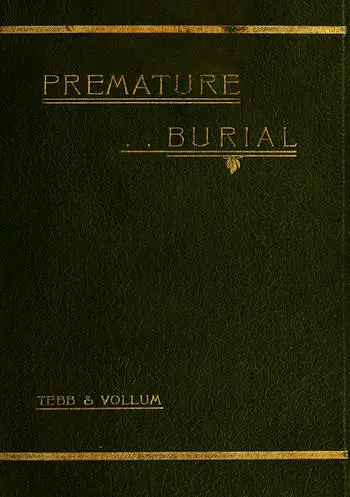
"Premature Burial and How It May Be Prevented" by William Tebb and Col. Edward Perry Vollum is a scientific publication written in the late 19th century. This work delves into the unsettling topic of premature burial, focusing on conditions such as trance, catalepsy, and other forms of suspended animation that can lead to misdiagnosis of death. The authors aim to both inform the public of the real dangers associated with hasty burials and propose reforms in burial practices to mitigate these risks. The opening of the book begins with a preface that sets the stage for the urgent discussion of premature burial, describing how personal experiences motivated the authors to investigate this distressing issue. Tebb recounts a family situation that highlighted the dangers of being declared dead incorrectly and discusses the collaborative inquiry undertaken with Vollum into various cases across Europe and America. The introduction follows, emphasizing renewed public interest in the last few years surrounding this topic and noting how a range of medical professionals remain skeptical about the existence of death-counterfeits. The authors stress the necessity of reform and attention to this issue, as their examination of evidence reveals a troubling history of negligence related to determining death.
Introduction adapted from the source catalogue; source summaries may be automatically generated.
Free to read · English · 119,296 words · No account needed
MAKE TIME FOR A GOOD BOOK
On by default. Untick to stop anonymous reading totals. Each page counts after 10 seconds in view. How this works.
Anonymous counting is on unless you have switched it off.
The writer of the following communication, which appeared in the Sunday Times, September 6, 1896, has substantial reasons for preferring cremation to the risks of burial:--
“Madam,--When I was about five years old, my paternal home was one day plunged into a state of great consternation, through the sudden apparent death of my father, who had been sitting up during a part of the previous night occupied with some literary work, without a fire (it was in January), which brought on a death-like numbness, in which he was found the next morning. The family doctor, who was sent for at once, declared life to be extinct, but said he could not tell the cause of death until after the opening of the dead body. My mother, however, who did not see any reason why a young man of thirty-six should have died without any previous illness, caused the body of my father to be rubbed for about two hours, which renewed its circulation and brought it to life again. My father lived thirty-two years after that memorable day. Without the prudence of my mother, he would either have been dissected or buried alive. About twenty years after that occurrence, I visited the cemetery of Père La Chaise (Paris), accompanied by some friends. While inspecting the monuments of some musical celebrities we heard a noise from another part of the cemetery, whereto we proceeded without delay. When we had arrived there we found a strong body of policemen surrounding an open grave. But in answer to our inquiring ‘what had happened,’ we were simply requested to leave the cemetery at once, which, of course, we had to do. Neither the portier nor any other person connected with the burial-ground would give any satisfactory answer to our questions. We left puzzled. But a week after, a young lady, who had been of our party the week before, went again to the Père La Chaise, determined to penetrate the mystery, in which endeavour she succeeded, partly through persuasion and partly through the gift of a twenty-franc piece to a grave-digger, who then told her the following story:--A poor young man of twenty-one years had been buried on the day of our visit. When the mourners had left the cemetery the grave-digger, who was occupied in filling up the grave, heard some noise coming from below. He hastened to the superintendent of the cemetery, imploring him to have the coffin opened, which, however, the superintendent could not do without the permission and the presence of the Commissaire de Police of that district. When the Commissaire appeared at last with his men, all was silent in the grave. But he had the coffin opened, nevertheless, ‘to appease the mind of that poor grave-digger,’ as he mockingly said. But great was the horror of the Commissaire de Police and his followers when the coffin was opened. The unfortunate young man (who was now quite dead) had been buried alive, recovered consciousness in his grave, scratched his face, bitten off the tips of his fingers, and turned around in his coffin, until suffocation put an end to his sufferings, which, if not long, must have been terrible. The Parisian newspapers did not mention the case. They were probably forbidden by the French Government to do so. But would it not have been wiser to let the whole world know of it, and thereby prevent repetitions of such dreadful occurrences? A similar case of live sepulture occurred in a village near Wiesbaden some thirty years ago, where a girl of sixteen was found with the same signs of suffocation in her coffin as those of that unfortunate young man in Paris. We are assured by a German authority that thousands of people are buried alive every year. But why should this be the case? If people must be buried before they begin to show signs of putrefaction (which seems to be the only reliable proof that life is really extinct), why not shorten their sufferings, in case of resuscitation, by opening an artery before they are buried? There is still much prejudice against the cremation of dead bodies, although two great facts are decidedly in its favour--viz., the impossibility of recovering consciousness when once inserted in the crematory oven, and the prevention of the unhealthiness which the slow process of putrefaction must entail.--Yours, etc.,
Your reading position is saved on this browser. Take it to another device with a library code. Reading pages adapt to text, rather than matching a printed edition.
BEHIND THE BOOK
This eBook is for the use of anyone anywhere in the United States and most other parts of the world at no cost and with almost no restrictions whatsoever. You may copy it, give it away or re-use it under the terms of the Project Gutenberg License included with this eBook or online at www.gutenberg.org. If you are not located in the United States, you will have to check the laws of the country where you are located before using this eBook. Read the source licence.
The original source file, including credits and licence, is retained by this library. Request an original-format copy at no charge. Please include the book title and Project Gutenberg identifier #50460.
KEEP YOUR CURIOSITY GOING
Charles G. (Charles Griffith) Ross
Hannah Webster Foster

Emily Lawless
Edwin Hamlin Carr

Charles De Lano Hine
Andrew Ure