
The Writing of News A Handbook with Chapters on Newspaper Correspondence and Copy Reading
Charles G. (Charles Griffith) Ross
THE CLASSIC COLLECTION · 1896
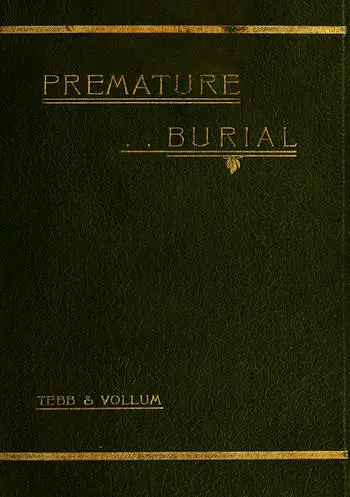
"Premature Burial and How It May Be Prevented" by William Tebb and Col. Edward Perry Vollum is a scientific publication written in the late 19th century. This work delves into the unsettling topic of premature burial, focusing on conditions such as trance, catalepsy, and other forms of suspended animation that can lead to misdiagnosis of death. The authors aim to both inform the public of the real dangers associated with hasty burials and propose reforms in burial practices to mitigate these risks. The opening of the book begins with a preface that sets the stage for the urgent discussion of premature burial, describing how personal experiences motivated the authors to investigate this distressing issue. Tebb recounts a family situation that highlighted the dangers of being declared dead incorrectly and discusses the collaborative inquiry undertaken with Vollum into various cases across Europe and America. The introduction follows, emphasizing renewed public interest in the last few years surrounding this topic and noting how a range of medical professionals remain skeptical about the existence of death-counterfeits. The authors stress the necessity of reform and attention to this issue, as their examination of evidence reveals a troubling history of negligence related to determining death.
Introduction adapted from the source catalogue; source summaries may be automatically generated.
Free to read · English · 119,296 words · No account needed
MAKE TIME FOR A GOOD BOOK
On by default. Untick to stop anonymous reading totals. Each page counts after 10 seconds in view. How this works.
Anonymous counting is on unless you have switched it off.
(2) “The stoppage of the circulation of the blood, apart from the absence of heart beating, if, after tying a tight bandage around the arm, the veins do not swell up, upon the hands being firmly gripped; also if, upon pricking the lips, no blood escapes; furthermore, if, on holding the hand in front of a bright light (the diaphanous test), the finger-tips are no longer translucent as in the living.”
Nor should the inspector ever neglect to examine the heart to ascertain the complete absence of all sound, and to test the absence of breath by other experiments.
The rescript further adds that these experiments “may not furnish absolute proof of death,” and describes what further proceedings to institute. These are referred to in this volume in the chapter devoted to Death Certification.
An editorial note in the Lancet, January 29, 1887, p. 233, shows the difficulty of distinguishing real from
“It was only last year that we commented in our columns upon the ‘signs of death,’ drawing attention to the more important criteria by which a skilful observer may avoid mistaking cases of so-called suspended animation from actual disease. Quite recently two instances have been recorded, in which, if report be true, it would seem there is still room for maturing the judgment upon the question herein raised. At Saumur a young man afflicted with a contagious disease apparently died suddenly. His body was enshrouded and coffined, but as the undertaker’s men were carrying the ‘remains’ to their last resting-place they heard what they believed to be a knocking against the coffin-lid, and the sound was repeated in the grave. Instead of testing at once the evidence of their senses, they, in accordance with judicial custom, sent for the Mayor, in whose presence the lid was removed from the coffin. Whereupon, to the horror of the spectators, it was observed that the dead man had only just succumbed to asphyxia. The above narrative seems on the face of it too ghastly to be true, especially as the occupant of the coffin must have been shut up in a space containing oxygen in quantity totally inadequate to sustain an approximation to ordinary breathing. But in cataleptic and similar states the organic functions are reduced to the lowest ebb, and history records several instances in which, for a time at least, the determination of the living state was a matter of uncertainty. In our issue of the 15th inst., p. 129, the reader will find an account of ‘Post-mortem Irritability of Muscle,’ in which the phenomenon was manifested in a marked degree two hours after death from a chronic wasting disorder--a condition which favours early extinction of vital action in muscle. It may be argued, then, with some show of reasonableness, that it is quite possible for the heart to stand still, as it were, and yet retain the power of action, although experience tells us but little on the question as regards the human subject. Experiments on the lower animals, however, show that over-distension of the right cavities of the heart causes cessation of cardiac contraction, and that relief from the distension may be followed by resumption of the function of contractibility. It must not be forgotten that an analogous condition is witnessed at times in patients suffering from capillary bronchitis or other physical states underlying acute distension of the right heart; for, in these cases, venesection is not uncommonly instrumental in arresting the rapidly failing cardiac contractions. The second case of apparent death alluded to above happened in ‘the land of big things.’ An inhabitant of Mount Joy, Paramatta, was believed to be dead, and his supposed remains were about to be committed to the earth, when a mourning relative startled the bystanders by exclaiming, ‘I must see my father once more; something tells me he is not dead.’ The coffin was taken from the grave to the sexton’s tool-house, and there opened, and was found to contain a living inmate, who justified the presentiment of his son by ‘slowly recovering.’ As no mention is made in either case of the period that elapsed between the occurrence of apparent death and the body being placed in the coffin, or of the time during which the encasement lasted, special and minute criticism is uncalled for. Enough has been said on the subject to emphasize the exhortation, ‘Get knowledge, and with all thy getting get understanding.’”
Your reading position is saved on this browser. Take it to another device with a library code. Reading pages adapt to text, rather than matching a printed edition.
BEHIND THE BOOK
This eBook is for the use of anyone anywhere in the United States and most other parts of the world at no cost and with almost no restrictions whatsoever. You may copy it, give it away or re-use it under the terms of the Project Gutenberg License included with this eBook or online at www.gutenberg.org. If you are not located in the United States, you will have to check the laws of the country where you are located before using this eBook. Read the source licence.
The original source file, including credits and licence, is retained by this library. Request an original-format copy at no charge. Please include the book title and Project Gutenberg identifier #50460.
KEEP YOUR CURIOSITY GOING
Charles G. (Charles Griffith) Ross
Hannah Webster Foster

Emily Lawless
Edwin Hamlin Carr

Charles De Lano Hine
Andrew Ure