
The Writing of News A Handbook with Chapters on Newspaper Correspondence and Copy Reading
Charles G. (Charles Griffith) Ross
THE CLASSIC COLLECTION · 1896
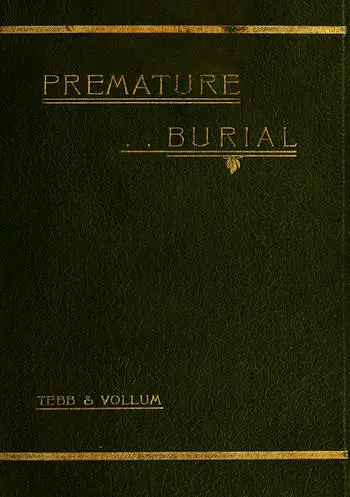
"Premature Burial and How It May Be Prevented" by William Tebb and Col. Edward Perry Vollum is a scientific publication written in the late 19th century. This work delves into the unsettling topic of premature burial, focusing on conditions such as trance, catalepsy, and other forms of suspended animation that can lead to misdiagnosis of death. The authors aim to both inform the public of the real dangers associated with hasty burials and propose reforms in burial practices to mitigate these risks. The opening of the book begins with a preface that sets the stage for the urgent discussion of premature burial, describing how personal experiences motivated the authors to investigate this distressing issue. Tebb recounts a family situation that highlighted the dangers of being declared dead incorrectly and discusses the collaborative inquiry undertaken with Vollum into various cases across Europe and America. The introduction follows, emphasizing renewed public interest in the last few years surrounding this topic and noting how a range of medical professionals remain skeptical about the existence of death-counterfeits. The authors stress the necessity of reform and attention to this issue, as their examination of evidence reveals a troubling history of negligence related to determining death.
Introduction adapted from the source catalogue; source summaries may be automatically generated.
Free to read · English · 119,296 words · No account needed
MAKE TIME FOR A GOOD BOOK
On by default. Untick to stop anonymous reading totals. Each page counts after 10 seconds in view. How this works.
Anonymous counting is on unless you have switched it off.
“A case has come lately under my observation in which the value of the diaphanous test of death has been illustrated at its just worth, and, as the matter is one of supreme practical moment, I think it may be considered deserving a brief notice in the pages of the Lancet. Readers of the Lancet need scarcely be informed that the diaphanous test consists in taking a hand of a supposed dead person, placing it before a strong artificial light, with the fingers extended and just touching each other, and then looking through the narrow spaces between the fingers to see if there be there a scarlet line of light. The theory is that if there be such a line of scarlet colour there is some circulation still in progress, and therefore evidence of vital action, whilst if there be no illumination, then the circulation has ceased and death has occurred. The French Academy of Medicine was so impressed with the value of this test that it awarded, I believe, to the discoverer of it a considerable prize. The illustration I am about to give indicates, however, that this test must be received with the utmost caution. The facts run as follows:--I was called in January last to visit a lady seventy-three years of age, suffering from chronic bronchitis. She had often suffered at intervals from similar attacks during a period of twenty-five years. The present attack was very severe, and as she was obviously in a state of senile decrepitude her symptoms naturally gave rise to considerable anxiety. Nevertheless, she rallied and improved so much that after a few days my attendance was no longer required. I heard nothing more of this lady until February 6--a period of three weeks--when I was summoned early in the morning to see her immediately. The messenger told me that she had retired to bed in the usual way, and had apparently died in the night, but that she looked so life-like there was great doubt whether death had actually taken place. Within half an hour I was by her bedside; there was no sign of breathing, of pulse, or of heart-beat, and the hands, slightly flexed, were rather rigid, but the countenance looked like that of a living person, the eyes being open and life-like. I believed her to be dead, and that the rigidity of the upper limbs indicated commencing rigor mortis; but this curious fact was related to me by a near relative, that once before she had passed into a death-like state, with similar symptoms, even to the rigidity of the arms and hands, from which state she had recovered, and after which she had always experienced the direst apprehension of being buried alive. Her anxiety, it will be easily conceived, was readily communicated to her relatives, who urged me to leave nothing undone for determining whether life was or was not extinct. Under the circumstances I suggested that Dr. (now Sir) Benjamin Ward Richardson, who has made the proofs of death a special study, should be summoned. He soon arrived, and submitted the body to all the tests in the following order:--1. Heart sounds and motion entirely absent, together with all pulse movement. 2. Respiratory sounds and movements entirely absent. 3. Temperature of the body taken from the mouth the same as that in the surrounding air in the room, 62° F. 4. A bright needle plunged into the body of the biceps muscle (Cloquet’s needle test) and left there shows on withdrawal no sign of oxidation. 5. Intermittent shocks of electricity at different tensions passed by needles into various muscles and groups of muscles gave no indication whatever of irritability. 6. The fillet-test applied to the veins of the arm (Richardson’s test) causes no filling of veins on the distal side of the fillet. 7. The opening of a vein to ascertain whether the blood has undergone coagulation shows that the blood was still fluid. 8. The subcutaneous injection of ammonia (Monteverdi’s test) causes the dirty brown stain indicative of dissolution. 9. On making careful movements of the joints of the extremities, of the lower jaw, and of the occipito-frontals, rigor mortis is found in several parts. Thus of these nine tests eight distinctly declared that death was absolute; the exception, the fluidity of the blood, being a phenomenon quite compatible with blood preternaturally fluid and at a low temperature, even though death had occurred. 10. There now remained the diaphanous test, which we carried out by the aid of a powerful reflector lamp, yielding an excellent and penetrating light. To our surprise the scarlet line of light between the fingers was as distinct as it was in our own hands subjected to the same experiment. The mass of evidence was of course distinctly to the effect that death was complete; but, to make assurance doubly sure, we had the temperature of the room raised and the body carefully watched until signs of decomposition had set in. I made a visit myself on a succeeding day to assure myself of this fact.
Your reading position is saved on this browser. Take it to another device with a library code. Reading pages adapt to text, rather than matching a printed edition.
BEHIND THE BOOK
This eBook is for the use of anyone anywhere in the United States and most other parts of the world at no cost and with almost no restrictions whatsoever. You may copy it, give it away or re-use it under the terms of the Project Gutenberg License included with this eBook or online at www.gutenberg.org. If you are not located in the United States, you will have to check the laws of the country where you are located before using this eBook. Read the source licence.
The original source file, including credits and licence, is retained by this library. Request an original-format copy at no charge. Please include the book title and Project Gutenberg identifier #50460.
KEEP YOUR CURIOSITY GOING
Charles G. (Charles Griffith) Ross
Hannah Webster Foster

Emily Lawless
Edwin Hamlin Carr

Charles De Lano Hine
Andrew Ure