THE CLASSIC COLLECTION✦Designs on prehistoric Hopi potteryCLASSIC FREE BOOKS
Designs on prehistoric Hopi pottery
Jesse Walter Fewkes
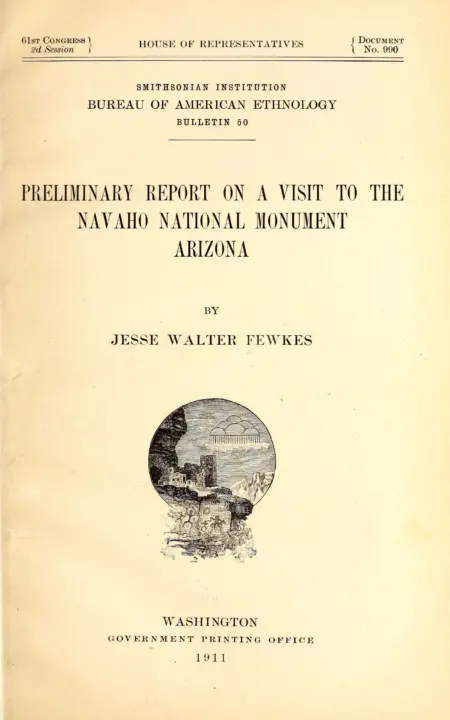
THE CLASSIC COLLECTION · 1911
"Preliminary Report on a Visit to the Navaho National Monument, Arizona" by Jesse Walter Fewkes is a scientific publication written in the early 20th century. This text serves as a preliminary report on Fewkes’ archaeological reconnaissance of the Navaho National Monument, focusing on the significant prehistoric ruins found in the area. The report details not only his observations and findings related to the ancient structures but also examines the cultural context and historical aspects connected to the Hopi clans that once inhabited these sites. The opening of the report includes a letter of transmittal from the Smithsonian Institution, establishing its official nature and scholarly intent. It sets the stage by describing Fewkes’ initial exploration of the Navaho National Monument after working on the Cliff Palace in Mesa Verde. He outlines his methodology for studying the ancient ruins and begins to introduce the various sites he encountered, mentioning the importance of preserving these remnants for scientific study and cultural understanding. The text emphasizes the connection between the ancient ruins and the modern Hopi peoples, hinting at the significance of these archaeological findings for understanding migration patterns and cultural evolution among indigenous groups in the Southwestern United States.
Introduction adapted from the source catalogue; source summaries may be automatically generated.
Free to read · English · 17,602 words · No account needed
MAKE TIME FOR A GOOD BOOK
On by default. Untick to stop anonymous reading totals. Each page counts after 10 seconds in view. How this works.
Anonymous counting is on unless you have switched it off.
[2] The exact situation of Tokónabi has never been identified by archeologists. Ruins are called by the Navaho nasazi bogondi, “houses of the nasazi.” The name Tokónabi may be derived from Navaho to, “water;” ko, contraction of bokho, “canyon;” and the Hopi locative obi, “place of.” The derivation from Navaho boko, “coal oil,” is rejected, since it is very modern.
[3] See A Study of Pueblo Architecture, Tusayan and Cibola, in Eighth Annual Report of the Bureau of Ethnology. The legend was obtained by Mr. A. M. Stephen.
[4] Evidently a mistake in identification of localities. Although the Navaho name Tségi has persisted as the designation of Canyon de Chelly, Arizona, there is little doubt that when the Hopi gave to Stephen the tradition of their former life in “Tségi,” they did not refer, as he interpreted the narration, to what is now called Canyon de Chelly, but to Laguna canyon, likewise bordered by high cliffs, which the Navaho also designate Tségi. The designation Canyon de Chelly was used by Simpson in 1850 (Sen. Ex. Doc. no. 64, 31st Cong., 1st sess.), who wrote (p. 69, footnote): “The orthography of this word I got from Señor Donaciano Vigil, secretary of the province, who informs me that it is of Indian origin. Its pronunciation is chay-e.”—J. W. F.
[5] The circular type disappeared before they arrived in the valley below Walpi. Legends declare that the original Snake kivas were circular, and there are references, in legends of clans other than those that formerly lived in the north, to circular kivas formerly used by the Hopi.
[6] Probably Lieut. William Hemphill Bell, of the Third Infantry,
United States Army.
[7] Since the writer’s return to Washington this party has spent
several months at Betatakin.
[8] Mr. Douglass has furnished the writer the following data from his report regarding the positions of the most important ruins in the Navaho National Monument:
LATITUDE LONGITUDE Kitsiel, 36° 45’ 33” north. 110° 31’ 40” west. Betatakin, 36° 40’ 57” north. 110° 34’ 01” west. Inscription House, 36° 40’ 14” north. 110° 51’ 32” west.
[9] One of these is designated Inscription House on Mr. Douglass’s map
(pl. 22).
[10] According to one Navaho the meaning of this word is “antelope drive,” referring to the resemblance of the canyon to such a structure.
[11] For photographs of Kitsiel (pl. 1) and of Inscription House (here pl. 2), published by courtesy in advance of Mr. Douglass’s report, the writer is indebted to the General Land Office. Acknowledgment is made to the same office for ground plans of Kitsiel and Betatakin, which were taken from Mr. Douglass’s report.
[12] Hopi legends ascribe the former home of the Snake clan to the
vicinity of this mountain.
[13] The Mexican Spanish name for the ground-owl, from Nahuatl
tecolotl.
[14] In American Anthropologist, N. S., V, no. 2, 1903.
Your reading position is saved on this browser. Take it to another device with a library code. Reading pages adapt to text, rather than matching a printed edition.
Jesse Walter Fewkes
Jesse Walter Fewkes
Jesse Walter Fewkes
Jesse Walter Fewkes
BEHIND THE BOOK
This eBook is for the use of anyone anywhere in the United States and most other parts of the world at no cost and with almost no restrictions whatsoever. You may copy it, give it away or re-use it under the terms of the Project Gutenberg License included with this eBook or online at www.gutenberg.org. If you are not located in the United States, you will have to check the laws of the country where you are located before using this eBook. Read the source licence.
The original source file, including credits and licence, is retained by this library. Request an original-format copy at no charge. Please include the book title and Project Gutenberg identifier #72541.
KEEP YOUR CURIOSITY GOING
Cécile Tormay

Moritz Busch
John L. Ransom
Frances Wright
Cécile Tormay

Mabel Potter Daggett