
Last letters from the living dead man
David Patterson (Spirit) Hatch
THE CLASSIC COLLECTION · 1902
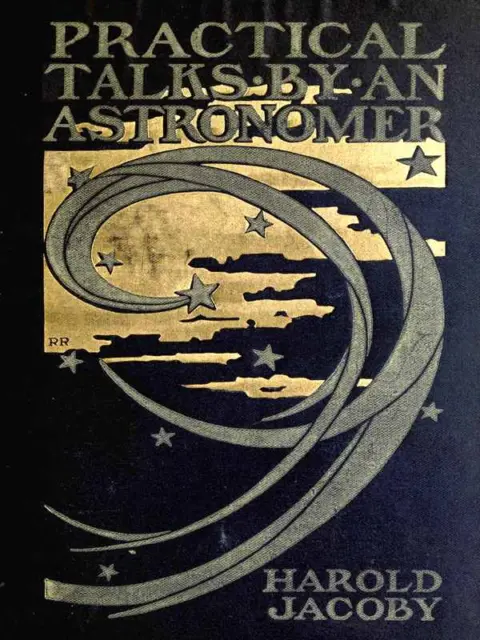
"Practical Talks by an Astronomer" by Harold Jacoby is a collection of engaging essays on astronomy written in the late 19th century. The work does not aim to serve as a comprehensive text on the subject; rather, it selectively explores intriguing topics within astronomy, using accessible language designed for a general audience. The book potentially appeals to readers who possess a casual interest in celestial phenomena without delving into overly technical detail. The opening of the work introduces the concept of using astronomy for navigation at sea, recounting historical methods and instruments used by maritime captains in times prior to modern navigation tools. Jacoby shares anecdotes from an old sea captain regarding how ships relied solely on a compass and observational techniques, like utilizing a sextant to measure the sun's position at noon, to determine their latitude, demonstrating the blend of history and science that characterizes the book. This approach highlights the practical significance of astronomical knowledge while piquing curiosity about the interconnections between science and navigation.
Introduction adapted from the source catalogue; source summaries may be automatically generated.
Free to read · English · 42,260 words · No account needed
MAKE TIME FOR A GOOD BOOK
On by default. Untick to stop anonymous reading totals. Each page counts after 10 seconds in view. How this works.
Anonymous counting is on unless you have switched it off.
Sextant, how used, 4
Sicily, latitude station in, 139
Sidereus Nuncius, published by Galileo, 52
Simplicio, character in Galileo's Dialogue, 55
Sirius, brightest star, 205
Size of Moon, measured, 166
Société de l'Optique, 177
Solar parallax, see Sun's distance.
physics, by photography, 109
system, stability of, 210
Spectroscope, its use explained, 147
used on pole-star, 19
to observe Saturn's rings, 147
Spiral nebulæ, 31
Stability, of Saturn's rings, 145
of Solar System, 210
Standards, time, of the world, 111
table of, 130
"Standard" time, explained, 127
Star-catalogue, general photographic, 102
Star-clusters, photography of, 98
Star-distances 94, 106
measured with heliometer, 158
Rutherfurd, 94
Star magnitudes, 91
Star-motion, toward us, 21
Star-tables, astronomical, 118
Stars, variable, 42
St Gothard railway, tunnels, 220
Sun, newspaper, the moon hoax, 201
SUN'S, DESTINATION, 210
distance, compared with star distance, 97
measured with Eros, 67, 106
motion, apex of, 221
Sun-spots, discovered by Galileo, 49
Systema Saturnium, Huygens, 143
Telescope, clock, 175
at Paris Exposition, 176, 180
double, for photography, 86
equatorial, explained, 170
first used by Galileo, 49
motion of, 87
mounting great, 170
unmoving, for polar photography, 197
TEMPORARY STARS, 37
in Andromeda nebula, 28, 29, 45
in Aquila, 40
in Cassiopeia, 40
in Perseus, 46
in Scorpio, 39
their number, 38
theory of, 42
Time, correct, determined astronomically, 113
differences between different places, 121
TIME STANDARDS OF THE WORLD, 111
standards of the World, table of, 130
system, in New York, 120
zones, explained, 128
Trails, photographic, 191
Transit, for determining clock error, 118
Tycho Brahe, his temporary star, 40
Ulugh Beg, early star-catalogue, 21
Undulatory theory, of light, 19, 148
Universe, theories of, 34, 53, 56
Uranus, discovered by Herschel, 59, 142
Use of occultations, 166, 167
Uses of astronomy, practical, 112
Variable stars, 42
in Argo, 205
Vega, future pole-star, 187
Visibility of stars, in day-time, 191
Vision, phenomenon of, 20, 149
Washington, its longitude first determined, 168
Waves, explained, 148
of light, 20, 148
Wilkes, at Naval Observatory, Washington, 169
Wilkins, imaginary voyage of, 208
Witt, discovers Eros, 66, 105
Wolf, M, invents asteroid photography, 104
measures Pleiades, 11
World's time standards, table of, 130
Yale College, Pleiades measured at, 15
Zones, time, explained, 128
Italic text is denoted by underscores.
Fractions in the two tables on pg 74 and pg 78 are displayed in the form "a-b/c" as 4-1/2 or 2-7/16 for example. The original text in the tables used the form "a b-c". A few other basic fractions in the text such as ½ and ⅖ are displayed in this same form in the etext.
There is only one Footnote in this book, with its anchor on pg 69. It has been placed at the end of the chapter containing the anchor.
Obvious typographical errors and punctuation errors have been corrected after careful comparison with other occurrences within the text and consultation of external sources.
Except for those changes noted below, all misspellings in the text, and inconsistent or archaic usage, have been retained. For example, time zone, time-zone; Le Verrier, Leverrier; light wave, light-wave; intrust; wabbling; unexcelled; crape; monumented.
Pg 146, 'James Clark-Maxwell' replaced by 'James Clerk Maxwell'. Pg 189, 'impossible to measure' replaced by 'possible to measure'.
Your reading position is saved on this browser. Take it to another device with a library code. Reading pages adapt to text, rather than matching a printed edition.
BEHIND THE BOOK
This eBook is for the use of anyone anywhere in the United States and most other parts of the world at no cost and with almost no restrictions whatsoever. You may copy it, give it away or re-use it under the terms of the Project Gutenberg License included with this eBook or online at www.gutenberg.org. If you are not located in the United States, you will have to check the laws of the country where you are located before using this eBook. Read the source licence.
The original source file, including credits and licence, is retained by this library. Request an original-format copy at no charge. Please include the book title and Project Gutenberg identifier #53396.
KEEP YOUR CURIOSITY GOING
David Patterson (Spirit) Hatch

David Patterson (Spirit) Hatch

David Patterson (Spirit) Hatch

Ralph Waldo Emerson

Maurice Baring

Oscar Wilde & James McNeill Whistler